

The people we let into our room are the very ones who will help us build it. As the saying goes, your network is your net worth. The quality of the people around you will have a major impact on the quality of life you have. Who is in your room? Who are the people you let in? In this episode, Marco Santarelli sits down with someone who greatly knows the importance of one’s network and can help you build the right relationships to lift you up. He interviews Dr. Ivan Misner, the founder of BNI, Business Network International, to share with us how we can shape and design the life we want through his book, Who’s In Your Room, where he provides great insights on how to find the right people who will help us become more successful—be that in our professional and personal lives. Plus, Dr. Misner then extends that very idea to real estate investing, reminding us of the very value of treating it as a team sport to assure your success.
Download your FREE copy of: The Ultimate Guide to Passive Real Estate Investing.
If you missed our last episode, be sure to listen to Ask Marco – The Pros and Cons of Investing in Notes
Enjoy the show!
– – – – – – – – – – – – – –
Download your FREE copy of: The Ultimate Guide to Passive Real Estate Investing.
Get your FREE coffee mug by leaving us a Rating and Review on iTunes. Here’s how.
See our available Turnkey Cash-Flow Rental Properties.
Please give us a RATING & REVIEW (Thank you!)
SUBSCRIBE on iTunes | Stitcher | Podcast Feed
Who’s In Your Room? With Dr. Ivan Misner
There are some famous quotes. One in particular that I love about your network and your net worth is simply this, “Your network is your net worth.” That has been quoted and re-quoted by so many people. I don’t even know who originated that quote, but it’s true. Look around, think about the people that you know that have higher than normal or average net worth. Look at their network, who they associate with, how many people they associate with and the people that they are tied into or tapping into. Meredith Mahoney also said, “Know where you want to go and make sure the right people know about it.” It’s all about your network. There are two things we’re going to talk about here with my special guest, Dr. Ivan Misner, and for some of you who recognize that name, you’ll know that he is the Founder of BNI, Business Network International. I had a great interview with him. He’s a nice and smart guy.
Our episode is full of golden nuggets. It’s interesting to know who you associate with and the people you let into your room, which is not a four-wall box, but what’s going on up here in your head. What’s going on between your ears has a major impact on your life, your happiness, and it’s all about, how do you shape your life? How do you take control of your life and design your life? That’s the first part of our interview. The second part is going to be about the power of networking and how you find the right people to let into your room that will help you to become more successful in your investing, life, relationships, and all that stuff. There’s a little bit of a slant towards real estate investing, but this applies to everything and every part of your life. At the end of the day, when you look at real estate investing specifically, Robert Kiyosaki said it best that, “Real estate is a team sport.” It’s important to surround yourself with the right people to help guide you and assure your success. With that, we’re going to get onto our interview and I hope you enjoy it.
—
It is my pleasure to welcome Dr. Ivan Misner to the show. Dr. Misner is the Founder and Chief Visionary Officer of Business Network International also known as BNI, the world’s largest business networking organization. Founded in 1985, the organization now has over 9,500 chapters throughout every populated continent of the world. In 2019 alone, BNI generated almost 12.3 million referrals resulting in nearly $17 billion worth of business for its members. He is a New York Times bestselling author who has written 24 books, including one of his latest books, Who’s In Your Room? He is also a columnist for Entrepreneur.com and has been a university professor as well as a member of the board of trustees for the University of Laverne. Ivan, do you want me to call you? Ivan, welcome to the show.
Thank you. I appreciate you having me on.
It’s an honor to have you on. What’s interesting is I used to be a member of BNI many years ago, and I enjoyed it thoroughly. I was a member for several years and I met a lot of great people. It’s a wonderful organization especially if you’re a professional looking to expand your network.
I always love talking to alumni and that’s great.
I never thought the day would come where I’d be interviewing you. It’s a lot of fun. I’ve come a long way ever since those days. I’ve started, built several businesses, and invested heavily in real estate. As I found out a few minutes ago that that was one of your past businesses as well. I want to start talking about your book first and then we’ll morph into real estate, networking, the power of networking and all that stuff. As small as that book is, it’s an amazing book. Let’s start off with that. In your book, Who’s In Your Room?, you ask us to imagine ourselves in a simple room, four walls. You ask us to beg the question, “Who are we letting in our room? Who are we kicking out of our room?” It’s a very interesting and simple concept.
Let me lay the groundwork for the audience. Imagine you live your entire life in one room. That one room has only one door and that one door is an enter only door so that when people come into your life or your room, they’re there forever. You can never get them out. Luckily, this is a metaphor, Marco. If it were true, would you be more selective about the people that you’re letting into your life?
Absolutely.
Everybody says that. The question is why aren’t we more selective about this? Some people say to me, “Why? The truth is Ivan.” It’s more than a metaphor. When I say that, they say, “The truth is I can get people out of my life.” Let’s talk about that, you can get people out of your life. If you’re reading this, I want you to think about people that you’ve gotten out of your life that used to be in your life, in your room, why did you want them out? What did they do to you? I want you to think of somebody, Marco. If you’re reading this, I want you, the readers, to think about this. Think of someone you got out of your life and why did you want them out? Were they toxic? Were they difficult? Did they do horrible things? You’ve got somebody in mind, Marco? You don’t have to say who.
I wouldn’t say the name, but the first type of person that comes to mind is someone who is either negative or is not like-minded because I only want to surround myself with like-minded people that can expand me, as a person, and expand my world and the reach that I have.
What is important is to think of an individual. You don’t have to say who, but I want you to think of an individual, what they did, and why you’re glad they’re out of your life. Do you have somebody in mind?
Yes.
Here’s the deal. If they’re still in your head, they’re still in your room and they will be for the rest of your life because the room begins on this temple and ends on this temple. It is your mind. It’s your brain. It’s all the experiences that you have in life. We interviewed a neuroscientist psychiatrist, not far from where you’re located Dr. Daniel Amen who did the PBS Specials. We talked to him about the brain science of relationships. He said, “When you have a relationship with someone, personal or professional, their fingerprints are all over your brain.” They’ll be there forever and ever. You can never get them out of your head. People that you’ve had a good relationship or a bad relationship with even if they’re out of your life, they’re still in your head. If they’re in your head, they’re in your room. If that’s the case, how do you get better at bringing the right people into your room? How do you deal with the people that are already in there that you didn’t understand the room concept before, or their family and you had no choice? That’s the premise of the book.
Correct me if I’m wrong, what you’re saying is that once someone is in your room, they’re in your head and it’s permanent. You can’t get them out no matter how hard you want, you can’t forget them.
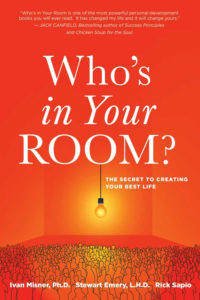
That’s exactly right. We all make decisions in the future based on the experiences that we had in the past. We may have an opportunity in the future, but because of some bad experience we had in the past, we go, “I don’t want to do that.” Even though it might be a great opportunity with the right person, we don’t want to do it because we had a bad experience with the wrong person. People’s impact on you changes the way you behave for the rest of your life. It’s important to bring people into your room that have resonant values and you alluded to that. They don’t have to be the same values, but they can’t be dissonant or incongruent. If they’re completely dissonant values, then you’ve got the wrong person in the room.
I’m sure you’ve got a few eyebrows raised and a lot of ears perked up to this point. The question now that a lot of people are wondering is, how do you evaluate the people that you want to let in the room and those that you block?
It’s all based on one-word values. You have got to get good with your values. You have to know what your values are. When I talk to people about values, I’ll say to them, “Give me a list in any order you would of your top seven values in life.” Marco, when I say that to people, it’s like deer in the headlights. They’re like, “What?” “Give me your top seven values.” You don’t have to give me any more than that. Most people could not answer hardly any. They’ll hmm and huh and they’ll go, “Uhm, honestly.” “Okay, you’ve got one, now give me six more.”
The problem is if you don’t know what your personal values are, your life is a revolving door and you’re letting people in and not out, they’re coming in and can’t leave. Over and over, without any discernment on the right people that you want to have in there. You got to know your values and here’s a good place to start. Start with deal-breakers. When I talk to people about values, they’re clueless for the most part. When I say deal-breakers, they got something right away. I’m going to ask you, what’s one thing that is unacceptable to you in a personal or professional relationship with someone else? What’s a deal-breaker? I don’t want anything to do with this person because they what?
I have a big answer to that question and I refer to it simply as negative people. I had my wife, who wasn’t my wife at that time, break her friendship with someone who I identified immediately as being toxic. She was negative all the time and it drove me bananas. To me, that is number one, negative people.
That’s a common one. Here’s the funny thing. Do you realize negative people don’t think they’re negative?
Isn’t that ironic or funny?
It is. I’ve talked to some people about it and they’re clueless that they’re negative. They’ll go, “I’m not negative. I’m being honest. Do you have a problem with honesty?” “I don’t have a problem with honesty. I have a problem with your negativity.” I always think it’s interesting, but I do too. There was a big one for me when I started thinking about this concept, drama. People that are dripping in drama. We all have a little drama. I’ve got some drama. We all have drama but I’m talking about the people that every day is drama. Their life is like a dust cloud all around them all the time. It hit me. When I started working on this book, I’ve got several people in my room that have a lot of drama and I let some of them in. The drama that’s around me, honestly, is all my fault because I let them into my room. I got to get better at screening people. That’s the second step. Once you get your values down, you hire a doorman. A doorman is your conscious and subconscious.
I was going to ask you about that.
You don’t hire a doorman but it’s your conscious and subconscious mind. You train your mind to screen out people, who are trying to gain entry into your room based on your values and their values. You want to make sure that those values are resonant, not dissonant. Resonance is powerful. If you have two pianos side-by-side, I’m not a musician but I’ve seen it done, and one person hits the middle C key real hard, the second person on the second piano hits no key oppresses the sustained pedal, the string of the second piano, it will vibrate.
You only hear sound from the second piano, even though you only hit the first piano. That’s resonance and that’s what you get when you have that kind of relationship with somebody where you have that resonant relationship. Remember, a relationship is fingers on a chalkboard and everybody cringes whenever you think of that. That’s dissonance. You can call the doorman whatever you want, call it your guard or bouncer. You’re in California, you can call it your door person if you want, it doesn’t matter. That’s the idea, you train your doorman or your mind to screen people out effectively.
I don’t want to get off this for a second here. The whole thing about negative people, which I have a big problem with, we all have negative people in our lives. How do we go about either restricting their access, which you just answered or better yet, when they’re already in our lives? I can think of people. How do you show them the door so effectively, they’re out of your life even though they’re still in your head?
They may be in your life, but their baggage doesn’t have to be. You can restrict that baggage from coming in. I’ll give you two examples. One is from one of my co-authors and it’s a great example. It’s in the book, Rick Sapio. When his mother was alive and he tells the story as she was toxic. She was one of those people that you have issues with. He said, “I understood why she was. She had a difficult life. I get it.” It was getting old. I was an adult and it’s still toxic. I would call her every Sunday. She would go off on a rant about my brothers and sisters and be toxic. He said, “Finally, I decided enough was enough.” He said to her mom, “From now on, when you start getting toxic about my brothers and sisters, I’m going to say to you, ‘Mom, I love you a lot. I’ll talk to you next week. See you. Bye.’ I’m going to hang up.” She’s like, “Whatever.”
The next week, he said three minutes into the conversation, she’s on a rant about his brothers and sisters. He said, “Mom, it was good talking to you. I will call you again next week. I love you a lot. Bye.” He hung up. He called her the next week. It took about twenty minutes before it happened. He said after that, she never did it again. He said the last two years of my mother’s life were the best years we ever had together because we had mature, adult conversations. He said it wasn’t wine and roses. Everything wasn’t great with my mother, but we had adult conversations. She had challenges but we talked about it like adults rather than this toxicity.
That’s a great example of someone maybe in your room but their baggage can stay out. Here’s another one. It’s fantastic. It was given to me after I published the book and I was writing about it. I asked people, “Do you have any stories?” Someone shared this story. She had a family member who would come to family dinners. She said she would always throw in these verbal grenades at a family dinner. She throws it out there and it’d be something horrible. People would get mad, they’d start yelling, the dinner would be over.
They met as a family and they said, “Let’s ignore it. Whatever she says, look at her, nod, ignore it, and go back to dinner.” She said it worked brilliantly. She throws this grenade out and they would look at her and go, “Okay.” “How about those Yankees? Weren’t they great?” They come back into the dinner, completely ignored. They said she stopped coming to the dinners because she couldn’t rile people up. She seemed to feed on that energy. She was invited, nobody ever yelled at her, nobody ever got mad at her, nobody ever said she wasn’t welcomed. They just didn’t respond to the verbal grenades.

Those people want to create the environment that they thrive in and they thrive in a negative environment. That’s what we refer to as a toxic environment. That affects your happiness, which by the way you mentioned, what are your values? Happiness is one of my values. I know a lot of people have a problem with maintaining happiness because they let other people affect them or what you’re calling coming into your room. How do you deal with people who are robbing you of your happiness? How do you disempower those people?
I’ll give you two techniques we talked about in the book. The first is benign neglect and the other is homeopathic doses. Benign neglect works well even when you don’t want it to. Think about a high school friend or a close friend you got along and you like the person, but over the years, you gradually lose touch. You don’t know each other anymore. You can’t call each other friends anymore. You were friends, but that’s benign what. Imagine doing it with a plan, where you say, “I’m going to start withdrawing from this relationship.” If you’re like some people I know, my son is one of them. He’s like, “Dad, why don’t you tell people you’re out? I don’t want to deal with you anymore.”
I don’t like burning bridges. I like the concept of benign neglect, where you gradually withdraw and you withdraw through homeopathic doses. Let’s say you were coming to visit here in Austin. There’s somebody in Austin that is toxic. You wish you never had them in your room. Rather than let him know a month in advance that you’re coming to Austin, you send him an email the night before and say, “I’m going to be downtown. I’ve got a 30-minute window open from [spp-timestamp time=”2:00″] to [spp-timestamp time=”2:30″]. I’d love to get together for a cup of coffee.” That’s it. They won’t even see the email and then they’ll say, “I didn’t see this until too late.” She gradually withdraws from the relationship. It’s effective.
Sometimes people think, “What if they say something?” We don’t talk about this in the book. In 2nd Edition, I’m going to add it. What if they say, “What’s going on? We used to talk all the time. You don’t seem to be around.” They’re much more ready for that conversation at that point. If you went to someone two years earlier or a year earlier and said, “I don’t want to hang out with you anymore because of X,” which is a conflict. If you gradually pull away and then they say, “What’s going on?” It’s easy to say it. I’ve seen this happen personally where you say to them, “You’re right. I’m not reaching out to you as much. If you want an honest conversation, I’ll be honest with you.” They usually say yes and then you deliver it a little bit of tough love. You say, “I don’t want to be around that toxicity.” Whatever it is, use gentler words, “I find that I need to be around more positivity. I need that in my life. You’re always upset and that’s what’s going on.” They know if they ask. If not, they don’t care and gradually part ways.
At least you do it gracefully that way.
I don’t like burning bridges, so that’s a good technique for me. My son is a full-frontal assault kind of guy.
As are my friends, they’re brutal. Some people refer to this concept as future pacing. That might not be the right phrase but as I recall, Tony Robbins talks about this and I think he calls it future pacing. What are the steps to create a powerful future for yourself based on what you’re talking about?
The answer to your question is positively unequivocally, can you change your life by starting with understanding that you control the room? People don’t control it. You need to get good with your values and you need to train your doorman on screening people, but then creating the life of your dreams takes other things. That’s towards the end of the book. We talk about, what are those other things to create the life of your dreams? We start by talking about balance. Marco, would you like to know what the secret to balance is in life?
A lot of us would like to know, but yes.
Forget about balance, you’ll never have it. When I tell this in an audience, there’s one person upfront who’s like, “Seriously? I was hoping for something good.” I hope to give you something good. Balance is the wrong way to look at life and here’s why. When we think of balance, we think of scales and our life must be completely in balance. Our business has to be in balance with our personal life, which has to be in balance with our health and our spirituality. The truth is, life is more of a juggling act than a balancing act. There are many things we juggle especially if you’re an entrepreneur, you’re juggling all kinds of things. I don’t have a life of balance. I never had but I do have a life of harmony. Harmony is different in balance. This is more than semantics. Even the graphic for harmony, the yin and yang are out of balance if you separate them.
I believe that you can create a life of harmony and it begins with the people in your room and managing that, but it ends with you understanding how to create a life of harmony. Here are 2 or 3 techniques that we talk about in the book to create that life of harmony. Here’s the first one. Simple sounding but so difficult, be here now. Wherever you are, be there. Don’t be at home thinking about the work project that has to get done. Don’t be at work thinking about the fact that you didn’t spend time with the family. Wherever you are, be fully present to that experience. You can live a life out of balance but yet have harmony.
When my son was seventeen, he’s sitting in our house in Claremont, we got a big-screen TV, we were playing Halo and he was kicked in by Tokas in Halo. We were leveling up. I said to him, “Was I around enough for you when you were growing up?” He looked at me like I was crazy, Marco, and he said, “What?” I said, “Was I around enough?” He said, “You’re around all the time.” I said, “I travel a lot. I’m gone every other week. I don’t know if you’ve noticed.” He’s like, “I noticed. I don’t know. It’s like when you’re here, you’re here. Can we get back to the game now?” I’m like, “Yes, we can get back to the game now.” To me, that was confirmation in my mind that this whole idea of harmony versus balance can work. Let me give you 1 or 2 other techniques if you’re interested.
You have to learn how to both let go and hold on. Contrary to popular belief, I do not believe you can have it all. You get a lot of success experts that say, “You can have it all.” I know some of them. They do not have it. You have to pick and choose what you want. What’s important to you in life? It comes back to values again. What do you hang on to you? You hang on to everything that is important to you or your values. What do you let go of? You let go of everything that is not resonant with your values even if you like it or you like the person who is presenting some idea to you, whatever it is, it’s a distraction to you. You cannot live a life of harmony if you are constantly chasing bright, shiny objects that don’t further your values in life. You’ve got to learn how to let go and hold on.
I’ll give you one more. You have to create margins in life. You want a life of harmony? Create margins like the pages of a book have margins. A notepad has a margin. Your margins are your time. You integrate into the pages of your life in those margins. Here’s an example. When my wife and I almost every day have what we call wine o’clock. We get together on a porch or in a balcony, we have a good Cabernet, talk and connect as a couple. We’ve been married for many years and we do that at least 4 or 5 times a week. We have wine o’clock and it’s a margin. It’s time for our relationship. If you can create margins, let go and hold on, learn how to be here now plus a number of other things, it will help you create the life of your dreams.
Everything you said was liquid gold. That was on-point and powerful. I don’t believe in life balance either. I never did because my life was never in balance. I never felt like I had balance. One thing I do think about in the whole concept of being in the present, be in the now, I constantly think about my daughter. Even if I was with her all day, I still would feel like I’m not spending enough time with her which is bizarre. She is the center of my life. I want to spend as much time as I can with her especially now that she’s growing up fast.
How old is she?

She turned thirteen last June 2020.
Somewhere around thirteen, aliens come down and take your kids.
I know, it’s the weirdest thing.
They replace them in their twenties.
She’s a great, well-behaved and smart kid. You’re making me think about being present. You don’t have to be there all the time but it’s important that when you are there, you’re there fully present and go as deep as you can. You reinforce something I was thinking. I love what you said so thank you. We’re going to wrap it up here soon but I do want to talk about the power of networking because your whole background for me came from BNI. It’s an incredible thing. It was powerful. To summarize what you talked about, you can shape your life by taking control of your room and you can live your life by complete design. It’s your choice.
I’ve learned that the hard way as most people have throughout their life. I wish somebody else wrote this book and I read it when I was seventeen. It would have changed my life. I have a good life. I’m happy with who I am and what I’ve achieved, but it would have even been better had I read this book when I was seventeen. You said it was short and it is. We had that book up to 45,000 words. It was three times larger than it is. We felt it was too much stuff. We took it and cut it down to 15,000 words to make it actionable and tight. It’s something somebody could read on an airplane, a two-hour flight, and you can come out with all kinds of great tangible workable ideas. That was our goal with it.
Let’s transition here because the demographic is a lot of business owners, entrepreneurs, self-employed people, professionals that read the blog, a wide range of male and female, positive, like-minded people, and they love investing particularly real estate investing. I was a member of BNI long ago and I loved it. One thing I learned from that is that there’s power in networking. There’s the old saying that “your network is your net worth.” I’ve had many people say that I don’t even know who the author is anymore. First of all, touch upon BNI. You know more about it than anybody. What is BNI for those people that are reading this that may be interested or curious?
BNI is a business and professional networking organization. We allow one person per professional category. We get together every week and pass each other referrals. We have 9,600 groups in more than 70 countries. As you know, we meet in person. We’re interviewing during the COVID virus. What we did was we pivoted quickly to move 9,600 groups online. All of our groups now are online. When this craziness ends, we hope to go back to in-person meetings but we managed to keep 9,600 chapters by running a BNI meeting, but doing it online as opposed to in-person for now.
That is a major pivot. I don’t know how you’re doing it. It must be like a Zoom-type service but that’s a huge pivot.
Zoom loves us.
I’m sure they do. What are your feeling or thoughts about networking, word of mouth and referrals? Is that all one and the same for you? There’s a lot of power in networking.
The purpose of networking is to get referrals and word of mouth. It was part of that. They’re all related and I believe that networking is more about farming than it is about hunting. It’s about cultivating relationships with people. It’s not a get rich quick scheme. It’s a way to build a solid foundation for a long-term business. Now more than ever, you need your network because we’re going from COVID into a recession. That’s a 1-2 punch. It’s a 1-2 punch I’ve never seen. I started BNI in 1995. I’d never seen anything like that. It’s going to be tough but I learned an amazing lesson from a real estate agent. Would you like to hear about the lesson?
I would love to hear that lesson. What is it?
It was in 1990. It was the first recession that I had been through in BNI. It was an amazing experience. I was at a chamber function on the East Coast. The only topic of discussion with everyone was how bad the economy was and how the real estate market bottomed out. It was such a depressing meeting. I’m like, “I shouldn’t have come to this. It was so depressing.” I saw one guy in the corner and I walked up to him. I introduced myself and I made the mistake of saying, “What do you do? How’s business?” I thought, “Why did I ask that?” Now, I’m going to hear the sob story about how bad business is. Many told me he was a real estate agent. I thought, “I’m in big trouble now because the market bottomed out.” He said to me, “Business is great.” I said, “Business is great. You said you were in real estate.” He said, “Yes.” I said, “You’re having a good year.” He said, “I’m having my best year ever.” I said, “Is this your first year in real estate?”
He’s like, “No, I’m in real estate for more than a decade.” I said, “How could this be your best year ever in this market?” He said, “It’s easy. When you have difficult times like a recession, you look for the opportunities that are out there. One of the opportunities is your competition is frozen in fear. Look around the room. That’s a real estate agent, that’s a real estate agent, she’s a real estate agent. What are they talking about? I’ve listened. They’re all talking about how bad business is. They’re all talking about how are they going to survive this? Instead of talking business, I’m doing business.” I said, “Take me to school here. How are you doing business? What are you seeing that they’re not?
He said, “Two things. First, real estate investors. People that are buying property as an investment to do rentals or leases. I’m going to them. I know many of them. Meeting new ones and I’m saying, ‘You cannot come to me two years from now and say I wish I would have looked at that duplex that you were talking about because the prices have gone back up and it’s expensive.’ You can’t do that if you are at all interested, now is the time. Let me send you a listing to look at. They’re saying yes. They’re looking at it and they’re like, ‘These are great prices.’ I’m selling.” I said, “What’s the second one?” He said, “First-time home buyers. I’m going to first-time home buyers and I’m saying, ‘Real estate is on sale right now. You couldn’t buy a year ago, but you can buy it now.’” I said, “Where did this all come from?”

He reached into his coat pocket and said, “I’m not wearing it.” He pulled out a button and the button said, “I refuse to participate in a recession.” I said, “It’s a mindset.” He said, “That’s what it is. It’s all about the mindset. You’ve got to go in with the mindset of what opportunities are there and then work the heck out of those opportunities because your competition is likely to be frozen in fear where you are motivated by that fear. You are focused by that fear.” This is from 1990. I keep it here on my desk. I went out and I made thousands of these buttons that say, “I refuse to participate in a recession.” We’re making them again in BNI because we refuse to participate. As a matter of fact, in the last few months in BNI, this organization generated $3.7 billion worth of business for our members. Our members passed to each other $3.7 billion in business, in a recession, during COVID. Now more than ever, you need your network.
The network is important. I know Robert Kiyosaki talks about real estate investing, being a team sport, It’s the people that you surround yourself with that helps to propel you forward and assure your success. I’m a big believer in networking. One of my mentors interestingly charted something on a whiteboard once. He said, “Every time you’ve gone up to another level and achieved something of significance, if you look at where that started, more often than not, it was always because of someone you met in your life. It was a connection that you made that catapulted you to another level that never could have happened unless you had met that person.”
I call that the Butterfly Effect of networking. The Butterfly Effect is part of Chaos Theory and talks about the flapping of the wings of a butterfly affecting something in an environment that affects something that affects something that changes the weather. I believe in that. The key is you want to find people that are good at what they do. It doesn’t matter if you’re networking up or networking down. It doesn’t matter if they’re more successful or less successful than you. What matters is, are they good at what they do? If they’re good at what they do, you never know who they know, who they can introduce you to, and how you can build relationships with these people. I’ve written about it on my blog and on Entrepreneur.com.
That’s a book. It’s worth picking up that book and reading.
The Butterfly Effect of networking is not a book.
That’s not a book but there’s a book written about the Butterfly Effect to understand the concept of it. Jim Rohn is one of my favorite people in the whole personal development space. He famously said that we are the average of the five people that we spend most of our time with. I keep telling people that time and time again. If you’re networking, you’re meeting the right people, you’re surrounding yourself with 5, 10, 15 people that inspire you and can help you get to another level, it’s almost impossible to fail unless you screw it up for yourself.

I couldn’t agree more. That’s why the book, Who’s In Your Room, is a funny book because it’s not about networking, but it’s all about networking. It’s about relationships. Relationships are about the people that you have in your room. It’s a curious book. It’s one of the few that I don’t talk about networking in there, but in a way, it’s about relationships, it’s about networking.
It all starts upstairs in your mindset and positive thinking is a critical starting point for all success, especially in real estate investing. The bottom line here is that you can shape your life, take control of your room, and live your life by your own design. That’s the ultimate message that you’re trying to get across to people.
I’ve seen more and more people embrace this concept and change their life because of it.
Ivan, it’s been a pleasure. Please share with our audience where can they learn more about you, find your books, your resources, follow you on social, wherever that may be.
I have a blog, IvanMisner.com. As a matter of fact, one of the first blogs I wrote in 2007 was The Butterfly Effect of Networking. It was how I met Richard Branson. I reverse-engineered how I got there and it was about that. I’m active on all the social media. BNI is at BNI.com. Go to any of those places for more information.
Ivan, thank you for spending the time with us. This has been a real treat. There were a lot of great takeaways, so thank you for all of that.
Thank you, Marco. It’s a pleasure being here. I appreciate the invitation.
Thank you.
—
I hope you enjoyed our episode. It was full of great golden nuggets. A lot of great advice and great information on how to control your room. What’s between your ears and in your head because that will help lead you to success in both life and investing. If you haven’t downloaded our free report on our website, The Ultimate Guide To Passive Real Estate Investing, be sure to do that. You can do that at NoradaRealEstate.com or PassiveRealEstateInvesting.com. Get your free strategy session with one of our investment counselors. If you are thinking about real estate investing, even if you’re not there yet, but you want a roadmap or a guide to get clarity on how to get started and what to do next, go ahead and schedule it. It’s a free strategy session. We’re going to get you on the right path.
Even if it’s only a fifteen-minute call, at least we’re going to have that first step and start building a relationship with you because we’re here to help and there’s no cost to you so you have nothing to lose. Do you have a question about real estate investing? Send it over to me. Go to PassiveRealEstateInvesting.com, click the Ask Marco button at the top. Submit that question and I will do my best to get to it as soon as I can. If you haven’t subscribed to this show, click that subscribe button, remember to get each and every episode sent you and notified to you so you don’t miss another episode. Help us spread the word, give us a rating and a review. We appreciate it. I do read all of them. I want to thank you in advance. That’s it. Thank you for being here. I will see you in our next episode.
Important Links:
– – – – – – – – – – – – – –
Download your FREE copy of: The Ultimate Guide to Passive Real Estate Investing.
Get your FREE coffee mug by leaving us a Rating and Review on iTunes. Here’s how.
See our available Turnkey Cash-Flow Rental Properties.
Please give us a RATING & REVIEW (Thank you!)