
Passing on a wealth of wisdom about various topics, Paul Moore, a Managing Partner of Wellings Capital, takes us into an eclectic ride that sheds light on what is going on in his life, how he attained success, and what is taking place in the world that very much affects us without our knowledge. As a finalist for the Ernst & Young Michigan Entrepreneur of the Year for two years straight, Paul shares his rags-to-riches story from having $1.5 million in the bank to $2.5 million in debt, and then back again. He also talks about his monumental task of raising money to thwart human trafficking while telling us the importance of the “big why” for investors, entrepreneurs, and executives. Going deeper into his life as an investor, Paul broke down the three subcategories of the passive real estate investing model. Discover great insights from Paul and create wealth for yourself that is far-reaching.
Download your FREE copy of: The Ultimate Guide to Passive Real Estate Investing.
—
This episode is a little different than most. I was talking to a colleague of mine, Paul Moore and we got talking about random things. He’s an interesting character. This episode is going to be somewhat eclectic because we’re touching on different things from human trafficking to mentorship to whatever. I break real estate investing into two general categories and that’s passive and active. Active being hands-on, more involved, taking on a little more risk and hopefully getting a little more reward but being more actively involved in it. Passive being an investment that you make that generates income and cashflow and it doesn’t require any active involvement. It doesn’t mean you’re not engaged. There is engagement but you more or less sit back and get the checks in the mail as they say.
Paul broke the passive real estate investing model down into three subcategories and I don’t want to steal his thunder. We didn’t talk about it for a long time but enough to basically say, “There are different paths to take down the passive real estate investing road.” I am going to let the conversation unfold and we’ll see where it goes. Anyway, if you have a question about real estate investing, don’t forget, you can submit that to me. Click Ask Marco! at the top of the PassiveRealEstateInvesting.com website. If you are in the market or looking to invest in real estate or even thinking about it, remember my team is here to help you. We offer free strategy sessions. They are free. We will spend as much as an hour or more if necessary in working with you to help you clarify your goals and take you to the next level.
Even if you’re starting or whether you have 20 to 100 or whatever the case may be, if you’re looking to grow that portfolio and do more with what you have, let’s explore the possibilities. They may not be a good fit but you won’t know until you take that next step. Don’t forget about the strategy sessions. Other than that, download our free report. The Ultimate Guide to Passive Real Estate Investing has been downloaded tens of thousands of times. It is a fantastic primer. Last but not least, if you haven’t done so already, remember to subscribe whether it’s on iTunes, Google Play, iHeartRadio, Stitcher and SoundCloud by all means, get these weekly episodes automatically. Remember to subscribe. That’s it for me. Let’s get to our interview here with Paul Moore.
If you missed our last episode, be sure to listen to Ask Marco – Do Providers Mark Up the Price to Hit the 1% Rule?.
Enjoy the show!
– – – – – – – – – – – – – –
Download your FREE copy of: The Ultimate Guide to Passive Real Estate Investing.
Get your FREE coffee mug by leaving us a Rating and Review on iTunes. Here’s how.
See our available Turnkey Cash-Flow Rental Properties.
Please give us a RATING & REVIEW (Thank you!)
SUBSCRIBE on iTunes | Stitcher | Podcast Feed
Three Paths to Passive Real Estate Investing Success
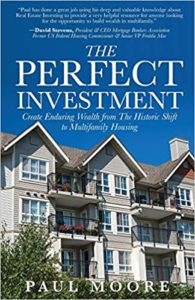
It’s my pleasure to welcome Paul Moore to the show. He is the Managing Partner of Wellings Capital, a commercial real estate investment firm based in Lynchburg, Virginia. Paul was a finalist for the Ernst & Young Michigan Entrepreneur of the Year for two years straight. He later entered the real estate sector where he flipped over 50 homes and 25 high-end waterfront lots, appeared on HGTV’s House Hunters, rehabbed and managed rental properties and started two successful online real estate marketing firms. He is also the author of the book, The Perfect Investment. Paul, welcome to the show.
It’s great to be here. Thanks for having me on, Marco.
I’m excited to have you on. You’ve got quite the background and a lot of experience. You have this interesting rags-to-riches story. I want you to tell our audience a little bit more about yourself because you have a great background.
It’s crazy. I wish I wasn’t a serial entrepreneur. I used to be proud of that. I wanted to put it on my business card but the most successful people focused on one thing like Bill Gates as a teenager and stayed on that and ignored a lot of the side streets that people go down, the distractions, the multilevel deals on the side and all that. I wanted to be a parapsychologist in high school, which is a ghostbuster. Then I found out they didn’t have that in college, not even in California. I became a petroleum engineer, which was my first mistake. I got an MBA and I went to Ford Motor Company, which was a great five-year run. I became an entrepreneur and sold my company to a publicly-traded firm and I got involved in real estate investing for the last couple of decades. It’s been a lot of fun and it’s been a lot of ups and a lot of downs. I’m glad to be where I am now.
I was reading on your website and learning a little bit more about you. You went from having $1.5 million in the bank to going to $2.5 million in debt and then back again. You did that in thirteen months. When you first read that, it sounds like a rags-to-riches story. Tell me what that means and how did you accomplish that? Thirteen months is a fast turnaround.
The crazy thing about it was it happened right in the very heart of the great recession. I had a couple of million dollars in the bank almost in 1997 when I sold my company. Several years later, I found myself on the eve of the great recession. Of course, we had no idea what was about to happen. We could see it was getting bad in late 2007 but I had $2.5 million in debt. Every bit of it was tied to real estate, which is one of the things I love about real estate but my partner quit. He said, “I can’t pay half of this interest anymore. It’s on you starting January 1st,” and a couple of friends of mine got together with me at a Hardee’s, which is like Carl’s Jr. restaurant and said, “How are you going to avoid bankruptcy?” I said, “I’ve got a plan. I’m going to get my way out of debt.”
I had this crazy idea that the law of sowing and reaping or karma was true. I believed if we could give generously, something good would happen. We started January 1st, 2008 giving a large weekly amount of money to various charities that we loved. A few weeks later, I met a real estate developer and I told him about my story. I told them how this five-acre waterfront parcel was my Achilles heel. He said, “You could probably subdivide that.” I said, “No, I can’t and here are the reasons why.” He said, “Think about it this way.” This light bulb went off and I don’t think he even knew what he had said that triggered this amazing series of events. I went to the County Planning and Zoning Board. I found a loophole thanks to him in the law and I said, “I should be able to subdivide this into five one-acre lots.” They were absolutely astonished. They said, “In all these decades of this law being on the books, nobody had ever used the law that way to do what the law was supposed to prohibit.” I went through with that and we sold four of these five expensive waterfront lots in the very heart of the recession, which was September to October of 2008. Thirteen months later, I was completely debt-free.
Did you come up with the idea or did the other guy come up with the idea?

The other guy gave me an idea that triggered the whole thought process. I could explain exactly how we did it. It’s much more amazing than I’m even telling you. Let me put it this way, if you took all five one-acre lots, the combined total value was $1.35 million. I had to convince the first buyer and the bank to pay me $1.35 million for this property that was worth as a five-acre tract, only $600,000 or $700,000 at most. I had to convince them to pay me $1.35 million and then split it and then sell it off in pieces that way. I was able to convince a local bank to do this right in the great recession.
You probably felt good about it walking away from the whole transaction and having learned a lot from it. That might be a good segue to my why question. A lot of us have a big why and unfortunately, many more of us don’t have an answer to the question of why do you do what you do? What is that big why? Why is it important for investors, entrepreneurs and executives to find their “big why?”
When I sold my company before my 34th birthday, I didn’t know anything about investing. I considered myself an investor. I was a speculator. Investing is when your principal is generally safe and you can make a return. Speculating is when your principal’s not at all safe and you’ve got a chance to make a return. I made a lot of mistakes investing in oil and gas wells, wireless internet companies, all kinds of dumb things that I shouldn’t have done. They could have had a 10X or 100X return but they didn’t or I wouldn’t be talking about them and I wouldn’t have a podcast called How To Lose Money but that’s another story. At any rate, I found out when I retired that I wasn’t happy. I thought I was going to be super dad, super husband and happy and I wasn’t happy.
I realized I needed a bigger why. I can tell you that I am passionate about telling the world about the horrors in raising money to thwart human trafficking. If you took the record profits, not the average but the record profits of Apple, General Motors, Nike and Starbucks, combine those together and double that number, that would be the estimated annual revenue generated by human trafficking in the world. There have been probably 200 to 300 people enslaved since we started this podcast. It’s a massive problem. It’s not causing a civil war as it did in the US in the 1800s. It’s not causing headlines as it did in the civil rights movement of the 1960s but it is a civil right. It has been ripped away from tens of millions who have been enslaved and it’s happening right here on our watch. I want to tell the world about this. I want to raise as much money as I can to thwart this evil.
You’re begging the question of how does one accomplish such a monumental task?
It’s getting the word out. Here’s an example. You probably know Monick Halm. Monick is very influential in the female commercial real estate investing space. She informed me that she’s dedicating 10% of her profits for the foreseeable future to fighting human trafficking. She’s donating those to a specific anti-trafficking organization in Haiti. If I can get a lot of people out there thinking that way and a lot of people aware of how awful this is, I’ve accomplished part of my goal and I’m generating funds myself to donate toward this cause.
Circling it back, I’m thinking about some of the things I’ve heard you talked about in the past and you talked about the “secrets.” The secrets used by the super wealthy to attain and even maintain their wealth and even pass it along for generations, something we call generational wealth. Can you maybe talk a little bit about that or share the so-called “secrets?”
A friend of mine who is in your area in Southern California said if the American people knew how little real estate investors pay in taxes, there would be another tax revolt. This time it would be against us. There are about a dozen different great tax savings strategies that real estate investors can use. The massive impact of saving, especially in the earliest years on taxes and on future wealth is huge. Real estate investors and oil and gas investors though I think it’s much more speculative in nature, have these benefits that very few other realms share. One of those is by directly investing in real estate. It’s one thing to invest in a company that owns real estate and gets a 1099 but your investors and mine share the benefit of getting, for example, at least with us a K-1. They get the depreciation, all the write-offs, all the benefits, the opportunity to do a 1031 exchange or a 721 exchange and roll that forward largely without income tax and capital gains tax.
That’s the thing I love about real estate and even Robert Kiyosaki talks about this. The fact that if you become a so-called professional investor, that doesn’t necessarily mean an institutional investor but someone who is investing in passive investments in that investment quadrant. You could literally pay up to 0% tax. If done right, you can shield all your tax. This is why the people listen to this show is because they realize that I can create wealth, I can create income and I can defer or eliminate my tax impact from that income. It’s a beautiful thing. One of Trump’s latest tax, it wasn’t a tax bill but there was an impact on the tax law. Real estate has become the most tax-favored investment class in the country. It used to be oil and gas because of the accelerated depreciation but because of the bonus depreciation available to us as real estate investors, real estate has become the number one tax-favored asset class.
I hadn’t thought of that because I think with oil and gas, you can write off something like 85% of the investment in the first year but with bonus depreciation, you could potentially write off 100%.
It’s 80% in the first year but you could also do cost segregation, you could literally tap it out at 100%.
Is cost segregation something that your investors get the benefit of sometimes?
They’re welcome to do that on their own. We can put them in touch with people who do cost segregation. In fact, I interviewed someone on the show who does that. You could do it on a single-family, fourplex or commercial real estate property. You could do it on virtually any type of real estate.
The engineering cost segregation study that costs $12,000 or more probably wouldn’t work for a single-family or a fourplex or whatever. What I’ve learned from one of my tax strategists we work with is there are simple studies that cost in the upper hundreds of dollars and that makes a total sense for $100,000 single-family or duplex.
That’s the service this guy provides. They do it on a smaller unit basis. It’s several hundred dollars or if you have a portfolio, they’ll do it across your entire portfolio but it’s no different than doing it with what you do on commercial real estate. It’s the same concept.
The goal would be to get cash in your mailbox and a negative number on your tax return.
Let’s talk about Millennials because I know it’s something that I’ve heard you talked about and you’ve had some very interesting charts about. We hear a lot about these so-called Eco Boomers, what we know as Millennials and we talk about it a lot. In fact, they’re in the media it seems like every single day without surprise but they make up such a huge segment of our population. I’m wondering in your opinion, how you think Millennials are going to affect homeownership going forward, maybe even commercial space? How are they going to affect real estate as a whole in the US going forward?
Several years ago, the bursting of the last century’s bubble and that bubble was for many people we believed and our parents and grandparents taught us that your home is your greatest investment. We found out that’s probably not true. As they watched their parents, their uncles, their friends and some of themselves lost their homes in the great recession. The government in 1995 had told mortgage companies and they put their thumb down on them and they said, “You need to make a loan to everybody who can fog a mirror regardless of their income and regardless of their credit score.” Home ownership went from 63% or 64% up to 69.2% by 2005. From 2005 to 2015, it dropped again down to the historical norm of about 63% or 64%.
Millennials look at home ownership and on average they say, “Why do I want to be tied down to a seemingly overpriced home and a 30-year contract when I might get a better job, a better opportunity or better friends across town or across the country next year?” They largely are overburdened by student debt and other types of debt anyway. They don’t have a huge propensity to save. They more likely than not are going to want to rent. The way I see it, the next generation that’s right behind them, Gen Z is going to be about the same or larger.
They might be even a larger demographic. We were talking about what you refer to as the three paths to passive real estate investing success. Let’s talk about that because that could ultimately be the core of this episode. Why don’t you break it down? I’ll throw in my own comments and maybe add a fourth if I can think of one.
I talked to real estate investors every week who are banging their heads against the wall trying to find that next house to flip because of HGTV and many other factors. It’s very competitive and it’s very hard to find that next house. It’s very hard for them to find those duplexes on their own. They’ve got a full-time job or they’re trying to enjoy retirement and they’re trying to build this portfolio on the side and it’s anything but passive. I talked to an oral surgeon in the Pacific Northwest and he said, “I was building a twenty-home portfolio on the side to replace my income for when I retire and I find myself between surgery appointments on the phone wondering where the painter is or trying to get or evict a tenant. This is driving me crazy and I’ve only got four homes. I’ll never get to twenty. I’ve got to go passive.”
Another guy I talked to in Fargo, North Dakota said, “I have 325 units between small multifamily and single-family and it is driving me insane. I went to the zoo with my kids. I couldn’t enjoy a minute of it. I was on the phone the whole time. Even though I’ve got a team of people that do this, I’ve got to find a way to go passive.” Whether they’re small players or huge players, a lot of people have found that passive investing is a better option for them. I asked a lot of people, “Why are you working harder than you need to make less than you could? Why don’t you consider passive investing?” I’ve come up with three different paths to passive investing success.
Path number one, I call it active-passive investing. What is active-passive investing? It sounds like a misnomer. Active-passive investing is when I spend a lot of time vetting a syndicator. I know I want to find an expert and I know I want to find somebody else. I’m willing to give up control. I’m willing to give up all that risk, all that hassle and all those courthouse visits where I come away without a house because somebody overbid. I’m willing to give up all that and trust somebody else. The goal here, the active-passive investor spends a ton of time vetting that operator. They say, “I want to see your criminal background check and your references. I want to go out and talk to other investors. I want to go on site. I want to look in your eyes. I want to have a meal or two or three with you. I want to see how you treat the waiter or waitress. I want to check you out very thoroughly because I’m going to be giving you a lot of money and trusting you potentially with my future retirement.”
The active-passive investor does all of that to vet the syndicator but they also are active in checking out every deal. That means they get to know the pro formas. They get to know the financials, they know how to check demographics, they know how to check income levels and crime scores and they go out often and see these properties themselves. They stay involved in every deal and every month they’re looking at their statements and they’re carefully analyzing it. That’s what the active-passive investor does.
Most people don’t have time for that and most people don’t know how to read all the numbers. The next group would be called the passive-passive investor. This group makes the same exact amount of effort, the same amount of work upfront to vet the sponsor or the syndicator but then once they’ve got them vetted, they give them money and they trust them with it. They don’t have time to go visit every property. They don’t have time to check the demographics and the crime scores and they’ve seen hundreds of examples in these operators track records that would say, “I trust these people.” Before your audience screams at me and says, “That’s handing way too much control to them,” realize you’re doing this all the time. Your audience might not invest in the stock market but if you invested with Berkshire Hathaway, you’d be trusting Warren and Charlie to make those decisions for you. You’re not sitting in Warren Buffett’s boardroom and analyzing every deal. You’re not looking over Charlie’s shoulder as he tries to negotiate with a company that they’re getting ready to acquire. You trust them. This is what I’m saying with the passive-passive real estate investor. You’re trusting that operator with your money and trusting them to make the right decisions.
The third path would be doing either the active-passive or the passive-passive through a crowdfunding site. There are sites and there are ways to now after the JOBS Act of 2013 that allow you to get access to all kinds of operator data, deal data through deal rooms and you can learn so much through a crowdfunding site. Sometimes these crowdfunding opportunities allow nonaccredited investors to invest or they allow a smaller investment increment rather than $50,000 or $100,000 that a lot of the bigger deals require. You might be able to invest $5,000 or even $10,000 and that allows you to spread your risk, dip your toe in the water and see if you like this person before you commit to a larger amount of money. Those are the three paths I’ve seen to passive real estate investment success.
The last one, would you refer to it as crowdfunding? Is that essentially what you’re calling it?
I would say it would be going down either the first two paths through the crowdfunding portal but I want to be clear. If you do that, you can’t trust the crowdfunder to do all the level of due diligence that you would want to do. You want to do your own due diligence and get to know the operator like you would with the first two paths.
The second one, the passive-passive, is that where you would categorize what we do with the turnkey rentals? There’s still a level of active involvement in the beginning until you close escrow but then at some point, the properties are professionally managed with a full-service management company. You’re collecting the income and booking the activity. Would that be considered a passive-passive?
I would think of it this way. Let’s say you were sending me deals and I had a lot of money available to invest, I would glance at it and say, “Here’s a check,” but to me that would be passive-passive. Active-passive would be, “I want to go out and analyze every single deal and I say yes to these two in Indianapolis and no to those two in Memphis,” for example.
The true syndicators of the world are going to fall under the active-passive investing model.
That investor could invest with a syndicator. I know there’s a company we invest with and we look at every deal and we turned down a deal in Key West with them. We’ve already vetted the operator. We’ve already invested with them three or four times but we turned down a deal in Key West. That made us an active-passive investor with them because even though we’re not operating this deal, we said no to Key West but yes to Greenville, South Carolina. Hurricane-risk was involved there.
I’ve never heard it described that way. For me, you’re an active real estate investor or passive real estate investor. You’ve got active investments such as rehabbing and then you’ve got passive investments, which you put in your portfolio and collect income from but what you’ve done is you’ve merged the two together and you’ve merged the methodology with the vehicle and that’s pretty clever.
They’re all passive in this model but I’m trying to break it down to the subparts because I have some investors who want to be involved and they want to go out on due diligence with us. I’ve got other ones that send us a check every time we ask. That’s where I came up with the difference.
Speaking of syndications, you came from the multifamily syndication space. You left that multifamily syndication business behind and then you ended up creating two commercial real estate funds. First of all, why did you do that and second, what was the motivation behind doing that?
We’ve been banging our head against the wall for about the last few years trying to find good deals. We’ve realized that the large commercial multifamily area is highly overheated. We were thinking, “If we can’t find good deals in this big space because we’re competing with international investors, with REITs, with 1031 money, with IRA money, with newbies who were overpaying. We’re competing with wolves in sheep’s clothing who are intentionally overpaying to make a buck off their investors. How are we going to do this?” We were looking for under the radar type things, maybe more mom and pop level opportunities. We see these in single-family and small multifamily across the country.
We also see these in self-storage which is largely operated by mom and pop operators but can be upgraded to an institutional level. In that way, they can be sometimes operated at a higher level and then sold to a REIT for a pretty significant profit. We decided to expand our portfolio to add these two asset classes and that’s self-storage and mobile home parks to multifamily. When we looked at it, we realized we’d never done this. We saw on paper how to do it but we’re late in the cycle. It’s not something we wanted to take millions of dollars of investor money to practice with. We decided it would be better for us to be an active-passive investor with great world-class operators who have been doing this for decades. We figure we can make enough extra money because of their great asset acquisition pipelines, their great operations and their great ability to sell to a REIT. We can make enough extra to more than offset our fees and that’s what we’re doing. We’re giving investors access to these people that they usually wouldn’t have heard of otherwise. We decided to do that by setting up two funds at Wellings Capital.
Essentially, you’re doing the due diligence, you’re finding the people who are doing the heavy lifting in creating those deals and you’re vetting the operators and finding the deals. Those deals are lucrative enough where you can make a spread to cover the fund’s revenue or profit.
We’re also getting a better deal. If we can bring a $2 million check to an operator, we can get up typically a much better deal than somebody bring in $100,000 check. By getting that better deal and giving that extra into the return, it’s more than offsetting our fees in most cases.
Let’s wind it down here. I want to ask you an off-the-wall question. I often get asked to coach other people and I’m sure you probably get asked questions about coaching or mentoring others and providing some value there. Give our audience some tips or advice when it comes to finding a mentor or seeking help beyond what’s readily available out there. How do you even know if you have a good mentor? If you have any comments about that, it would be a good way to end this.
A great mentor should be able to teach as an educator but also do as a practitioner and they should be able to communicate those skills and activities to you. There are two great kinds of mentors out there and there may be more but first of all, I would talk about an apprentice-master type relationship. Many years ago in the US, if you wanted to be a blacksmith or do other things, you would be maybe sixteen or eighteen-year-old, you will go for seven years and work for a master. You watch them. They apprentice you and you don’t get paid but they might provide room and board and they would teach you their trade.
One way to find a great mentor is to go out, find somebody in your area who was a great practitioner and you take them to coffee and you pay for the coffee and ask them, “Is there anything I can do to serve you? I want to learn the business. I don’t need to make any money. I would love to help you out on nights and weekends. I know something about SEO, spreadsheets, deal analysis or whatever. Is there anything I can do for you for free to serve you so I can help learn your business and so I can help you too?” Before long, if you do this and do a fabulous job, you might get invited to do more or they may say, “I feel bad. I can’t keep not paying you. I’m going to start paying you.” They might start paying you or they might give you an opportunity to be a deal finder, a capital raiser or do something else and maybe eventually even partner on deals. That is one great way to find a mentor.
A second way would be the paid coach model. The paid coach model is what we’re most familiar with and that as you go out and find somebody who’s a great coach, mentor or whatever you want to call it and you say, “I’ll pay you,” and you could pay them something like a few thousand dollars or up to even what I paid. I’ve paid two mentors over the years $25,000 each and it dramatically accelerated my learning and got me into two different businesses over the years much faster and effectively than I would have on my own.
I liked the first model because if you can find the right person and provide value to them, what you learn through osmosis from being around them and learning their systems and their techniques and their style, there’s so much to be gained from that. Many people overlook that and they don’t even try but you should. That’s a great way to grow as a person. You have to get out of your comfort zone anyway to grow, so do it. Is there anything else you’d like to share with our audience?
It’s been great to be here and you’ve got such a great reputation across the country. Hopefully, your audience appreciates the value you’re bringing to them. If investors could get it out of their head that they have to have that thrill of chasing down the deal, banging those hammers on a Saturday night at [spp-timestamp time=”9:00″] PM and taking so much time to make so little money. If they can find someone like you to partner with and bring them deals that they can invest in passively, the money they’ll make and the time they’ll save is monumental. I know you don’t get the thrill of the hunt but go find your thrill somewhere else. It’s thrilling to get a large check in your mailbox.
The truth could be said for you too. You’re providing a valuable service that fills a similar need and a niche in the business. Congratulations to you as well. Paul, please do our audience a favor. Tell them how they can find you and get more information about you.
They can go to our website. It’s called WellingsCapital.com.
Thank you so much for taking the time to come out and be on the show.
Thanks, Marco.
– – – – – – – – – – – – – –
Download your FREE copy of: The Ultimate Guide to Passive Real Estate Investing.
Get your FREE coffee mug by leaving us a Rating and Review on iTunes. Here’s how.
See our available Turnkey Cash-Flow Rental Properties.
Please give us a RATING & REVIEW (Thank you!)