

Investing in tax lien certificates is an alternative way to include real estate in your portfolio, at least another source of income. When a homeowner falls behind on their property taxes, the county or municipality where the property is located can place a tax lien against the property. A tax lien certificate is issued usually by the tax assessor’s office, verifying that there is a lien in place and the amount of taxes owed on that property by the current owner. According to the National Tax Lean Association, an amazing estimated $14 billion in property taxes goes unpaid each year. This is a pretty broad market for investors that most people don’t understand. Ted Thomas explains how you can diversify a little and generate some extra cash using these tax lien certificates. Ted is a Florida-based educator, publisher and author of more than 30 books. His home study materials are international best sellers and draw clients from as far as Europe and South America. Find out how you can earn and make more money through an alternative form of passive real estate investing.
Download your FREE copy of: The Ultimate Guide to Passive Real Estate Investing.
—
Investing in tax lien certificates is an alternative way to include real estate in your portfolio, at least another source of income. When a homeowner falls behind on their property taxes, the county or municipality where the property is located can place a tax lien against the property. A tax lien certificate is issued usually by the tax assessor’s office, verifying that there is a lien in place and the amount of taxes owed on that property by the current owner. According to the National Tax Lien Association, an amazing estimated $14 billion in property taxes goes unpaid each year. This is a pretty broad market for investors that most people don’t understand and this is something I personally have not looked into all that much. I understand it, I’ve looked at it, I’ve never pursued it, and then maybe I’ll change my mind. When a property has a tax lien, it can’t be sold or refinanced until the past due taxes are paid.
The lien certificate itself, however, can be purchased by you, the investor. This typically occurs through a public auction and it’s organized and held by the county or sometimes the municipal tax collector’s office, but auctions can be held in person or online, which is what makes this an easier thing to do. I’m not saying it’s easy, I’m just saying it’s relatively easy. You wouldn’t necessarily go to Zillow all the time to buy a property, but you could. If you know what you’re doing, it becomes a lot easier. With certificates, they go to the highest bidder, so it’s essentially an auction. My guest explains how you can diversify a little and generate some extra cash using these tax lien certificates.
If you missed our last episode, be sure to listen to Bitcoin, Blockchain And Real Estate. Oh My!
Enjoy the show!
– – – – – – – – – – – – – –
Learn more about Your Roadmap to Real Wealth.
Download your FREE copy of: The Ultimate Guide to Passive Real Estate Investing.
Get your FREE coffee mug by leaving us a Rating and Review on iTunes. Here’s how.
See our available Turnkey Cash-Flow Rental Properties.
Please give us a RATING & REVIEW (Thank you!)
SUBSCRIBE on iTunes | Stitcher | Podcast Feed
Passive Income From Tax Lien Certificates
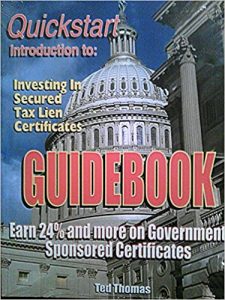
It’s my pleasure to welcome Ted Thomas to the show. Ted is a Florida-based educator, a publisher and author of more than 30 books. Over 75,000 clients have evaluated Ted’s Quickstart Introduction in Secure Tax Lien Certificates. His home study materials are international bestsellers and draw clients from as far as Europe and South America. I’ve invited Ted onto the show to discuss about this lesser known form of passive real estate investing and that’s what we all love because that’s what I titled the show, Passive Real Estate Investing. Let’s find out how we can earn and make more money through an alternative form of passive real estate investing. Ted, welcome to the show.
Thank you. I’m happy to be invited.
I’m glad to have you on. It’s been over three years that I’ve been doing this show and I don’t think I’ve ever done an episode about tax lien certificates. It’s something that I’ve known about for a long time and I will admit, personally, I’ve never dug deep and invested into myself. I’ve had the opportunity, but now I’m far more interested. I comb through your website. You have an interesting background. Let’s start off by learning a little bit about you. Tell us how you got started in real estate. I know you have an Italian background, which I love, but tell us how you got involved in all this.
My first career was as an airline pilot and I flew for Aloha Airlines in Honolulu, Hawaii. When I found out how much money you can make in business, I said, “This is a whole new world.” I left Hawaii and went to California and those days we said, “We’re going back to the mainland.” Sure enough, I started up real estate business in California and it was only for commercial. By that, I mean apartment properties, office buildings. The smallest one I bought was a 50-unit apartment and that business exploded. I started in the ‘70s and it grew and grew until 1986 and then the whole country went through a massive foreclosure epidemic. The market is completely reversed, buildings dropped 60%, 70% in value and it was exactly what took place again in 2008. The market got way overbuilt, financing was too easy, it all crashed down, and I lost my assets. I lost everything. I had to start over and I said to myself, “I’m getting out of the risk business. I don’t want to be in a risk. I’m a conservative investor, so you see me in a suit, I’m going to wear a dark suit and a striped tie. I’m not going to get hung out because I had done that.” We built this in the ‘80s. I have to 200 employees and $200 million worth of properties, which would probably be a billion today.
I started to learn about tax certificates. Tax at tickets are available in about half of the states. It works as a simple process and this is so simple. It was all created 200 years ago when people couldn’t read and write. What took place was there’s going to be a certain amount of people that just won’t pay their property tax. Maybe they went through a crisis or maybe the wife had a baby and the car got wrecked and the roof leaked. Everything happened at once, so they don’t pay their property tax. Every property in America, whether it’s in downtown Los Angeles, Miami Beach, Boston, wherever you want to name every property in the United States has a tax. That tax is always owed to the local county. In half of the states, if you don’t pay your tax, what the local government is going to do, whatever county you happen to be in, that local government is going to issue what’s called a tax lien certificate.
Don’t think that’s complicated. It’s a piece of paper, just like the one that comes out of your printer. It’s just a certificate. They print that certificate, but that certificate is very valuable for an investor like you or your investors that you have in your group or myself because we can go and pay someone else’s taxes. I could pay someone’s taxes. Why would I want to do that? I want to do that because depending upon where I buy the certificate, for example, if I bought one in Phoenix, Arizona, that certificate would have attached to it a 16% interest rate. If I bought it in Miami, it would have an 18%. How about in Iowa at 24% or Illinois all the way up to 36%. This as a certificate you want to get your hands on. Everybody’s saying, “I don’t pay someone else’s taxes. What if they don’t pay?”
Tax certificates, only two things can happen. One, you get paid because the people want to buy back the certificate because if they don’t buy back the certificate, you get the property. That makes the tax lien certificate a predictable certain secure investment. It’s predictable because it’s going to have an interest rate attached to it. It’s certain that government’s the one that’s going to say, so it’s predictable, certain, and secured by the real estate. Now, you bought a certificate, like you bought a mortgage, and now, it’s secured by that real estate. Only two things can happen in a tax certificate. You either get paid or you get the property. It’s a very simple investment. These things are invented a couple of hundred years ago. In life, we all know this. Certain amount of people is going to become like hermits. They get older and the kids go away and maybe the husband or wife dies and they stay in the house.
Sometimes they just forget to the tax. Sometimes they die or there’s no telling how many things can happen to people. 2% to 3% of all properties in the United States will go to tax auction every year. Let’s put this into perspective. I said 2% to 3%, doesn’t sound like many, but there are100 million taxable properties. That means $2 million to $3 million of these tax default at auctions are going to take place every year. Everybody that’s a bargain hunter and real estate’s out there trying to scratch around and find mortgage foreclosures, buy them from the banks, go out and knock on doors, forget all that. That’s all nonsense. That’s been on television for 25 years. Learn about tax lien certificates. You don’t have to learn it from me. You can just get onto your local county.

Half of the states sell the certificate. Let’s use California as an example. In California, they don’t sell tax certificates. In California, what they do if the people don’t pay their tax. California’s a very liberal lenient state. A little bit too much so because it can’t pay their bills because they will let people be in delinquency on their property tax for as much as five years. Can you imagine in your property you didn’t pay the tax for five years? At the end of that five years, what are they going to do is the local government, I don’t care if it’s Orange County, LA County, San Francisco County, Contra Costa County, you name a county in that state, what they’re going to do is they’re going to confiscate that property. The local government is going to take the property away and they’ve got to put it up for auction. Here’s the part you love. They’re going to put it up for auction. They don’t put it up for our retail price. They put it up for the back taxes and the penalties, so that means you could buy one of those properties starting bid at an auction at $0.10 on the dollar.
How many of those are there? I mentioned 2% to 3%. I’ve gone to the auction in Los Angeles County about five times over the past 25 years. I could guarantee anybody that wants to go to that auction, they will find 1,500 to 2,500 properties would starting bids of the back taxes. Let’s stay on the passive side of this. If you’re buying real estate at auction, you’re an active investor because you’re going to need to have to fix it up or you’re going to have to sell it or you’re going to have to do something to it. The day the gavel comes down and the auctioneer says, “That your property,” you own it. You’re not anything but an active investor. Let’s hang in with these tax lien certificates and learn the passive side. Most of your clients like passive. I’m using the extremes. Los Angeles on one side and here in Florida on the other side. A place like Tampa, Florida, that’s a city and county and surrounding area of about a million people, maybe a little bit more. In the Gulf of Mexico side of Florida, they will have annually, just that one county, which is called Hillsborough County, that one county will have 40,000 certificates available every year.
Just in the state of Florida, one million property owners did not pay the tax. That means all 67 counties in Florida issued tax lien certificates. Anybody can go to the sale. Some of them are just a little strip of land next to the road, so that’s only going to be $50 in tax, but most of them are on single family homes. Most of these certificates you buy, you can buy them from a $1,000 to $100,000. Any number that you want to invest. Let’s say you decided to dial the phone or if you want to just do it on the Internet and you go on the Internet and you look up Hillsborough, Florida and you want to see their tax lien certificate list, that list is going to be so many pages like hundreds and hundreds of pages of tax lien certificates available.
The starting bid on all those certificates in Florida is 18%. There’s a down bidding process. Let’s pick other states now. I picked giant states to talk about simply because there are so many people in population. California, you got a big population. Then you go to Texas and you come to Florida and New York. Going back to Texas. Texas is ruthless about collecting taxes. You like that if you live in Texas because in Texas, they have an auction every month. Every 30 days, first Tuesday of the month in Texas, all the properties in that county that haven’t paid the taxes, they auction them. They say, “If you haven’t paid your tax, we’re going to auction it off.” You can go there and they’ll have those certificates that you can buy. You buy the certificate, you just raise your hand at the auction. You give your money to the government, you’re going to get a check back from the government. When I say a passive investment that’s predictable, certain and secure, you can invest with me, you invest with the government and you’ll get a check back from the government. If you don’t get paid, you get the property.
How the interest accrue and how is it paid? It sounds like it’s not like a monthly payment of interest like you would get with a rental property where you have net cashflow come to you. How is the interest accrue and how has it paid?
We’ll do it two ways. One way, it would be in Florida. Let’s start with Florida. What happens is you raise your hand, you buy the certificate, so you pay the local government, let’s say it was Miami-Dade, you pay them the amount of the taxes. You just passively sit on your rusty dusty, you don’t do anything. When the people finally come in and pay the tax, you can’t collect tax because you’re not a tax collector, so they have to pay the tax to Miami-Dade. As soon as a paid Miami-Dade, then Miami-Dade will push a button and that will signify right to your computer and say, “These people paid their tax. Do you want to put it on your account? Do you want to put it in the bank? Where do you want the money?” They send you the money. It’s that simple.
How often does that happen? What’s the length of time or typical length of time?
Typically, if we look at the history of tax certificates, 95% of all the certificates you’ll have all your money back in 24 months. 95% of those two certificates. They might be wanting to go a little longer than that. A lot of them will be less than that. In Florida, if they pay you in 35 days, you’ll make 5% on your certificate, no matter what, you’ll always make it at least 5%. There’s a bidding process that takes place on a certificate. If in Florida pays 18% but you want to buy a certificate and so do I, we both want at the same one, you’ve been eighteen and I say, “I think I want to get that one,” I’ve been seventeen.
We could have a down bidding process that could bid it. Some people could bid that all the way down to 1% if they want to do. The reason they would do something like that is it would bid down to 1% because they know that people in that wealthy neighborhood will realize you haven’t paid the tax and we’ll pay it in 90 or 120 days. They’ll make a minimum of 5%, just quick money. I had one of my students who bought 57 certificates and his worst case is to make 5% on those certificates. His best case was to make 14%. There’s some bidding there that’s going to go back and forth. You don’t get paid until the county gets paid.
I assume these percentages are all annualized percentages. If the certificate was paid off in four months, it’s 5% over the course of four months. These are annual rates of return.
Here’s the difficulty for the client. The client needs to decide where they want to buy. They all became states at different times, so there are different rules in every state and every county. That’s totally confusing. If you are in Baltimore County, which is obvious, Baltimore City, you would get 24% on a certificate. If you’re in Prince George’s County right next door, they only pay 12%. It’s just up to the county. This is a county run program. All 3,000 counties are allowed to do what they want. On the East Coast, we have what’s called municipalities. It’s another 1,400 tax districts there. They can do what they want, so a person has to learn that. Everything I tell you is general information.
All I was asking is when you talk about 5% or 12% or 24%, I assume you are referring to a percentage over the course of a year, that’s an annual percentage calculation?
Everyone’s going to be different now but in Florida, they annualize it. It’s basically 1.5% for every month that you own the certificate. Now, I’m going to do the opposite. Let’s go to Texas. They’re ruthless. They have what’s called a penalty return. Let’s say you and I are in Houston at Harris County and we raise our hand, “I want to buy that one. I’ll pay $12,000 for that.” Texas, the minimum payment and the maximum payment are the same. When the people come in to pay their tax, they have to pay me my $12,000 and a 25% return. That 25% return is called a penalty return, not annualized like we did in Florida. You could see why people would want to go to Texas.
Five of the states are penalty states, so that’s always a penalty. Indiana’s one, Delaware’s another one. Georgia’s another one that’s famous for this. In Georgia, they have 169 auctions every month and they pay a minimum in one day. Let’s say you and I went to Texas. We invested $12,000 and two days from now the guy comes into pay. They have to pay the $12,000 plus the 25%. That’s our return. I have a database on every auction in the United States. We can go in there and tell you what that is, but we teach you how to do it. We have what you call a thumb drive and we can access every property in the United States from your office.
The penalty that you referred to, does that go to the state or the county or does that go to the investor?
All the county wants is the tax. They can’t charge more than the tax. The penalty goes to the investor, like the interest rate went to the investor, the 25% goes to the investor. People line up to do that, like in Houston, every month they’ll have an auction. I don’t think I’ve ever seen less than 200 properties. It takes them all day to auction and they auctioned them off and you might get paid the next day.
There’s no such thing as a monthly payment per se, or quarterly payments. You only realize your return once that certificate has been paid in full, right?
Exactly, and you can’t pay partial payments in 99% of the counties. All the counties you either to pay or you lose the property.
These are not streams of cashflow. In other words, there’s no monthly income coming from it. They’re chunks of cash. If you have a portfolio of these certificates, you might have ten of them, 50 of them or 100 of them. It’s as they get paid off, you get chunks of cash, that interest plus potentially that penalty that comes in as the certificates are paid off.
That’s to our advantage. Whenever there’s money involved, the big boys want to play. It’s still the banks, but it’s the hedge funds. The hedge fund would look at a list and on the list there would be 60,000 certificates. They just want to buy multiple pages of it. Then it drives him nuts because now they’ve got to set up accounting and business for every one of those accounts that they go crazy. You and I, entrepreneurial people, it’s a perfect investment because we can pick and choose and do whatever. Keep in mind, you live in a neighborhood, so you know that neighborhood, you know your county, you know, the adjacent counties or whatever that happens to people. They get to know that just like you would get to know real estate.
I’ll give you an example. A lot of people had been to a place like Scottsdale, so that’s northeast Phoenix. You could buy all those you want. You’re probably never going to get an $800,000 house in Scottsdale, but you might get the 16% interest. You can then look at the list, you can buy any certificate over there. What’s your risk? You either going to get paid something on your money or you’re going to get a property. That’s me. I want to be out of the risk business. If you don’t lose money, you’ll always have money, but when you lose it, it’s a killer. You go upside down. The other side is that people that want to buy tax defaulted property. Nothing wrong with that business either if you know what you’re doing.
In terms of how these are priced, it sounds like they’re priced based on the past due taxes plus a potential late fee or penalty and then it’s just the interest that accrues from the day you acquire a purchase that tax lien certificate to the day it’s paid off.
If a person went to a county that they weren’t used to, it’s easy to get to know these counties because there’s so much information on the net. You could start out with Chamber of Commerce information all the way through to county information all the way through to whatever certificate you want. You can watch these audits. They do the auctions online now. It used to be you’d have to go to every auction. We can do almost all of them online.
Statistically speaking, what percentage of the time does the investor end up taking back the property?
Statistically, it’s going to be way less than 2%.
It’s very uncommon.
If it’s a piece of trash property, don’t just pick a number and buy it and hope it’s going to work. There’s going to be properties that aren’t good. If you went to northeast Phoenix, we said that was Scottsdale. If you went to northwest, it’s bread and butter. If we went to southeast by the airport, that’s industrial, so you don’t want to start buying around industrial property because you don’t know whether the people ever going to pay for it again. Do you want something like that in your portfolio? You wouldn’t want that. If you bought up in northeast Phoenix where it was Scottsdale, you’d want to buy. You do have to do some research and educate yourself. It’s not a business for gunslingers, but you don’t have to be a complete analytical either.

This is very similar to what we do. You want to pick the right market and then within that market you want to pick the right neighborhoods to invest in property. Same thing with tax lien certificates.
Once you know that neighborhood, just keep doing them in that neighborhood. There’s always going to be too many because there are so many tax certificates. A place like Phoenix would have 20,000 or 30,000 every year is it. The numbers are overwhelming. There’s too much for you, so you’re going to have to narrow cast into area that you want.
When you buy your tax lien certificates, do you hope that you end up taking over the property or do you just hope it gets cashed out?
I teach classes on this and I say, “When you buy this tax certificate, if you looked at it and you know what it is, you’re going to go home and you’re going to get down to your hands and knees and you start praying that the people don’t pay.” I spend more time now buying tax defaulted property. You’re a sophisticated real estate investor as you’re making your people be, even though they are passive. It’s possible that these people, if they could see a $300,000 house that they could get for $0.20 or $0.30 on the dollar and they weren’t afraid of the risk of fixing it up and they were willing to go look at it if you could buy for $0.10, $0.20, $0.30 on the dollar. When you go buy $0.30 on the dollar, you’re trying to compete with all those flipper guys and you don’t have to do that. If you can’t steal it, don’t buy it. There will be plenty of those. Los Angeles would have a couple of thousands of those at every auction.
That doesn’t mean San Diego won’t have it. It doesn’t mean that they won’t have them over in Van Nuys. They’re going to have them all over every state and it’s just a matter of doing exactly what you have already taught them, look at the location, what’s going to happen and look at the property. You can do that online now. You can sit at home. I teach this class in all the provinces of Canada. I have people with six-figure incomes in Canada, they have never been in the States ever and they buy and sell online. I teach it in Singapore, Bangkok, Sydney and Melbourne, Australia. That’s how much you can do online. They can get into that then go to the website and look and learn more about that.
Is it possible to lose money investing in tax lien certificates?
It’s possible lose money in anything because people would go crazy. I’m a conservative investor. I tell people, “When you start this, don’t be a gunslinger. You could lose your money if you bought the wrong property.” For example, someone doesn’t want a property because it’s bad. All they have to do is they just have to abandon it. If you abandoned the property, you’re going to get a tax bill and another tax bill. After so many tax bill, the county will confiscate the property, so it will belong to the county. You don’t want to get the priority. There is some intelligent investigation that people should do. I don’t say it’s hard, but they need to investigate what they’re going to buy. They shouldn’t just buy because it’s on a list or because you and I said it was pretty good investment. They should not do that. They need to either hire an expert to work for them to do it or they need to learn how to do it.
How often does that happen where you get stuck losing the investment in the tax lien certificate?
The big boys walk away from them. The big boys are going to go to an auction, they’re going to see a property with a value of half a million to a million dollars, and they buy it without looking at it. When they get there, they see the neighborhood isn’t good. They see that it’s going to cost too much to rehab it, so they’ll just take the hit, whatever they invested, and keep going onto the next one. The little guy is not going to get hurt because he’s going to go look because we tell them, “If you don’t look at the property, you’re a fool.” That would be anybody. Unless you got an expert, or you buy it from an expert or something? You need to look. You can do almost all of that online. There’s a lot more online, go to Google to look at properties. There are satellites now that come right down and tell you there’s something on the front porch. You can see these and you can check neighborhoods. Now’s the day of the Uber driver and tell them to go out there and take pictures.
There are literally services out there where you can pay them a nominal fee and they’ll drive by and check. They’re not going to go in the property, but they’ll take photos of the front and the back. They’ll basically be a private investigator from the outside looking in.
The person that’s willing to do a little research is going to be fine. The person that doesn’t want to do anything and thinks they’re smart, they might get hurt. I don’t want to ever tell anybody they’re not to lose money. I want them to be cautious. I want it to be aware. I’m conservative. I had months where I made a million dollars a month. When I came down, I bounced a few times and I got to the bottom, so I had to start all over. I’m out of the risk and I don’t want anything that’s got risk.
If you were to take an average purchase price of your students, purchase price meaning what they’re purchasing these tax liens for on a per basis, what would that be? Are these like $5,000, $10,000, $1,000?
It depends on where they live. If they are living in Florida, an average certificate in Florida is a little over a thousand dollars. That’s not very much. Texas going to be a little higher than that because you’re paying more. What happens after you have done a half a dozen of these? It’s easy to invest $20,000, $30,000 a pop.
That’s what I was wondering. How often or how much do investors buy? They’re only a thousand each. I would imagine they’re buying, $10,000, and $20,000 a hundred at a time.
Not that many. Most people will start out with two or three. It’s like walking over to the pool, “It’s a little cold. I got my toe in, I’m not going in.” They want to stick their toe in the pool and do one or two little ones, make sure the whole thing works. Here’s the beauty of it. I don’t care what your market is, your market meaning the real estate market going up and whatever. I don’t care what it is because a tax lien business is level. It’s always the same. We’re always going to have somewhere between $2 and $3 million tax defaulted properties every year. Good economy or bad, it’s steady.
It’s disconnected from the real estate cycle.
Because people don’t understand it. Test any broker you want, and they’ll say, “I don’t know about that. I don’t have a clue.” It’s that people don’t know. Test the banker. The banker would know about it. They’re not bad people, don’t get me wrong there. They’re just regular people know. It’s too small a market for the average big real estate company or to do. They’re not going to do it.

I would imagine this is a good fit for a self-directed retirement account.
It’s perfect. The guys that make it big in using those funds and if they’ve got a Roth IRA, they’re cleaning up.
Is there anything I didn’t ask you that I should have?
You did great. Matter of fact, you got into it in-depth, so that will make people feel good. I can tell you that both sides of the business work. The attractive part for everyone are these predictable certain secure returns. However, the part that requires a little work and that it’s very exciting and makes the money is where you can buy their tax defaulted property for $0.10, $0.20, $0.30 on the dollar.
Ted, this has been great. Please tell our audience how they can find you and get more information about your program.
Just go to TedThomas.com and there will be free videos there they can watch. If they want to see a complete presentation on both sides in which I’m selling, then they can see a complete presentation. I speak on platforms where people like Tony Robbins and Kiyosaki and people like that from time to time. We video those and we put them on and people can see it. At the end of that, there’s a pitch.
Ted, I appreciate you spending time with us. This has been very interesting and informative and check it out.
Good luck on your meetings. Call me again anytime.
Thank you, Ted.
You’re welcome.
Tax lien certificates can certainly be an excellent investment to add to your portfolio. The key, like any other investment, is to know as much as you can about the property, the neighborhood, and the town in general. In other words, you want to do your due diligence. You don’t want to just be buying up tax lien certificates for the sake of buying tax lien certificates. There’s no guarantee. Every type of investment carries an element of risk. You never want to get stuck with a property that you don’t see any upside in. Buy tax lien certificates only on the properties that you ultimately would feel comfortable owning if you had to take title to it if you had to take possession.
If you have any questions about real estate at all, contact one of our investment counselors or if you already have one, contact your investment counselor and ask your questions. You can call them, you can email them. If you haven’t reached out to us and you’re thinking about investing in real estate, set up a free strategy session with us. We can answer your questions and help put you on the right track. If you are listening to this podcast and you haven’t subscribed yet, hit that subscribe button and get a plugged in. We come up with an episode probably once every week. Sometimes we skip one when I’m out of town. When I’m out of town it’s hard to keep up but I’ll do my best. Help us spread the word. Please visit iTunes and leave us a rating and review. We would greatly appreciate that. As always, thanks again for listening.
– – – – – – – – – – – – – –
Download your FREE copy of: The Ultimate Guide to Passive Real Estate Investing.
Get your FREE coffee mug by leaving us a Rating and Review on iTunes. Here’s how.
See our available Turnkey Cash-Flow Rental Properties.
Please give us a RATING & REVIEW (Thank you!)