
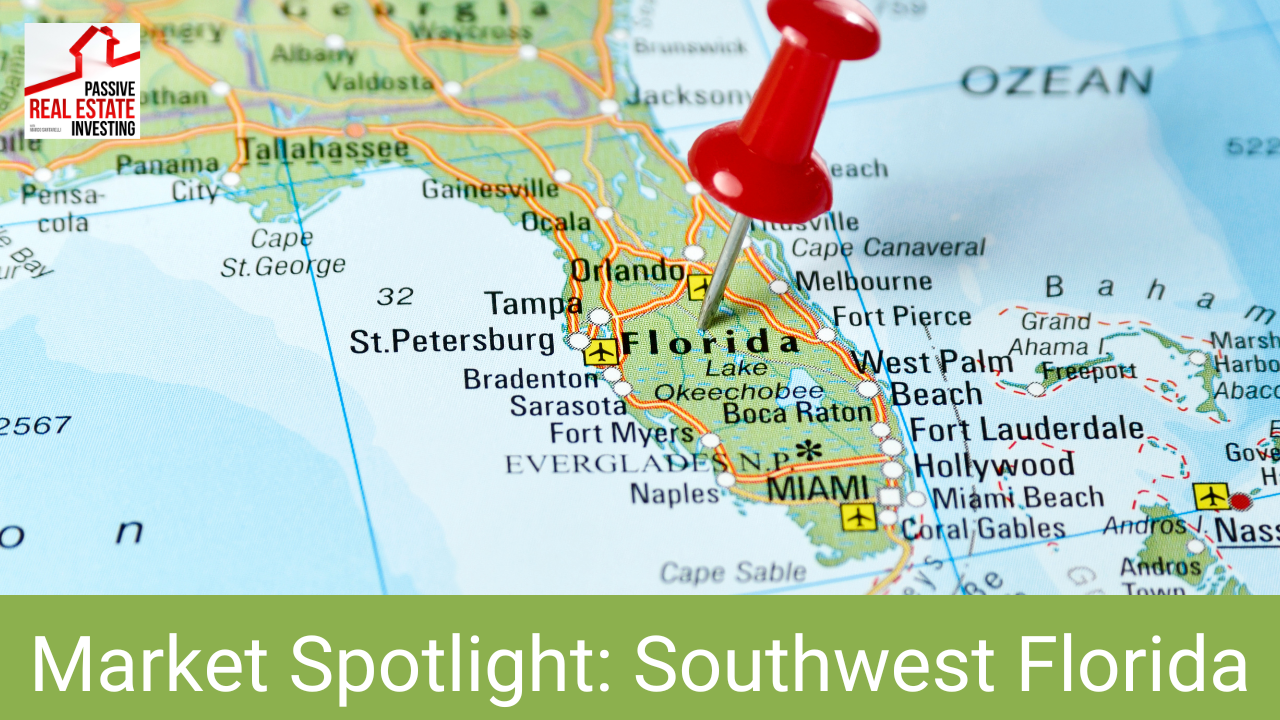
Hello, and welcome to another episode of Passive Real Estate Investing. I’m your host Marco Santarelli. Well, today we’re gonna do a quick, relatively quick episode and market spotlight on Southwest Florida. It’s been a hot bed for a new construction for job growth, for price growth, for economic growth. It’s just a great location. And it’s a place that I was investing in way back when in 2005. So go figure things go full circle. So anyway, with me, today is one of my trusted builders and a good friend Reed and Reed is a guy who has been providing us a lot of great new construction inventory, not just in Florida, but other places too, but he’s especially focused in Southwest Florida. And we’re gonna talk about the market and the opportunities there for you as an investor. And that way you have a better understanding of this particular option. So Reed, welcome to the show.
FREE copy of The Ultimate Guide to Passive Real Estate Investing.
If you missed our last episode, be sure to listen to Market Spotlight: Charlotte, North Carolina
SUBSCRIBE on iTunes | Stitcher | Podcast Feed
Hey, thanks a lot for having me today, Marco, it’s been a pleasure working with you and your team over the last few years.
Yeah, likewise, definitely you guys are very professional and a class act and all the product we get from you guys is fantastic and you service people very, very well. So we’re very happy about that. And of course our clients, the investors are very happy too. So I’m talking a little bit fast <laugh> and you know why it’s because the battery on my laptop is running very, very low. So I don’t wanna run out of time because of lack of battery juice. How embarrassing is that? Right. Anyway, we’ll get through it. So re let’s talk about Southwest Florida. First of all, let’s define what we mean by Southwest Florida, cuz we’re not talking about one specific city. You’ve got Cape coral, you’ve got Punta Gorda, you’ve got all these, you know, secondary tertiary markets. Why don’t you clump that all together and give us an explanation of what we mean by Southwest Florida.
Yeah, yeah, no problem. Yeah, exactly what you said. You know, these markets that we build in are our secondary tertiary markets. Some people call them bedroom communities. It would be markets like Cape coral, north port, port, Charlotte, Punta Gorda, Lehigh acres. And these are all markets where you know, they’re very, very strong rental markets. They’re just outside of more maybe well known or, or quote unquote major cities just outside of like Sarasota or Fort Myers. So a lot of people that live in these towns work in the larger towns, but that being said, there’s still plenty of jobs in the smaller towns. Florida has unbelievable low unemployment right now. So everybody’s working, even my kids have two jobs and they’re teenagers. So I don’t know what that says.
Right. Well, that’s great. Especially in today’s environment where we have really low unemployment, even in the economic environment that we’re in. It’s interesting how everybody’s kind of struggling to find people to hire. Now there are some companies that are slowing down or stopping employment just because you know, of, of economic uncertainty, but I think that’s gonna be short lived. What cities are we talking about with the new construction homes that you guys are building in Southwest Florida? So we know the markets that we’re talking about.
Well, the main markets that we’re building in right now, and we have upcoming projects now we’ve got projects in all the towns that I had mentioned earlier, but you know, for your clients and your investors, the, the projects that are coming up soon. So if you got somebody with a 10 31 exchange or a cost se before the end of the year or something like that, we would wanna look at markets like Punta Gorda, Cape Coral and Port Charlotte. Those would be the areas that we’ve got projects finishing up in the next say 90 to 120 days.
Okay. So really there’s two main markets that you’re talking about, pun Goda and Cape coral at this point, correct? Yeah. Correct. Okay. I always like asking this question, it’s a very broad general question. It’s kind of the starting point is from a high level, why would I, as an investor, want to be investing in these markets or these cities in the market, which we’re referring to as Southwest Florida?
Sure. I mean the super high rental demand. I mean, obviously during, you know, the, the peak of COVID, we had a lot of folks moving here from other parts of the country, and I’m not saying that trend is as, quite as hot as what it was two years ago, but the trend is continuing and, and, and we’re seeing something a little bit different is we’re starting to see a lot more Canadians and Europeans moving to this area for some of the same reasons. I mean, they couldn’t escape for a couple of years and they’re now able to work remote. So there’s a big lack of for sale inventory out there. So it is turning some people that would be home buyers into renters. So rents continue to rise because there’s literally no inventory. They rent up very quickly. People always choose new construction or over older homes, you know, when given that option. So that’s the option that our company provides is, you know, high quality, new construction, single family. And we do have a handful of duplex rentals available.
Interesting. Okay. So breakdown, what makes up the local economy? I like markets that have diversity in terms of what industries, the businesses and jobs fall into. So, you know, we don’t have these one trick pony markets that are heavily based on, let’s say tech or oil and gas and very little elses. What makes up the economy in Southwest Florida?
You know, we’ve got a really nice mix of obviously, you know, healthcare and medical is big in Florida because we still do get a lot of retirees. Now, the average age of somebody moving to Florida has dropped dramatically over the last few years, but we still, you know, we still have some boomers moving here and some older folks that need some extra help. Obviously we have construction, we have tourism, you know, people that work in restaurants and bars. We’re also starting to see, you know, some, some of the larger tech companies, maybe not plant, you know, huge campuses. But one example is Gartner, which is a big tech technology research firm has a huge campus in Fort Myers, Florida. And it’s, it’s one of the most premier jobs in the area. And there’s some biotech coming here, some smaller biotech companies, probably not, not anything that anyone has heard of, but we’re the, the, I moved here 20 years ago from Indiana and the economy is infinitely more diverse now than what it was say in the early two thousands. You know, just based on, you know, a lot of the new jobs coming here and the demographics of people moving here, starting to trend younger, it’s attracting more companies, you know, for higher, skilled and many high skilled professions.
Well, that’s a good trend. That’s a very positive trend. What are you seeing? I mean, this is more of a, you know, an economic type question based on what we’re seeing today in the market. I mean, you know, the fed has been raising rates. We’ve seen a little bit of pumping of the breaks by people buying homes and investments and whatnot, just because of uncertainty with, and with mortgage rates rising. Although that, that seems to have tapered off. What are you seeing in the local market there in terms of interest in new home construction demand for new home construction rents and rent rates, maybe you can just kind of paint a picture for us.
Sure. You know, it’s funny I saw or I was listening to the radio on my way into the office this morning. They were talking about new home construction demand being down 20%, but that was a national figure. And a lot of that, they said on the radio was concentrated in the Western part of the United States. I haven’t truly seen a drop off for, for new home demand in Southwest Florida. I think, cause we’re still relatively, you know, lower priced compared to other nice places to live, you know, in the country in terms of rental demand. Because we don’t have a lot of for sale inventory. You know, you’ve got a pool of people who, you know, someday will buy a house. They just can’t find what they want right now. You’ve got people moving here who are remote workers. And then you’ve got your, you know, your everyday renters where it’s a, you know, two income household, you know, maybe combined income is a hundred, 120,000. And we’re starting to see, you know, rents, you know, creep into the low two thousands to, you know, 2,500 for some of our four bedroom product. So really it’s you know, from a cash flow standpoint, you’re still even with the slightly higher rates, which historically these are still fantastic rates, but we kind of got spoiled there for a couple of years. Right. But there’s still positive cash flow to be had with, you know, 20 to 25% down right now.
Yeah. That’s interesting. Okay. Reed, so let’s kind of start drilling down a little bit more granularly, you know, I always look at markets first because I want markets that have jobs and job growth. And I want markets that have population growth, ideally net migration, positive net migration, but in migration as well. Clearly we have that in Florida period, but we are especially seeing that in places like Southwest Florida, because the jobs bring people in and there’s a lack of housing. So we have to obviously build new homes. But after that, I start looking at neighborhoods like submarkets areas and neighborhoods. What kind of areas are you building and what kind of neighborhoods are you building them in? How would you classify them? Because I think that is just as important as the type of market that you’re investing in.
Yeah. One of the things I do for the company is I do a lot of, well, not a lot. I do all of the land acquisition in Southwest Florida. So I’m very choosy and you know, it’s, everything is gonna be B plus and above. I will spotlight one market cuz it’s kind of a unique market for us. It’s in Punta Gorda Florida. It’s a small community that where we’re building pun go is a, is alar, well, not a large, it’s a mid-size little Southwest Florida fishing and boating and golfing town. But within that, we’re building in an area called burnt store village. And it’s an area of about 500, we’ll be about 500 homes. There’s probably about 150 200 homes in there right now. And we picked up quite a few pieces of property in there. It’s a, it’s a deed restricted community, but it doesn’t have crazy HOA fees.
The HOA fee is literally a hundred dollars a year. It’s it’s enough to maintain the signs and, and the community’s website, but really, really nice. I mean really nice roads, all the houses in it, you know, have to meet certain square footage requirements, be store village is a really cool area within Punta Gorda. It’s an area that’s got about 500 or will have about 500 homes in it. And there’s about 150 homes in there right now. It’s really nice, nice roads. It does have a small HOA, which is a whopping $100 per year, but it’s so it’s, it’s enough to maintain the website and maintain the signs out front, but it’s all water and sewer in the deed restrictions, there’s certain architectural and square footage requirements. So I really think it’s unique. We, we don’t normally do deed restricted communities. I just got lucky and got a good price on, you know, 25 or 30 lots in there. So it’s a good opportunity for your customers to get into a true class. A, you know, no doubt about it. City water, city, sewer, which is hard to come by in Southwest Florida. You know, a lot of what we do down here is well in septic which is fine. They work great. They’re great rentals, but the city water city sewer is kind of a special thing for us.
So is that area on the outside edge bleeding edge in the path of progress or is it part of a larger metropolitan area?
So you’ve got Punana go the, the actual downtown to the north and you’ve got Cape coral to the south and it’s towards it’s, it’s more towards the PAG go. It’s across the, the line between Lee and Charlotte counties. So you’ve got Cape coral moving north towards it and PAG go just kind of expanding down towards it. So, you know, it’s about two miles from the nearest Publix, which if you’ve ever been to Florida, you want to be near a Publix cause that’s our main grocery store. Yeah, that’s true. It’s, it’s a really cool area.
Yeah. Okay, great. What are you seeing in terms of the rental market, in the areas that you’re building, including Cape coral, but POAG, Goda and whatnot? Oh,
The, the rental market has showed absolutely no signs of slowing, you know, with all the reasons we talked about before, I would say nine out of 10, our customers have somebody lined up ready to move in, you know, the day they close. The nice thing about new construction is we know about 30 days out when the house is going to finish. So that gives the property management team a full 30 day runway to line up a renter.
Okay. Well that’s positive. Are you seeing rent rates still increasing? I know they were kind of going up rapidly for the last 24 months or so I think things have kind of tapered off a little bit in most places around the country, but there’s still positive growth. What are you seeing down there?
Yeah. You know, before, you know, if we would’ve had this conversation and we did have this conversation, you know, two or three years ago, you know, we were seeing kind of rapidly increasing rents at the beginning of COVID and I think we’ve kind of hit an equilibrium with that. There there’s no negative growth at all and it just slight positive. So I think if, you know, while you’re doing your personal performance, if you factor in a couple percentage points a year in rent, rent growth, you know, that’s a pretty conservative estimate, but I think that that’s about it. Okay. At least right now.
Okay. Good. All right. Good news. So, you know, as we know, properties can vary from market to market and even by neighborhood, what are you guys building? Like, describe the product type and just get into a little bit of the detail. And then let’s talk about the price ranges and rent ranges that go along with those properties.
Okay. So in Punta Gorda and in Cape coral right now and actually in all of our markets, we’ve we, we used to build a 1,550 square foot model. We’ve now gone to more of a four bedroom model. It’s 1,915 square feet four bedroom, two bath, two car garage. It’s got to wood plank tile throughout. So the tile that looks like wood, you’ve got granite stainless steel appliances nine foot four ceilings. So it’s not an entry level house. It’s, it’s not a custom house. So it’s somewhere in the middle price ranges on that are they’re running from between like four 20 and four 50, depending on the market. And the rent ranges are, say 24 to 2,800 and, you know, give or take. And again, it depends on the market.
Okay. What are you guys doing in terms of amenities for these properties? Are they different than everything else being built around it? Are they, they geared towards, you know, being tenant occupied or is it just kind of like a standard stock type model?
No, no, because we only build for investors. We build the interiors of the homes that while they’re beautiful, they’re, they’re Bulletproof. That’s why we use the granite. Why, why we use the, you know, the tile, you know, we make it so we’re planning on it being a rental property for probably five to 10 years until the investor decides to exit it. But you know, they look really good and you know, if anybody replies I’ll be able to send out some pictures of some finished product. And I, I think they’ll be impressed, really great floor plan, big Lanai in the back, which for non Florida, people is like a big covered back porch. So, you know, there’s outdoor living areas associated with these homes as well. So really, really nice product.
Okay. What are you telling people like investors today? I mean, we seem to have a constantly changing environment and we’ve just had this issue for years where we’ve had low supply, strong demand, and that’s still there, although it’s, you know, cooling off a little bit, but because prices have increased tremendously and rents have increased as well, but not at the same pace as, as pricing, we’ve seen cap rates being compressed and therefore cash on cash returns being compressed as well. You know, they’ve shrunk so often properties and this is true for new construction. They don’t seem as sexy on the front end in the beginning as they used to. But what we have seen also is very strong rates of, of appreciation, very strong price growth. Now, of course, you know, there’s no guarantee that goes on forever or at the same pace as it has, you know, you, there is the, the expectation that it has to cool down and it has, but when investor, you know, talks to you about the rates of return on a property, how do you position the investment with these new construction homes, knowing that, you know, the cash flows have dropped, but there’s still strong price growth.
Yeah. There is strong price growth. And, and I think you’re gonna see that continue for a couple of reasons, really the, the change in demand. There, there there’s really not a large change in demand. I ran the numbers the other day. We still are at about two months of active inventory in our MLS. Two months is not a healthy market, no six months the healthy market. The other thing is I look at the, the percentage of cash buyers in a market. And I look at it year over year, I looked at 29. I looked at the last four because sales counts are down slightly from 2020 and 2021. But in our, our ML Southwest Florida, MLS, we’re still gonna close almost 2000 houses in July. We’re we’re on pace to do 2000, which is what we did or in 2022, which is what we did in 2019. Now, 2020 and 2021. It was more like 24, 2500 were the sales counts. So has it cooled from 20 and 21? Yes, but we’re now we’re kind of back to a normal market, you know, 2000 1800 to 2000 sales in July is normal. I think we’re gonna continue to see the appreciation, the other, the other metric that I track is the percentage of cash sales. And we in our MLS year to date, we’re at 44 and a half percent cash sales.
Wow. That’s a lot.
That’s a healthy market, you know, it’s not a leveraged market at all.
Yeah. Which has its advantages. I mean, it doesn’t put any stress on the market in terms of, you know, property values coming down and people defaulting on their property. We’re just in a completely different environment. In fact, most mortgages today, virtually all of them are from well qualified buyers, you know, with average credit scores of seven 20 and above. So nobody’s speculating and there’s not a lot of subprime mortgage financing out there. So it’s a, it’s a completely different environment than what we had back in 2008. Right. And that’s all good. Yeah.
Somebody sitting around waiting for foreclosures to happen, they’re gonna be sitting around waiting for a very long time.
Exactly. Yeah. Yeah. Cool. Is there anything else you want to add or comment on in regards to the properties and the investment itself?
I, I think kind of the main thing is, you know, we’re really, really good at working with 10 31 buyers cost segregation buyers because we’re a spec builder. We build everything on our own dime with our own money. We don’t expect your clients to go out and get construction loans, which are a kind of a pain in the rear end and B very expensive. So when you, when you see a price from us, what you see is what you get. We used to put properties on our list that were six or eight months from completion, 20, 20 and 2021 taught us not to do that anymore. So if you see it on my list, it’s within 90 days of completion. So we don’t have to worry about price increases or anything like that. It’s just a, you know, it’s a very stable investment appreciation, you know, 20, 22 probably won’t be to use your word.
Probably won’t be a big sexy year in 22, but you know, if we can get three, four, 5% appreciation, and then I think, you know, as our uncertainty goes away and, and the economic climate, hopefully normalizes a little bit, I think we’ll, we’ll get back to something that’s, you know, typical Southwest Florida is four or five, six, maybe 8% appreciation. And you, you kind of mix that with positive cash flow. Now, you know, every time interest rates go up a little bit within 12 to 18 months, they come back down, you know, you could always refi into, you know, a lower rate at another time. Yeah. You know, I don’t have a crystal ball, I don’t know for sure. But historically when they go up within 12 to 18 months, they come back down.
Yeah. And that’s actually my expectation. I’ll probably do a podcast episode talking about, you know, what we can expect to see for the rest of the year, but the fed needs to cool down inflation. And they’re doing that with these rate hikes, but at the same time, they’re gonna have to start easing again. And once that happens, we’ll probably see mortgage rates start to come down again, although not as fast as before, but they will start to inch their way down. And so that won’t be this year. It’ll probably be next year.
Yeah. I think probably in, in 23, probably second quarter of 23. Yeah. I’ve talked to quite a few mortgage lenders who work primarily with investors, some of your people, some, some people I know and they all kind of tell the same story. They might be three to six months different in what their opinion is. But sometime in 23, we, we will see mortgage rates ease with it with all likelihood.
Yeah. I agree. Just last question about the properties, the warranty, what kind of warranties are attached to these properties?
So every property we build is gonna be warrantied by the builder for the first year. And then we also tack on an additional what we, or it’s called a two 10 warranty. It’s a third party warranty, which warranties is all the structural, major mechanical, all the big things in the house are warranty for 10 years.
Cool. Any final comment about the market neighborhoods, the properties you’re building, the opportunity there, growth advice, anything you want to add to this episode?
I don’t think the sky is falling. I think we’re, you know, we’re in a, we’re in a weird, I was listening to a, another podcast on the way to the office. And it’s, we’re kind of in a weird situation where we have inflation and interest rates at the same time. Normally, you know, you lower interest rates, you know, in an inflation or, or I’m sorry, I’m saying it the wrong way, but we, we’re just in a weird situation right now. And you know, these things work themselves out
Well, we’ve lived through multiple recessions, multiple rate hikes, you know, we’ve seen all kinds of economic ups and downs and turmoil, and we always survive, you know, the length of time differs, but we always come out on the other end fine. And in some cases, you know, with many opportunities to create more wealth. So I always look at these pullbacks and downturns as an opportunity to get in on better deals and profit from it down the road. It’s just the way I look at it.
Yep. I think that’s absolutely right.
Yeah. Cool. Well good. So if you’re listening to this and you want more information about Southwest Florida and the properties that are being built there and the investment opportunities that we have, I just reach out to my team here. We have six investment counselors to help you. They’re all dialed in with Reed and his team. So we can certainly pass along all the information that’s current at the time, as far as inventory and, and market information for you. So Reed, thanks for coming on. I appreciate you taking the time.
Thank you very much, Marco. I appreciate it.
Well, thank you.
Thank you.
That’s it for this episode. Thank you for listening. We appreciate everything you guys provide us. As far as listeners. Remember, we have six investment counselors to help you here. So just contact one of them through our website and they can give you some guidance and talk to you about the markets and the different opportunities in the different parts of the country as well. Well, as the inventory available and what’s coming down the pipeline, as well as, you know, what might be the best for you, depending on what your investment goals are. Sometimes it’s more cash flow based and sometimes it’s more appreciation based. And so you’re looking at markets like many Florida markets, where there is strong appreciation potential, but you know, pretty much everything that we have is cash flow positive or at worst case scenario is cash flow neutral. And that’s okay in the beginning, you know, that will change and grow over time.
But I’ve said before, and I’ll say it again, sometimes in the investments you make you give up, what is essentially a rate of return or cash flow on the front end, but make up for it many times over on the back end with the equity growth in the property. And I’ve talked about this in detail on a previous episode, the title of that episode was the real rate of real estate returns. It was episode I believe 221. So if you go back to 221, I’m pretty sure that was the episode, but I talk about and compare cash flow and cash on cash returns compared to the rates of return on equity growth, through amortization and appreciation. And you’ll see, there’s a pretty significant difference. So real estate is a tremendously good wealth creator and wealth preserver. So don’t be hyper-focused on cash flow. Yeah. You want cash flow and you’ll certainly build that over time, especially as you build a portfolio and as rates or rents increase, but anyway, you get the point. So that is it for today. I appreciate you all listening. Remember to subscribe to the show, if you haven’t. I think iTunes changed that word from subscribe to follow. So now you’re no longer a subscriber. You are a follower. So anyway, remember to subscribe and follow and that way you never miss out on a weekly episode. Thanks for listening. We will see you all on our next episode.
Download your FREE copy of: The Ultimate Guide to Passive Real Estate Investing.
Get your FREE coffee mug by leaving us a Rating and Review on iTunes. Here’s how.
See our available Turnkey Cash-Flow Rental Properties.
Please give us a RATING & REVIEW (Thank you!)