
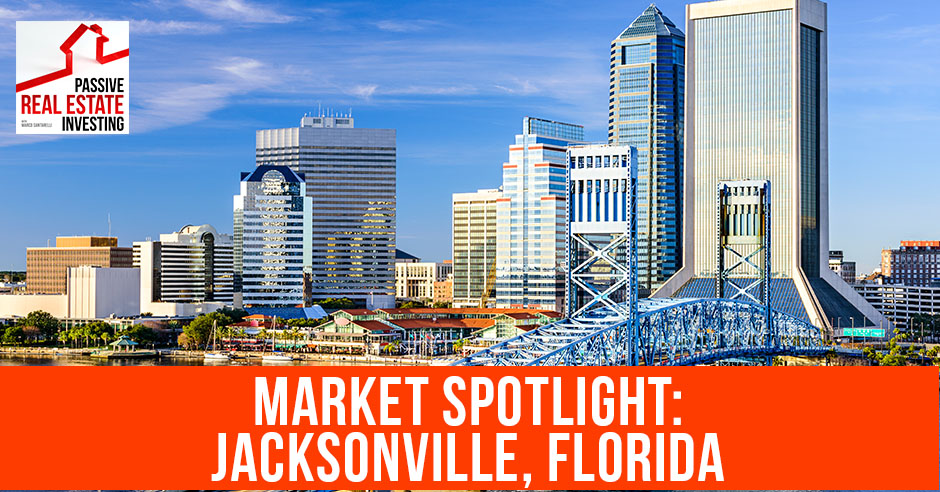
In this market spotlight episode, be ready to hear all things real estate investing in Jacksonville, Florida. Host, Marco Santarelli, talks to a trusted local property partner about why the city’s growing and why it’s such a vibrant, energetic city for real estate. A coastal city with a population of 1.2 million, it is boasting an affordability index that is unheard of. They talk about the intricacies of building in a growth market and what makes Jacksonville attractive to baby boomers. Discover Jacksonville’s story to find out if it is the investment haven everybody is talking about.
Download your FREE copy of: The Ultimate Guide to Passive Real Estate Investing.
Identify great tenants using SmartMove. Visit www.TenantScreening.com and Save 25% using podcast code NORADA25.
Try LandGlide FREE for a week by visiting www.LandGlide.com/PassiveInvesting
—
If you missed our last episode, be sure to listen to Ask Marco – Calculators for Evaluating Investment Properties.
Enjoy the show!
– – – – – – – – – – – – – –
Download your FREE copy of: The Ultimate Guide to Passive Real Estate Investing.
Get your FREE coffee mug by leaving us a Rating and Review on iTunes. Here’s how.
See our available Turnkey Cash-Flow Rental Properties.
Please give us a RATING & REVIEW (Thank you!)
SUBSCRIBE on iTunes | Stitcher | Podcast Feed
Market Spotlight: Jacksonville, Florida
It’s time to do a market spotlight. We haven’t done one and I figured we should start spotlighting all the markets that we’re in. We’re going to start with one of my favorites, it’s Jacksonville, Florida. Jacksonville is a very large coastal city located in the northeast corner of Florida. Unlike some cities, what I like about Jacksonville is it’s mainly a white and blue-collar type of market. Instead, the most prevailing occupations for people in Jacksonville I have found are a mix of both white and blue-collar type jobs. Overall, Jacksonville is a city of sales and office workers, professionals and service providers. It’s one of the reasons why I like that market so much. With me is Jim. He’s one of our trusted local property partners down there and he’s going to be able to get into the weeds with all this stuff that I’m talking about and what I’ve been looking at it in the Jacksonville market. With that, welcome, Jim.
Thanks, Marco. It’s good to be here.
It’s great to have you back on. I got a little excited talking about Jacksonville because I got thinking about all of the things that are going on there, why the city’s growing and why it’s such a vibrant, energetic growing city. I’m going to leave that for you to share. Why don’t we start off by talking about the market? As I recall, and correct me on this, Jacksonville is a very large coastal city has a population of close to 1 million people. I think it was over 900,000 the last time I checked. Tell us about the market. Why do you like the Jacksonville market?
I’ve been there full-time for fifteen years. The Jacksonville market brought me from where I was originally in California because it was something that you don’t normally hear together, Marco, and that’s an affordable coastal city. Those words don’t normally go together and Jacksonville had an affordability index that was very helpful. People are wondering what’s the average salary compared to the average price of a home. We had a very healthy equilibrium there, which you don’t normally find in large coastal cities, especially one with Jacksonville with such a diverse economy. What originally brought me here was that inexpensive housing with high rents and being so affordable, there’s a large population influx happening right here. There are about 75 families a day moving to Jacksonville because of that affordable coastal lifestyle and the amount of job source. That’s what originally attracted me here and still continues to be my most exciting projects here in Jackson.
How big is the population? Is it close to one million now?
If you’re in the greater Jacksonville area, you’re going at about 1.2 million. It has grown tremendously in the last few years and then going into greater Jacksonville areas, the counties just on the outskirts and things, you’re going into about 1.2 million.
What’s the story with Jacksonville? Every market has a story. It answers the question of why invest in the Jacksonville market.
You hit on a lot of areas like in far South Florida can be good, but they’re based on real estate, construction, and tourism. Those things are great and they’re here, but this has a much more diverse economy with nine universities, eleven hospitals. It also has the port industry here. It has the military, it has a tech industry, a banking industry. The logistics industry. We’re the only spot in America where I-10, which goes from California to Florida, and then I-95 which goes from Miami to Maine intersect. We’re a logistics capital for trucking, for trains. CSX, the largest train company in the US, their headquarters is located here. There’s just a diverse economy. When you have that many diverse economies and jobs, usually wages are higher and that allows rents to be higher.
When I left California in 2005 and came here, that was a time when the markets were very high all over. By far, Jacksonville was the most affordable, large coastal city in the nation. Me loving to be by the water and warm and I’m a surfer and I like to go to the beach with my family, I just found that intriguing. That continues to grow in a lot of areas in Jacksonville. We’re not even back to peak pricing, meaning what were things selling for in 2005, and that’s surpassed in lots of markets by now. We’re past the peak pricing, but here in Jacksonville, we’re below peak pricing in some areas, which shows to me we’ve had a healthy recline to get back to where we should be.
I agree. High tech is huge there. Medical is probably one of your largest employers. I think there are over 100,000 jobs in Jacksonville that are tied to the medical industry by itself. You mentioned military and it’s a major logistics hub. The last time we spoke, I remember you talking about this major port expansion that was going on. Can you maybe update us on what is going on with the port expansion?
That’s still happening. The port expansion is going on. Matsui, one of the big people I’ve come here along with Hanjin out of South Korea. We’re usually ranking right around two or three on the East Coast for the port expansion. We are still going to the port industry. The thing I like about the port, Marco, is it has job source where there are high paying blue-collar jobs. When it supplies these higher blue-collar jobs with hourly rates, it affords them to be able to afford good rent. The port continues to grow. The Navy has a big presence here with Navy port as well, but that’s just one aspect of the economy. It is a multibillion-dollar industry here in Jacksonville.
You must be seeing property values rise because I know I am. I track over 400 markets. Are you seeing rent growth keep in lockstep with that or are you seeing rent growth tailing behind the price growth?
I’ve seen price growth come back depending on the REO market. It’s definitely gone up. That’s why we’ve gone to more of a new construction model, and rent have lagged a little behind. That’s to our favor because when you’re getting into a property. I think the values have gone up but are still solid and have a good return on investment. I look forward to that because that means I think we still have some more wind at our back to keep the rents starting to accelerate more in the future.
As far as population growth, you guys 5measurably see population growth there. It’s not that people are moving out and in.
Fishman did a report group here and they were saying there are about 75 families a day moving to the greater Jacksonville area.
That sounds like it’s a net number. I mentioned that I track over 400 markets. Jacksonville ranks in the top 25%. It’s on the 76th position on that list. What that tells us is that there’s still a lot of momentum, although what we’ve seen is that momentum has slowed down a bit, but it’s still very strong. The market as a whole is still in a wealth phase. It’s a great opportunity to get into the market and take advantage of that momentum that’s going on, which builds equity through appreciation, not just the amortization of a loan. That started around mid-2012. It’s still a great market. It’s got a lot of growth.
We’re still seeing it. I think the themes that are driving those have made Jacksonville sleepy for a long time. We were the little brother to Tampa, Orlando, and Miami, but with this huge amount of jobs in stores coming here and that affordability index, we’re starting to get a lot more attention. More people who like something different from South Florida may be wanting to move more to the Carolinas. They get that feel here around Jacksonville and that’s been to our advantage. The thing that I know a lot of people are liking as well where a lot of Northeastern investors or West Coast investors are coming to us is there’s no state income tax. We have a ton of Baby Boomers moving here with a lot of extra income that they’re looking to spend. There’s no state income tax here on properties, which is great.
There are also friendly landlord laws, especially Duval County. I don’t want to say they’re pro-landlord, Marco, but they’re very fair to landlords. That’s something you want when you’re owning the property. Because I invested in California for years before coming here and it’s a tough situation to be in where a landlord is a bad guy. I don’t want to be a bad guy, especially when I provide a good property. I want to be able to make sure that we can ensure our rents. If someone’s not paying, then we can take appropriate action.
I don’t like real estate investors being cast in a negative light in some of the states where you would label them the bad guy. We provide affordable, safe, clean, functional housing for so many people. At the end of the day, your tenant is your customer. We’re running a business and providing value and making a return in return for that. I love Florida for those reasons. The tenant-landlord laws are favorable. It’s a low to no-tax state. Property taxes are not very high. That’s a favorable thing. There’s just a lot of good things going on there. Let’s talk about the economy for a minute here. I looked at a report from an organization called Elevate Northeast Florida. It’s more of a regional type of publication. They were saying that the seven counties that make up the greater Jacksonville area can “realistically aspire” to becoming one of the highest performing economies in the country. They’re projecting that to happen over the next five years. That says a lot because that just means that there’s going to continue to be jobs and more importantly, even job growth, which will keep driving the real estate market there. From where you sit, being boots on the ground, what does the economy like? What are you seeing and who are some of the major employers down there?
I used to buy some property down South near Kennedy Space Center, but it was a little town in the only thing there was the Space Center. When the space center had cuts, you feel it with rents and vacancies. It was quite profound to watch the tie-ins together. What I like about Jacksonville is that diversity like we talked about. The tech industry is huge here. The trains are doing phenomenal with shipping and logistics. CSX is a major employer here. The military is a major employer. The port industries with Matsui and Hanjin are major, so they’re all in different sectors. Let’s say if tech is doing bad, all of a sudden there was a tech bubble like 1999. That will affect us but it’s not our only industry and vice versa. I’m just seeing a lot of diversity. Also, universities and hospitals are doing well. A lot of people might not know, but the Mayo Clinic is here, one of two Mayo Clinics in the US and everyone follows the Mayo Clinic when it comes to cutting edge surgeries and health advancements. Normally there’ll be others around them wanting to be close. The Mayo Clinic heads the charge on so many things.

By having that healthcare here, when Baby Boomers are migrating from the Northeast where I grew up and coming down here, they’re looking more at this affordable area where it has a little bit of season change opposed to South Florida and the medical care here is second to none. All these things influence in a combination. That’s why I get excited about Jacksonville. Where I was in Bakersfield, California, it was all agriculture and oil. Those can be very strong markets, but if one of those two had a bad year, you would feel it. Here, there’s just so much diversity in what is driving our market, it gives us a little more steady.
No market is static. Things ebb and flow and you have to adapt. What we’re seeing in so many markets around the country is inventory tightening up. We’re not getting as much of a certain type of product as we would like and sometimes not the amount of volume we would like. Even how great Jacksonville is doing, I’m sure things have been shifting there. I know we’ve talked a little bit about this. Let’s talk about the areas, how that may have changed in terms of the areas within Jacksonville that we’re investing in or providing inventory in and the types of deals. I know that there has been a squeezer tightening on the turnkey type inventory and this overall trend, not just in Jacksonville, but nationwide towards a build to rent model, which is essentially new construction. Why don’t we talk about the types of neighborhoods that we are building and offering these products in, and then we can talk more about the properties.
We were going to a new construction model and did it years ago. I can name the reasons why. We are doing A-properties in B-neighborhoods. Our focus is single-family homes, duplexes and quads because we’ve found investors like a diversity of the single-family for more growth and then the duplexes and quads for higher cashflow and there’s a demand for them with that population influx coming in. I wore my badge of honor, Marco, as I went into this full-time 21-years-ago, and I was always a rehabber. I always started rehabbing HUD and bank foreclosures. That was my focus. When the bottom pulled out in 2008 and then ’09, that’s when things started to be open to inventory. That was a great time to be doing what I’d always done. Working with bank REOs, buying them, fixing them and keeping them for myself or working with investors. About five years ago, you started to see that market drying up. You heard about this shadow inventory, but we didn’t see it in Jacksonville. Those deals have pretty much dried up. The few fixer-uppers that come out from the bank or some other stores, their price points are so high that to be able to get them fixed the right way for myself and for investors is tough. Have you ever read that book, Who Moved My Cheese? My cheese had moved.
I said, “The new construction, there’s a need for this housing. We’ve been on a hiatus from building for so many years because of the meltdown. There’s a demand. The bigger builders who we wouldn’t want to compete with, they’re not building anything less than $220,000 for the most part, because they need those bigger spreads and those bigger numbers.” We started to look at doing single-family homes between about $150,000 and $190,000. Also, for the duplex and quads, the price per square unit was even lower and the big builders don’t build those anyway. That became our point of focus and it was a very good decision. Because what I’ve seen, again, I have a lot of class of turnkeys and they can be great investments.
What I found now going into new construction is I’m able to get usually a longer-term tenant who stays for longer with much fewer maintenance repairs. We’re able to control the inventory and where we’re getting it in already established neighborhoods. We’re building by infill lots and just little sections where there’s a lot of owner-occupied people in there. It has been a good switch. It was different because rehabbing homes is very different than building. Now going into about our fifth year of this, we’re excited we got on this because we were the one the first to do it. It’s proven to be such a safer, more predictable and more statistical positioning for ourselves and our people.
It says a lot when you can say that inventory has become tight in the state of Florida because Florida is a judicial foreclosure state. It’s the slowest and one of the last states in the country to get rid of their pent-up foreclosure inventory. California is an example where you have deeds of trust and foreclosure can literally happen in less than six months. You have three notices when you’re in default. If Florida is out of foreclosure inventory, that means that inventory is going to be dry pretty much all around the country, so you have to pivot.
People will ask, “Are you afraid of the next crash?” I say, “You can never predict the crash. You look for a return on investment.” think it was the years between 2010 and 2013, there was an obscene amount of properties in the submarkets we focus on in Jacksonville where it was all-cash buyers. Because there was just a lot of people coming out of more expensive areas in the Northeast of California. There’s not a lot of leverage in the market, which makes me feel good. When the crash was happening, there was a lot of leverage. People were getting 100% financing. Now a lot of the properties are owned free and clear cash. That gives a real stabilization in the market, which gave us even more encouragement to be able to start going into new construction homes.
We’re building single-families, duplexes, fourplexes, all new construction. You talked a little bit about the price range. Can you expand a little bit on that in terms of what the price ranges are on the single-families and maybe even the quads? How does that compare to the rents that those are generating each month?
Single-family homes in Jacksonville were usually done in between the $160,000 and $190,000. That’s our $30,000 range that we stick into. Rents are not going to be quite 1%. They’re going to be a little bit below the 1%. For what we’re seeing from giving the people at $210,000 warranty and have a longer-term tenancy, the numbers are coming out well for that. The same thing with the duplexes and quads. Those are going to yield a little bit higher, closer to the 1%, but we have to sacrifice a little bit for new construction and those longer warranties to be able to get that. That has become our main focus and we do not require the people to get a construction loan. We take on all that risk as you know, Marco, and requested, which is very fair. They just stepped in with a permanent loan.
The good news is when you’re building in a growth market or you’re investing in a growth market, for example with Jacksonville in Ocala, our sister market out there. It took us on some of them almost a year to build our first round. The surprising thing, which shouldn’t have been that surprising was they were valued about $25,000 to $30,000 more per building and then the rents were averaging $75 more per unit than what we had estimated. That’s the power that I saw of building in a growth market. It takes a little more time to get the property up to speed and closed because you’re going through a building process. With the wind at our back, there are things happening in growth phase before you even close on the property.
I want to add to that, it’s tied into the whole concept of being in a market in a growth phase. Some investors get hung up on the “1% rule.” It’s not a hard and fast rule. It’s just an ideal target. It could be 1.1%. It could be 0.9% or even 0.8%, and I have purchased at 0.7%. The key thing here is the give and take or the tradeoff is what you’ll often find in markets that have strong momentum or strong growth. You’re going to have a lower rent to value ratio or rent a price ratio, but you are going to make it up many times over more often than not on the appreciation.
The growth you’re going to see over the next one, three and five years of holding that property just because there are so much growth and momentum and it’s just going to push the price up. I don’t say that as a gambler or a speculator. I don’t speculate and I don’t want anybody to read this and think, “I’m going to invest for the hope and for the sake of appreciation.” No, that’s wrong. That’s not why you’re investing. You’re investing for an immediate rate of return, but you invest intelligently and position yourself where you take advantage of that appreciation because you’ve got all the ducks in a row and you’ve got those odds stacked in your favor. If you’ve got a 0.9% or even a 0.8% RV ratio and you’re in a growth market in a good neighborhood with a great property or new construction property where it’s very low to no maintenance, especially in the beginning, you’ve stacked everything in your favor to experience decent rates of return immediately, but a lot of total return from that equity growth over the next one through five years. Do you agree with me on that or did I miss anything on that?
I agree wholeheartedly. As you said, I don’t depend on appreciation Marco, and I do my best to get in its way. If you can get into a cashflowing property where you sacrifice a little bit of cash on cash return but it’s still producing a strong cashflow much stronger than if he were in the bank or CDs or anything like that. You’re following trends of where there’s population growth, economic growth, affordability, desirability and healthy supply and demand like Jacksonville, I had to look back on my twenty-year career and it’s been getting in the way of growth and avoiding negative cashflow and properties. Getting in the way of growth, that’s where I made more of my money as opposed to cashflow. There are two ways of it I’m sure, and I know you have, you make money from cashflow, and you make money from growth. You don’t depend on the growth, but if you go into markets that are poised for it, you can have the best of both worlds. When I had to look at my balance sheet for the last twenty years, equity growth made me more money than cashflow.
Yes, usually that’s how it works out, but you don’t bank on it. You stack them together, but you work it intelligently. I like to call cashflow glue. If you’ve got cashflow, you have a glue to hold your deal together and then you grow your equity over time because it just carries itself. We’ve talked about the rental market a little bit. You can add more to that if you want, but what is the typical demographic client or tenant for this type of product that you’re building? Let’s just wrap it up by talking a little bit about the management services that are tied to these properties.
The ideal tenant is exactly what we were describing, that higher wage blue-collar family. That’s the majority of the people that are renting from us. They’re getting paid a good wage so they can afford a good rent. More starter families would be probably our avatar and it might be lower entry, white-collar or high wage blue-collar. That’s our main person for the single-family homes. People say, “There’s a lot of Baby Boomers moving there.” I said, “Absolutely.” The Baby Boomers aren’t moving in our house, but the people that work for these businesses live in our houses that the Baby Boomers are creating this whole new economy here for us. Because we were never a retiree town until recently.
Do you see that trend increasing? Are you getting more and more retiring Baby Boomers coming in or are you seeing more of a younger crowd, be it Millennials or otherwise? Because I’m not following the breakdown of Millennials versus Baby Boomers because essentially the Millennials are a bigger demographic and they’re replacing the Baby Boomers. It’s hard for me to track where they’re moving to and from.
The Northeast is definitely attracting a lot because the taxes and just the affordability are not good and they’re moving here where they can live an incredible lifestyle close to amenities and good health care. The average age for Jacksonville is 46. We’re a young city. Forbes, we were ranked number four in the nation for cities for new retirees. 46 is the age average for Jacksonville, but we’re also being ranked by different publications like Forbes for the top areas for new retirees to move to. We have a pretty double thing happening. We’re already a younger area then Southwest Florida or things like that, but there are two driving forces coming here.
If you want to break it down, we have a huge micro beer craft industry that’s grown here that’s getting some recognition. We have the tech. We have anything from sections for younger Millennials like Murray Hill, Riverside, Avondale, St. Augustine where it’s more of a hip area, and then there’s the old-style country. We have a very diverse role that most cities don’t have. With the management, like you were talking about, when I moved from Bakersfield and started to buy properties here, I hired and fired four property managers and that’s painful.
I took all of our stock in house. I was managing over 100 properties and I like the investment part. I don’t like the management part. I like to delegate that. I ended up delegating out the management of my own personal portfolio and then our investor clients to a group that I’ve worked with for years. The interesting thing too, my building partner that I went into this with also owns the management company that manages my personal portfolio and works with your network. The reason I liked that, Marco is I like to have someone involved who is going to be involved with the property in long-term. It’s very much in the interest of my building partner to build the property right and with real desirability because they’re going to be managing it long-term.
As we all know, managers made better money and had better businesses if they have fewer complaints. It’s that simple, whether it’s from the tenant or the owner. With doing this new construction model and continuing to fine-tune, the units, and the single-family homes we do, it’s making management so much more smooth, so much easier and longer-term tenancy. My management team is a father-son team I’ve worked with for years. We started the property building together. They manage it. They are looking long-term. There’s an extra incentive to make sure they’re built right.

Being new construction, often what happens is people have to reserve a property because it’s essentially not built yet. What’s the situation here? Are these standing inventory or to be built or a combination of both? Just give us the 40,000-foot view of the process that an investor would reserve and pick and choose a property through our team here and working with you.
If you’re working with one of the coaches, they all have access to the inventory that we have. Once in a while, there’s one on-demand that maybe it fell out of escrow or someone had an issue with their financing and it’s ready right away. We have properties that are already within four to six months that obviously would fit the 1031 exchange buyers. We have ones that sometimes go six to twelve months. The good thing is just to reserve the property to get it going, it’s just a standard purchase and sales agreement and then a $7,000 deposit, which goes towards your down payment. That’s pretty much how it works. If you’re in within 1031 exchange guidelines, we have certain properties that will close before that or if you’re more patient, you’re looking long-term, you can get into a property that will be built within the next six to twelve months. You’re locked in at a price. You don’t have any change orders. You will not have any construction loans. You just need your permanent loan.
You already have an inventory of lots to choose from.
Anything that we’re working with you on, Marco, we’re already starting to build or getting final approvals of the land or preparing the land and then we have times of when it’s going to be built out. We have properties that’ll be built within four months. We have ones where the projects are a little longer and it’s going to be ten months. Depending on what you’re looking for, we can be able to concede on that.
Part of the reason I was asking the lot question is that some places like Lee County, Florida for example, in the Southwest, the builders don’t hold lots. They don’t have that inventory. You pick a lot, buy and close on a lot. The builder comes in and starts building. You have to have the lot before the builder builds.
We constantly have our land guys out looking for them. If anyone is talking to me about a property, we already own the lots. They’ve already been entitled. All that has been set up and we’re just waiting for deposits to get approval and break ground.
Jim, is there anything else you’d like to share with our audience?
No, I just think overall everyone has different investment styles, but if you’re looking for cashflow with growth, Northeast Florida has become the hub for them. If you liked the idea of new construction, we’re probably a good fit for that as well.
If anyone has any questions, just contact your investment counselor and we’ll certainly get you all the information you need, answer all your questions. Keep in mind that not all the properties that are in the pipeline or available, including the lots are on the website. We just can’t keep up with all of that. It’s always best to talk to the investment counselor because if they have an idea of what you’re looking for, it’s simple for us to contact Jim and his team and get that information right away and then out to you. That would help you make better and quicker decisions. Jim, thank you for coming back. It’s always a pleasure having you on because you’re just a wealth of information.
No problem. It’s great to be here. Thank you, Marco.
Thanks.
– – – – – – – – – – – – – –
Download your FREE copy of: The Ultimate Guide to Passive Real Estate Investing.
Identify great tenants using SmartMove. Visit www.TenantScreening.com and Save 25% using podcast code NORADA25.
Try LandGlide FREE for a week by visiting www.LandGlide.com/PassiveInvesting
Get your FREE coffee mug by leaving us a Rating and Review on iTunes. Here’s how.
See our available Turnkey Cash-Flow Rental Properties.
Please give us a RATING & REVIEW (Thank you!)