
What are the keys to entrepreneurial success? A lot of what it takes to answer that question requires us to go back to what the definition of “entrepreneur” is. If you haven’t read what was probably the bestselling business book of all time, then it’s bound to be way different than you imagined. Join in as host, Marco Santarelli and his guest, Michael Gerber, the author of the business classic, The E-Myth, unlock the secrets that differentiate successful entrepreneurs from the bulk of business owners. How do you ensure that you have a business and not a job? What is the difference between “working in” your business and “working on” it? What are successful entrepreneurs doing differently? These are but a few of the golden nuggets you can pick from this wonderful episode.
Download your FREE copy of: The Ultimate Guide to Passive Real Estate Investing.
If you missed our last episode, be sure to listen to Ask Marco – Is My Future Real Estate Plan Reasonable?
Enjoy the show!
– – – – – – – – – – – – – –
Download your FREE copy of: The Ultimate Guide to Passive Real Estate Investing.
Get your FREE coffee mug by leaving us a Rating and Review on iTunes. Here’s how.
See our available Turnkey Cash-Flow Rental Properties.
Please give us a RATING & REVIEW (Thank you!)
SUBSCRIBE on iTunes | Stitcher | Podcast Feed
Keys To Success With Bestselling Author Of The E-Myth, Michael Gerber
This is something that I love doing is putting out this content that relates and connects to real estate investing personal development, and finance. I’m excited about this guest because it ties into what we do on many levels in our life, not just business and real estate investing, but these are essentially the keys to your business and real estate business success. My guest is the bestselling author of The E-Myth Michael Gerber, and he has multiple books. He has authored, I believe, 20 or 22 books. He is one of my mentors because I remember reading his books, The E-Myth Revisited specifically. The takeaways I had from that changed how I looked at things and my perspective. It affected me in not just business, but real estate investing. When you understand the simple principles and concepts in his book, you will have a new framework or a new lens that you can look at the world through that will help you become more successful in the things that you work on and what you do in terms of business and investing. With that, I want to introduce my guest and dive right into everything that we were going to talk about.
—
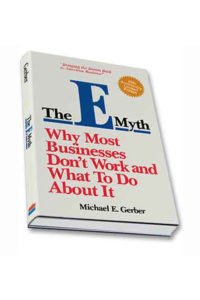
It is my pleasure to welcome Michael E. Gerber to the show. Michael is an American author and Founder of Michael E Gerber Companies, a business skills training company based in Carlsbad, California. A few of his great books include the small business classic, The E-Myth, as well as Awakening the Entrepreneur Within. Here are some interesting stats about his book, The E-Myth. It was originally published in 1986. It has sold millions upon millions of copies. In 2011, it was named the bestselling business book of all time. It has sold in 145 countries. It was translated into 29 languages and taught in 118 universities. That is unbelievable. Inc. Magazine calls Michael the World’s Number One Small Business Guru. With that, Michael, welcome to the show.
I’m delighted to be here.
Michael, it’s an honor to have you on. I read your book The E-Myth and it changed my perspective on business. I didn’t look at the business being layered the way you have it and how you migrate from being this technician of a person and you are the business, and then to succeed in business. You morph that into becoming something that is not you anymore. You’ve disconnected yourself from the business, but I’m getting ahead of myself here. Let’s start with you, I would assume that most of our audience know who you are or has at least heard of you. For those that don’t know, let’s start with a little bit about your journey because I know you stumbled into the world of small business. Tell us how your journey started.
It was simple and a complete accident. I was on my way from one place in California to Northern California and we stopped over at my brother-in-law’s home to say hi. We hadn’t seen him for a couple of years. What started out as dropping off and saying, hi, ended up staying there for a couple of weeks because, Ace, my brother-in-law and I had some way wonderful synergy between our philosophies on life. Ace thought I was radically the supreme in what I was doing. I thought Ace was a fascinating guy in many cases. Ace came to me and he said to me, “Michael, I’d like you to come and visit one of my clients.” Ace owned a small ad agency in Silicon Valley and he said, “He can’t convert our leads into sales. Would you come and meet with them?” I said, “I don’t know why I would do that, Ace. First of all, I don’t know anything about business.” This was before Michael Gerber and business. I certainly don’t know anything about high-tech. He said, “Michael, you know more than you think you knew. For the sake of our friendship, come and meet with them, and let’s see what happens.” I did, and Ace introduced me to Bob, his client. Ace said, “Bob and Michael, I’m taking off for an hour. I’ll come back and pick Michael up, get to know each other.” He took off.
I was there with Bob not knowing anything about business and Bob not knowing anything about me. He asked me, “What do you know about my business, Michael?” I said, “Nothing, Bob.” He said, “What do you know about our product?” I said, “Less than that, Bob.” He said, “Michael, if you don’t know anything about my business and you don’t know anything about my product, how can you help me?” I said, “I haven’t a clue, Bob. Ace thinks I can. You like Ace, I like Ace and we got an hour to kill. Let’s see what happens.” That’s what happened. I started the conversation with Bob by asking questions. The assumption was on my part that I didn’t know anything about business and that Bob did because he owned one. Every single time I asked him a question, Bob would give me an anecdotal answer. The more questions I asked, the more it became obvious to me that Bob didn’t know anything about business. I was suddenly aware that I did know something. The thing that I knew is that selling is a system and I knew that because interestingly, a long time before that, I was selling encyclopedias door-to-door.
When I learned how to sell encyclopedias door-to-door, I learned how to memorize the system for selling encyclopedias door-to-door and because I was a musician, memorizing the words was simple for me. I realized that Bob didn’t have a system. I said that to Bob, “Bob, your problem is you don’t have a selling system.” He said, “What’s a selling system?” I said, “That’s a fascinating question, but it’s simply the process that your salespeople use in order to open and then close the sale.” He said, “I’ve never heard of such a thing.” I said, “It’s obvious because you don’t have one and every single one of your ‘salespeople’ who are ultimately sales engineers, they had to be engineers.” He thought in order to understand his high-tech product and they had some sales experience. They’re all doing it differently one to the other. That doesn’t work. Bob said to me, “Can you create a selling system for me?” Given how I am, I said, “Sure.” Ace picked me up and he says, “Michael, what happened?” I said, “I’m consulting with Bob to create a selling system for his company.” He says, “I don’t know Bob and you are you going to do that. You don’t know anything about business.” I simply said, “Ace, you told me I did and I discovered I did.” That was the beginning. Understand, Marco, I was 40 years of age when that happened.
Up to that point in time, I was not interested in business at all. I was simply doing this, doing that. I was what I call a Wandering Jew. I was looking for what I was here to do. I hadn’t found it. Suddenly, I’m working with Bob and Ace’s ad agency. I came to the realization that I knew something critical to Bob’s business, but not only to his selling system but because as I became involved in it and I realized, there was no system for doing anything in Bob’s business. There was no management and marketing system. There were no systems in Bob’s business. There were just guys doing the work. As we began to do that, I began to work with client number 2, 3, 4, and each and every one of Ace’s clients was in a different business selling a different product. Every single one of them had identical and the same problem. It came to me that Ace was in the wrong business. The more I came to realize that and the more I stress that with Ace, the more dissatisfied Ace became with my position and what I was doing. What I was doing was truly having a markedly stunning impact on his client companies but he wouldn’t let me do that with his ad agency.
It became obvious to me that I had to leave. Ace brought a guy in to replace me that guy’s name was Tom Travisano. I say, his name was Tom Travisano because after Tom got to experience what I was doing and how he was doing it, he asked me, “Where are you going?” I said, “I’m going to start a company to do this.” He said, “I want to go with you.” At the same time, Tom and I left to create my first business development firm called the Michael Thomas Corporation. I was Michael, he was Thomas. The purpose of that company was to transform the state of small businesses worldwide. That’s what we called our dream to transform the state of small business worldwide by inventing the McDonald’s of small business consulting services. Why McDonald’s? It is the most successful small business in the world. If you could mirror what Ray Kroc did at McDonald’s, I don’t care what business it is. You could transform what you do and do something stunningly successful. That’s what we set out to do.
McDonald’s is the poster child of systems. You’ve said the word systems about twenty times in this path conversation. That seems to be at the heart and the core of The E Myth, which is The Entrepreneurial Myth. For those reading this and wondering, “What does E Myth stand for?” It’s The Entrepreneurial Myth. Before we get to that, I don’t want to leave the story yet. Why did you tell Bob that he was in the wrong business? Did you mean that he was in the wrong industry or he was in the wrong seat, on the bus for his business?
He was in the wrong seat on the bus in his business, but not only that, he simply didn’t understand business and the nature of business. Understanding here, I was completely new to the whole conversation about business, but what I was able to see was that his relationship with his business was extraordinarily dysfunctional. I began to ask the question, “What’s missing in this picture?” Anybody reading, that’s the most critical question every single one of you can ask, “What’s missing in this picture?” To understand that relates to everything it relates to our marriage. It relates to our relationship with our kids and with every single thing we do in our lives. The more you begin to ask that question, the more you’re going to begin to understand that there is something terribly missing in this picture for everyone.
To the degree, you begin to understand that something happens. The something that happens is that breakthrough of consciousness. That’s exquisite when it does take place because it suddenly simply opens the doors to the unknown in a way that transforms the lives of people, no matter who they are, no matter what they do. Real estate investors, you’ve talked about small business owners, students, teachers, professors. It doesn’t matter what we do. What’s missing in this picture is the sum total of the substance of what I learned I was here to do when I began my career and what I’ve become since that time at the age of 40, which is the author of over 30 books. All of which talk about the process of transformation in many different categories in many different ways.
Is your question about, “What’s missing?” More philosophical, or is it a more tactical type of question?
It’s both, but understand when you say, is it philosophical or is it tactical? That’s one of the most important things that have to be addressed. The philosophical and the tactical all live within one world. It’s not the philosophical and the tactical, it’s philosophical, the strategic and the tactical. It’s all combined into what it means to be alive. Without the philosophical, there is no E-Myth and no transformation. Without the philosophical, psychological, sociological, and the immense totality of this, it’s not even interesting. It’s just working.

Let’s dive into The E-Myth or The Entrepreneurial Myth here. Why did you call it a myth? Why is it a myth?
It’s a myth because everybody thinks that anybody who starts their own business is an entrepreneur. The word entrepreneur is banding about for everybody. Anybody who’s a business owner and goes off and starts their own company is supposedly an entrepreneur and 99% of them aren’t. Ninety-nine percent of them have simply created a job for themselves. Ninety-nine percent of them are simply going out to become their boss, and 99% of them are working for a lunatic. They’re working for a lunatic, what’s missing in this picture is about everything. You understand when we begin to work with somebody who owns a business, doing it, busy. When I talked about transformation, I don’t use the word light-year. I mean that we are transforming the state of reality between that human being and everything he or she does. The difference is light-years. The minute you begin to remove yourself from doing it, you remove yourself and move your office down the street.
Ray Kroc’s, corporate headquarters from McDonald’s was down the street from the first McDonald’s hamburger stand. Ray Kroc didn’t have an office in the McDonald’s store. Ray Kroc had an office down the street and the headquarters of McDonald’s. This was with the first store. Ray Kroc didn’t work in McDonald’s. He worked on it. The process of doing that, you understand he wasn’t doing it. He wasn’t making a hamburger, fries, and milkshakes, and so forth. It was, he was viewing it from above. The process of that removal from everything changes.
That was one of my biggest takeaways long ago, Michael, to be on your business, not in your business. If I was to remember one and only one thing from the book, that was it. A lot of people don’t even think about it. It’s a blur of working in and on the business. It’s one and the same to them but when you step back and you look at your business as the separate thing from yourself, it is not you, but something that lives and breathes on its own, then you can have a different mindset. You can take a different approach, broaden your skills, and focus on working on building that business and creating the systems to help automate and build that system and scale it.
It’s significant. If you, Marco, weren’t sitting there interviewing me and you were sitting in an office and somebody else was sitting there interviewing me in your business and you’re viewing it from apart, everything’s changed. You have to be able to acquire that distance and when you acquire that distance when I say the transformation is marketing, it’s huge. We’re in a completely new life. Our work with people who own and operate small companies is to get them to have that experience. First of all, it’s terrifying at the beginning because they haven’t a clue how to relate to it. Once they begin to something dramatic occurs, and that’s why people call me every single day saying, “Michael, you changed my life. I’ve never been the same. It’s astonishing. How come nobody told me this?” People say to me. People reading have to understand how much of their experience is personal. When indeed what we’re driving for is an impersonal experience and one can begin to have an impersonal experience. One can truly begin to transform the experience of other people by creating a system through which it works. Story number 1, 2, 3, 17, 57, 3,642, and on and on. Imagine that.
I’m going to parallel everything that you’re saying and say this to the audience. Everything that Michael was saying, I want you to internalize it and think about it from the perspective of being a real estate investor. I’ve said this many times on this show, being a real estate investor is no different than running and owning your own business. You need to think of it, treat it, and run it as your own business. The next part that I’m going to get into here with Michael will clarify this. My point is that as you read everything Michael said, relate that to your investing journey, regardless of whether you’re starting out and you’re a newbie, or you’re a seasoned real estate investor. Everything that he’s talking about, these principles and concepts, as it applies to businesses, applies to you as a real estate investor because you are running an investing business.
It’s interesting that you say that because it’s obvious that real estate investing is a business, meaning it has all of the component parts of a business. All of those component parts of that business must operate it in a significantly predictable manner and to the degree, it doesn’t, that’s where everything goes wrong. Suddenly, Mary doesn’t show up to do this and John doesn’t show up to do that. Mary didn’t even know this had to be done. John didn’t even know there wasn’t Mary and so forth. The whole thing comes and collapses. Everything is business. My life is a business. Every single thing we do is a business because there is an economic reality to every single thing we do.
That’s an interesting perspective.
That doesn’t mean I’m trivializing what we’re saying, I’m doing something quite different than that. I’m simply looking at it. As a matter of fact, it’s economic, social, relational, spiritual, and philosophical. It’s a whole totality of things and we’re not able to separate from it to see the quadrants and how they meld together into a seamless whole. Until we’re able to do that, we’re missing so much.
Here’s a big a-ha that clarified things in the book. Regardless of whether you’re a real estate investor or a business owner, a business owner needs to cultivate and balance essentially three roles and three mindsets. All of them are necessary to run a business or be a successful investor. You talk about these in the book. I’m going to let you talk about them. The technician is the first one and that was my first a-ha. What are these three roles you talk about in the book? Can you define those three people?
They’re simply the technician, the manager, the entrepreneur. The entrepreneur is what I call the creator. The manager is the organizer. The technician is the doer. The creator, the organizer, and the doer all have a relationship with each other. That individual who “starts the business,” we’ll call it the real estate investor. She doesn’t understand herself as an entrepreneur. She doesn’t understand herself or himself as the creator becomes the manager but because few people manage anything. What she becomes instead is the producer, the doer. She does everything that needs to be done. Her real estate investment depends upon her to do this. If it doesn’t work, she tries harder to do this and she’s doing it all wrong. The minute you see the real estate investor as an entrepreneur, the creator of an enterprise.
The enterprise has a dream, a vision, a purpose, and a mission. The dream is a great result I intend to produce. The vision is the form it takes in relation to real estate investing, the form that real estate investment company takes because I’m not going to be doing all real estate. I’m going to be doing some real estate. Within that some real estate, I’m going to be specific about what real estate? Where is that real estate going to be? We’re going to define that. That’s the vision. The purpose is the story underlying my real estate investment enterprise. I call it an enterprise, but that’s thinking on a grander scale than most of your real estate investment people do. They have a real estate investment job. Effectively, they might invest in a couple of pieces of real estate as opposed to 20, 100, and 3,000 pieces. They’re not an enterprise in most cases but you can see the job from a company of one, Marie’s and Mary’s doing it to a company of 1,000. From a company of 1 to 1,000 and the work we do enable everybody and anybody to traverse that gamut from doing it, to creating an enterprise that gets it done.
Here was my crazy attempt, Michael, to try and map the technician, the manager, and the entrepreneur to the life, times, and journey of a real estate investor. I don’t know how well I did at this, but you tell me if I’m off the mark here. I also wanted to do this to explain it to myself and to try to have our audience relate to this because everybody should pick up The E-Myth Revisited book and read that. You had recommended Awakening the Entrepreneur Within, which I purchased and I have yet to read, but I plan to read it because I know it’s going to be a great book. Here’s the way I look at it. The technician, in our case, as real estate investors, still being business people are what I will refer to as the solo investor, much like what you call a solopreneur. That’s the person who starts out fixing and flipping properties. They’re all hands-on. They’re handling virtually everything. They’re likely to self-manage their own properties, but that’s the technician. They don’t have a team. They’re not outsourcing or offloading anything. Maybe they migrate to a position like a manager. They are building a business. They buy and self-manage their own properties and they’re working in their business. They’re self-managing. They’re managing the people and they’re heavily involved in it, but ultimately, they want to get to the entrepreneurial level.
The way I look at that is what we talk about and teach all the time through the show and our team of investment counselors and that is to be a truly passive real estate investor. That means you have a team that is doing everything. You’re the owner and you think of yourself as the CEO of the company, but you’ve outsourced everything. You own or control all your real estate, but you have property managers, attorneys, CPAs. You have every rule filled by someone that is not yourself. You’re profiting from your enterprise of investment properties. Is that a fair mapping of those three?

It’s perfect. Let’s change the word you use passive. The entrepreneur is not passive. The entrepreneur is strategic. Effectively, the entrepreneur has a leadership role every single day, but in a completely different way than the producers, doers, accountant, CPA, attorney, framer, plumber, etc. His or her role is the significant role that binds all of these people together into an enterprise. In short, she creates the world within which they live, but that’s not passive. That’s simply a higher form of active like Ray Kroc. He wasn’t passive at McDonald’s. The CEO of a major corporation isn’t passive in that corporation. They’re strategically active in that organization to orient, design, build, launch, and grow that organization in a specific way. It’s that specific way and that mindset that I’ve written about, and that we’ve applied with the hundreds of thousands of small companies we’ve worked with over the years.
That’s another way of saying that you’re working on your real estate business, not in your real estate business. You’re taking a high-level strategic role in conducting and running all the pieces.
Somebody has to.
It’s you. It’s your business and your empire and that’s why I say it’s a business.
You got it. That’s why I call it the difference between a job, a business, and an enterprise. A job is where you’re doing everything. A business is where you have managers who are managing what those technicians are doing. An enterprise is where you are the leader of managers who is organizing the business model that you’ve applied the brand of investment that you are making. The thing that differentiates your investment company from everybody else who’s doing it.
I’m interested to hear what you’re going to say to my next question. This will help complete the whole concept of The E-Myth and your book. We’re scratching the surface here. I would love people to read your books. A typical small business develops across three phases, as you outlined from infancy to maturity, which only makes sense. You say that a lot of them many have failed before reaching maturity. First of all, why do most businesses fail before they reach maturity? Whether before or after, describe these three phases that you talk about in your book?
They fail to reach maturity because the owner fails to reach maturity. You have to understand all of this is a product of the mindset of that person I’m calling the entrepreneur. The owner doesn’t transfer from the doer to the creator and doesn’t understand the difference between the two. The company will always consume that individual. That individual will always be overwhelmed.
We’ve all been there.
“Why don’t they do what I said? Why don’t they do what I tell them to do? I have to do everything myself.” It’s patently obvious, the minute one has the experience of doing it. This is the liberating factor in all of that. That’s why my book had such a profound impact on many people. That’s why when people read it, they suddenly say, “You’re talking about me, Michael.” In the book E-Myth Revisited, I’m talking about Sarah. Sarah is the pie maker. I get people all the time saying, “I am Sarah. No kidding.” That’s the problem. That’s also the opportunity. When you get what I’m saying to you, you can suddenly see the gap between where you are and where you could be if you’re willing to go through the process.
Some people work endless hours, 12, 14 hours a day working in their business they think they’re working on their business. When people ask them, “How’s business?” “I’m busy. Things are great. I’m working fourteen hours a day. I couldn’t be happier.” They wear it like a badge of honor. I was in that camp. I used to think that, “Things are great because I have this small business that I run and I’m working 5, 6, 7 days a week, 10, 12 hours a day.” I thought I was proud of that but I’m looking back and thinking, “That’s a bunch of crap. I should be embarrassed about that.” I should be saying, “I’m working on my business four hours a day because I have a smart team that’s better than myself at doing these functions and roles.” I own a successful business that I only need to spend 4 or 2 hours a day in.
Let me correct what you said, “Because I have a smart team,” change that, “Because I have a smart system.” It’s the system. It’s not the team. It is not people dependent. It’s systems dependent. It’s how it’s done, not who is doing it. You can’t replace who you could own the replace how. When you begin to understand that a business becomes people dependent, they’ve cut you by the short hairs.
This is why you put emphasis on systems. Everything is about systems because it’s a framework that almost anybody can follow. This is why you keep using Ray Kroc and McDonald’s as an example.
It works. When I say, systems don’t turn it into a technology, it’s simple functionality. I have a way of telling this story. You can replicate my way of telling this story. You can tell my story as well as I can tell my story. You can do that by simply reading my book and then reading it again. My co-author, Ken Goodrich in the book, The E-Myth HVAC Contractor is one of nineteen co-authors we have of nineteen vertical books, The E-Myth Real Estate Investor, The E-Myth Chiropractor, The E-Myth Attorney, etc. Ken Goodrich understood the minute he did this, he read it once. He read it 39 times. He grew a company from bankruptcy to $200 million a year HVAC Company. He did that by following this system step by step. When I say that, I mean that the system is the solution. “No, not like that. Like this. You do it.” Everybody’s doing it. It’s our way. Many of you understand the power of that. You understand the secret underlying McDonald’s, IBM or name it.
That is the most effective and least painful route to essentially grow scale and succeed. Not just in business, but in life and your relationships, whatever you do, swimming, you name it.

It’s the only way.
That makes complete sense. Let’s start to wind this down. I don’t know if these are your rules for success. These are things you’ve said that I believe are rules for success. I’ve heard you say, “To be an incredible student.” This goes back years ago this was on a video of yours. I don’t know if you still say this, “Become an incredible student.” I assume, what you mean by that is to become a perpetual student and constantly educate and learn.
Yes, you’re constantly looking at it, whatever it may be. I said it, and I’m going to repeat it. What’s missing in this picture? I’m saying that because I’m not getting or producing optimal results. Nobody is producing optimal results. When I say optimal, I mean optimal. Could you be better at real estate investing? Could you have a better process for selecting real estate to invest in? Could you have a better process for monetizing your real estate investments? You could, but everything you see around you, including yourself is simply waiting to be improved. That’s why I say the three critical criteria, innovation, quantification, orchestration. Innovation, continuous improvement, quantification know the numbers and orchestration turnkey it. It’s simple, continually improve it, measures its improvement and once it is improved, turn it into a system orchestration and then you own it and then go to work on that system, improving, quantify, and orchestrate it. That’s the process of business development and life development. That’s the process of developing anything.
I’m listening to everything you’re saying with two sets of ears, one from being a business owner and running my businesses. Second, as a real estate investor and how I can imply the exact same things that you’re talking about to my real estate investing business and journey. There’s innovation, absolutely there’s quantification and certainly orchestration because I am overseeing and managing the different parts. Not managing in the sense of hands-on managing, but keeping track of the income and expenses that are happening with each of my properties in the different markets and dealing with my property managers as they are essentially on the front line managing my assets. I’m thinking through this and listening with two sets of ears and I’m hoping that the audience too is also having the same takeaways or thoughts. The thought process that I’m having as it relates to real estate investing. Last thing, Michael, I wrote down a couple of notes, innovation is a big one. Maybe let me ask you about that. You talk about learning how to communicate. I’m left in the dark on that one. Can you maybe elaborate on what you mean by that?
Learning how to communicate, I talk about five essential skills to everybody. Concentration is the first and that’s my ability to be present. That means my ability to be here with you, not going there, not going here, and not thinking about that not thinking about being here. That’s concentration. The second skill is discrimination. If the concentration is the ability to focus my attention, then discrimination is my ability to choose what to focus my attention on because I can’t focus my attention on everything. Once I am capable of developing my martial arts skill of concentration, my black belt of concentration, then I am going to apply it. The third skill is organization, and it’s the skill through which I turn chaos into order. Order is a paramount requirement of your real estate investment enterprise. The organization of your real estate investment enterprise is critical. The fourth skill is innovation and I call it the best way of skill. That means you’re continually looking for a better way because you will never know the best way. Finally, communication, which is what we started, which means the process through which I’m capable of engaging with another, for the purpose at hand.
I understand I said for the purpose at hand because I’m never engaging with another, for all purposes. I’m engaging with another, for the purpose at hand. If I’m the be able to concentrate, discriminate, organized, and innovate how I think about the purpose at hand, that can organize my communication with everyone into categories of communication that I can go to work on and improve. “I didn’t do that well. I could do that better.” I can say that about my communication with my wife, with an investor, and with a client. I can begin to organize my relationships, my client, my wife’s relationship, my partner relationship into categories of relationship, each of which called for communication. I can go to work on that communication and improve upon it. That takes us back to this conversation about being a student. I’m simply a student of life.
I’m sure all of that leads to better clarity and focus and I’m sure less stress.
I could’ve done that better. What’s missing in this picture? I wasn’t here when I did that. I wasn’t there when I said that. I didn’t think about her when I was in that conversation. I was thinking about something else.
I’m sure that’s in an effort to strive for excellence, not perfection because you can never achieve perfection. You’ll drive yourself crazy.
That’s why I say it’s never the best way, it’s a better way. There is no perfect relationship. Not even my relationship with God. Given that I know I’m human, then I’m going to give up the possibility of having a perfect relationship with myself, let alone with you or with anyone but I can improve upon it. It becomes a system. What’s the system? It’s simply a way we do it. That’s all the system is, “This is how I deal with here.” Every single one of the people reading this can get a clear taste of this. I’ve spoken to you about our school.
I want to end with that. If you want to bring it up, go for it.
We call it Radical U. Radical because it is radical, U because it’s about you, but it’s also a university. It’s a university of creativity, growth, scale, and opportunity, which traverses what I call the 8 Fold Path. To every single one of the people who are reading, there’s a process for all of this. We call it the 8 Fold Path Path. I’ll tell you what the eight steps in the 8 Fold Path are a dream, vision, purpose, mission, job, practice, business, and enterprise. I have a dream, vision, purpose, mission, job, practice, business, and enterprise. From steps 1 to 8, it’s all a hierarchy of steps. I don’t start with the job. I start with the dream. The dream is a great result I intend to produce. I’m in the real estate investment business and I want to create a great result. What is that great result? Once I understand what the great result is, I want to transform the state of small business worldwide.
That is our dream. In order to transform the state of small businesses worldwide, I have to transform the state of entrepreneurship worldwide. Once I’ve transformed the state of small business and entrepreneurship worldwide, we will inevitably transform the state of economic development worldwide, which means that every single solitary human being on the planet can Awakening the Entrepreneur Within. I have a dream, vision, purpose, mission, job, practice, business, and enterprise steps 1 through 8. Every single step you take, you can take it Radical U and you can join Radical U, get this, for $10. You can join us for one whole year 52 weekly sessions on video that will walk you through the process of discovering your dream, vision, purpose, and mission in year one for $10.
That’s a steal of a deal. You have far underpriced it.
When somebody said to me, “How much we’re going to charge for it?” I said, “It’s $479.40.” That’s what the price has been for a year. That was the hell with it. Let’s give it away and see what happens. Somebody said, “You can’t give it away. You got to charge them something, how much?” I said, “Okay, $10.” Every single one of you who is reading this, I’m saying to you, you can join us for $10 one time and you will understand what your dream, vision, purpose, and mission are. I don’t care what business you’re in.
You should easily 100 X that investment from the content of your program, if not 1,000 or 10,000 times that investment. You’re crazy not to spend the $10 on yourself to educate yourself. That’s incredible. You told me about it when we had our conversation and I signed up immediately. I’m starting to get into it. It’s good. It’s well-produced. Michael, this has been brilliant, tons of great content. This has been thought-provoking and I’m sure people reading this are thinking about it, not just from a business perspective, but from a real estate investing business perspective. That’s what I wanted them to take away from it. For those that haven’t read The E-Myth, you should read it. The E-Myth Revisited is the one I’m thinking of specifically and Awakening the Entrepreneur Within, would be a good follow-up to that. Michael, how can people reach out to you not you specifically, but your organization the RadicalU.com?
The easy way is 2020.RadicalU.com and you’re in. That means you’re immediately in Radical U.
Amazon, the world’s biggest bookseller, has all twenty-some books of yours that are not a problem there either. Any final comments, Michael, before we close it off here?
Remember what Marco said. Marco said the one takeaway from the book that has never left his mind is to go to work on it, not in it. I’m saying to every single one of you goes to work on your life, not in your life and your entire relationship with your life will be completely transformed. Trust me in that. Try it. It will blow your mind.
Michael, thank you so much for your contribution and your time. I appreciate it.
Marco, thank you.
Thanks.
—
That was incredibly enlightening and I was looking forward to having Michael on the show. He is someone I look up to and I say that because I’ve read his book. There were two books that I read many years ago, and it helped transform my mindset much like what Rich Dad Poor Dad did in terms of how I looked at things from a financial perspective. I hope you got a lot out of this particular episode. If you did great, leave us a rating and review. I would greatly appreciate that. As you know, I always read the comments, ratings, and reviews that you leave. I always say, thanks in advance for that. In wrapping this up here, if you are interested in what we do here behind the curtain, as an investment company specifically with real estate investing, although there are other things that we have going on, as well as notes investing, promissory notes and a few other types of investments that we have that we don’t put on the public face.
Regardless, go to NoradaRealEstate.com and you can click on the contact form and set up a strategy session with one of our investment counselors. They can help you in mapping out a roadmap to help you build your real estate investing enterprise. That way you can be a strategic, passive real estate investor as we talked about in this episode. Remember to subscribe to the show. If you haven’t already, we are putting out to more than one episode per week and I am answering questions as we go. Thanks for reading. I will see you all on our next episode.
– – – – – – – – – – – – – –
Download your FREE copy of: The Ultimate Guide to Passive Real Estate Investing.
Get your FREE coffee mug by leaving us a Rating and Review on iTunes. Here’s how.
See our available Turnkey Cash-Flow Rental Properties.
Please give us a RATING & REVIEW (Thank you!)