
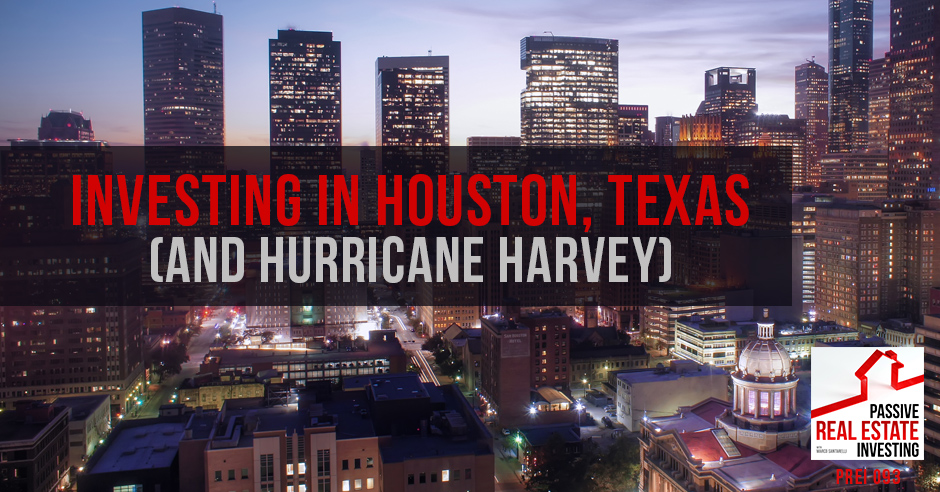
Welcome back to another episode where we’re going to talk about the Houston, Texas market. One thing that we’ve been getting asked a little bit about recently is the effects of Hurricane Harvey. As you know, Hurricane Harvey ripped through the Caribbean and beat up some of the islands down there and hit the coast pretty hard. However, the good news is that there was no bad news. We haven’t heard from any one of our clients that had invested in the Houston market reporting any kind of flooding or damage. That’s a good thing. There’s really one key reason why that was, and we’re going to talk about that today with my guest, Bryan.
Houston is an interesting city. We’ve been there for many, many years. We’ve had a lot of happy clients and success there because it’s such an incredibly diverse and progressive city. It’s the nation’s fourth largest city, growing fast. It’s known as the city of infinite possibilities. It’s quickly approaching six million residents, that’s more than 32 states and it just continues to grow. Strong jobs, strong population growth, a friendly business climate, lots of cheap land to build on, it’s just a great market. Coupled with all that, we have a lot of what we refer to as STEM jobs. STEM meaning science, technology, engineering and math. When you have jobs in the STEM field, what you have are high paying jobs. Roughly 6% of employment in Houston is held by STEM job holders. That adds to equality rental pool, that just means more stable tenants. Houston is drawing businesses in from everywhere as well as new residents. These are not only people who are looking to buy and live there, but also people who are tenants. That’s good for you and I as landlords. That’s what we’re going to talk about today.
If you missed our last episode, be sure to listen to Passive Income with Syndications – Mauricio Rauld.
Enjoy the show!
– – – – – – – – – – – – – –
Download your FREE copy of: The Ultimate Guide to Passive Real Estate Investing.
Get your FREE coffee mug by leaving us a Rating and Review on iTunes. Here’s how.
See our available Turnkey Cash-Flow Rental Properties.
Please give us a RATING & REVIEW (Thank you!)
SUBSCRIBE on iTunes | Stitcher | Podcast Feed
Investing in Houston, Texas (and Hurricane Harvey)
It’s my pleasure to welcome Bryan to the show. Bryan is one of our team members and boots on the ground in the Houston, Texas market. We’ve been working with them for many, many years and have had tremendous success. Bryan, welcome to the show.
Thanks, Marco. It’s a great pleasure to be here.
The reason I wanted to bring you on, Bryan, is because of the recent hurricane in the Houston market. Actually, it hit a major coast line but that was Hurricane Harvey. I know we were talking off air about this briefly, but you had some really interesting things to say about it. I call it the elephant in the room, and to me, it’s just a big question. We’ve had a number of clients ask us this question. I will say that as far as I know, none of our clients who have invested in the Houston market have had any problems or reported problems of after effects from Hurricane Harvey, which is fantastic news. Let me throw it over to you and ask this question. How are things in Houston after Hurricane Harvey?

Marco, I think we’re doing very well. I think one of the things you will learn about, and people should know about Houston, is how resilient this whole market is. We manage a large number of rental properties. We manage 750 rental properties. Out of those properties, we only had fifteen that sustained any flood damage, so that’s 2%. Perhaps we were lucky but I think we really go out of our way not to acquire properties or build properties on land that is subject to flooding. There are some great tools that are available that we utilize all the time to ensure that we don’t buy properties or land that’s in any kind of 100 or 500 area flood zone. It really seemed mundane at some point, and then all of a sudden, you have an event like Harvey which was a historic storm come through. You’re very thankful that one of the processes on your acquisition checklist is to check and see if the property is on a flood zone. It really paid off for us after this last storm, having so few properties that sustained any damage.
I assume you’re referring to FEMA flood zones?
Correct. There are some great tools that we use here and I know they are available in other parts of the country too. Every time we purchase a property, one of the things we do as we pull it up on a map that has the FEMA flood zones outlined on it and if it’s in the flood zone, in the past, we haven’t purchased them. That’s probably why so many of our properties stayed dry during this last bad storm. We’re on the coast and Houston has a history of flooding. It’s something that we’re all aware of here. It’s for people that invest from outside of the area, it’s something that they should be aware of. It really helps to have a provider that’s knowledgeable and will keep you out of those precarious or maybe dangerous areas where they could flood.
The other benefit of being outside of a FEMA flood zone is the lenders, if you’re financing your acquisition, they don’t require you to get flood insurance and so that cuts down on your insurance expense every month, which increases your cashflow. I think that’s a great benefit.
There is a huge difference in insurance rates if you are in the flood zone versus if you’re outside of the flood zone. On a typical rental property, if somebody just can’t sleep at night for fear of flooding, you can buy for somewhere between $400 to $600 on a typical home on a property that is not in a flood zone. Whereas, that same coverage if you’re in the flood zone could be several thousand dollars in insurance.
Here’s a curveball question for you. I’ve seen this happened once before and this was years ago. We had a client purchase a property in an area that was outside of a FEMA flood zone, but the lender came back to them and said, “We know it’s not in a FEMA flood zone but we’re still going to require you to get flood insurance.” How often do you see that happen?
I’ve had it happen to me. There are options in that situation and one of them is go get a survey, which is what I did. When I had the survey company go out, which cost me under $500 to do, but it also revealed that the house was six feet above the flood plain. One of the things that you have to be aware of is that a lot of the insurance companies and lenders even, they’re just not as accurate as somebody who’s here on the ground. They’ll utilize tools sometimes that are actually even a little dated. It happens; I’ve had it happen to me. In that situation, all I did was get a survey that show the property was actually well above the flood plain and I didn’t have to buy the insurance.
Houston is the nation’s fourth largest city, last I checked. It’s somewhere around 5.7 million people. That’s an enormous population, that makes it larger than about 32 of the US states combined. The question now is why invest in Houston, Texas? I certainly can come up with answers to that question but let’s talk about this and break it down. Economically speaking, the one thing I love about Texas is that it’s a business-friendly environment and that’s the reason why so many businesses move there. Toyota, a massive employer here in California has been moving down to the state of Texas and many other companies are moving there, and they bring jobs. You have a business-friendly climate and you have friendly tax laws. This has created a very, very strong job market throughout the state, especially in Houston. Tell us why an investor want to look at Houston from an economic perspective?
You bring up some great points, Marco. I don’t want to get too much into politics but I will tell you that I came to Texas in 1990. It was almost 28 years ago. The Texas economy wasn’t in great shape then. It was in terrible shape because there had been an oil and gas downturn in the commodity price just like we’ve just been through. The economy wasn’t diversified back then. There were people that made very difficult choices back in the mid-90s. There was something called the Texas Economic Development Act that was enacted then. What it was was tax abatement strategies. When you talk about a business-friendly climate, that’s what’s you’re talking about.
In modern day terms, it’s a very salient, very contemporary subject because right now, we’re being bombarded with tax break from the government, all that talk. I can tell you what it did in places like in Texas where they gave businesses huge tax breaks, that’s when they moved in and the jobs and the population came with them. There was a great article that was in the paper about an oil and gas company in The Woodlands, Texas. They’re a huge company, it’s called Anadarko. They were given a huge tax break on their property. In fact, there are several people that work for Anadarko in those towers that they built up in The Woodlands that pay less taxes on their property than Anadarko does for that entire building and complex that they built.
A lot of people screamed back then in the 90s and said, “This isn’t fair.” A lot of the rhetoric was exactly the same that we hear now. The only thing I could tell you is that there were several key players that moved in to the market. Hewlett-Packard was one of them through their compact acquisition when they bought that company. We’re seeing companies like FedEx, Daikin, which is a huge Japanese company that acquired a HVAC company here. We have seen diversification of the economy here because so many companies took advantage of the decrease in taxes. That brought them into the Texas area, brought them into Houston and we’re still seeing the benefit of that today. The growth in jobs and population go hand in hand. Harris County, which is what Houston sits in has been the fastest growing county in the United States for nine out of the last ten years. That’s because people are coming here to take the jobs in places like the Houston Medical Center, which is just south of downtown. It’s the largest medical center in the world. We have seven teaching hospitals here now because they’re getting tax abatement, tax breaks to build and continue to grow.
That’s a huge driver. You’ve got a lot of major employers there. Texas Medical Center is an employer that employs about 50,000 people, right?
Right and it’s huge and growing all the time.
People think of Houston as an energy capital, it’s an economy based on oil and gas, which for the most part it isn’t but it is a major factor.
It’s a huge piece of the economy here.
Energy is a major factor but you’ve also got a big footprint in terms of healthcare, engineering, education and people don’t think of transportation but you are a logistical hub in many ways because you’ve got the port. You also have a major international airport there as well.
There are actually two now. Southwest Airlines flies into Hobby. Hobby Airport is a major hub and they just continue to expand. I understand they’re going to even go into Hawaii next year. In the last two years, Southwest has added major international destinations out of the Houston Hobby Airport.
I don’t know if these counts are correct but Houston is the home of 29 of the nation’s Fortune 500 companies. Of that, sixteen of those are on Fortune 100 Fastest Growing Companies. Is that still true?

I believe it is. Again, you hit the nail on the head. It’s a business-friendly culture. It is a business-friendly environment here. The same is true for people that want to invest in real estate.
The key here is that Houston has been a major metropolitan area for job creation for a number of years now. That’s one of the most important factors when you’re looking at markets and determining where you should be investing is where are their jobs? Where is this job creation? Then you have that in-migration, you have population growth and that pushes demand for housing both sales and rentals. That is a great environment to be in as a landlord.
I have to agree. Again, Marco, I can’t stress enough that the people that we really owe some gratitude to are the people that made the decisions back in the 90s to really go forth and diversify the economy because they took a lot of heat for it. They took some political heat for it at the time. We can sit here now and say that Texas is the second largest economy in the United States. It is. Our economy is bigger than Canada. It’s bigger than South Korea. I think it would be the number ten if we were a standalone country. That’s because of the vision and the foresight of the folks had back then in the 90s to diversify and try to attract these other industries to come in.
It’s hard to poke a hole in the Houston economy picture, isn’t it?
I think we’re so resilient. We’ve just had a much worse oil and gas downturn. The commodity price dropped by 50%. We hemorrhaged oil and gas jobs for the last two years to almost 80,000. I don’t know any place that could hemorrhage 80,000 good jobs. We’re still at the highest employment that the city has ever seen since they’ve been keeping records. We took a storm. We took the worst flood. If there’s one thing that I could leave your listeners with is that Houston is probably the most resilient city in the country.
Let’s segue to housing. Houston, as far as I know, has about 5.7 million residents.
That’s growing. The numbers that we saw this year is at some point, we were supposed to pass 7 million in the greater Houston area.
Population growth is a very strong factor when it comes to demand for housing and also potential appreciation. The thing that’s fighting appreciation growth even though you’ve been seeing pretty strong appreciation there is the availability of land. You have lots of land to build and grow and it’s cheap. You’re not in Boston with mountains and rivers. That kind is a check and balance when it comes to strong population growth that’s being countered by the fact that you have lots of cheap land to build on. You have a low cost of living so you’ve got millions of people, low cost of living, growing demand. What is the housing scenario like? Describe the housing picture in terms of sales, demand, limited supply, which is a problem we’re seeing all around the country in terms of availability of product? What are you guys seeing there?
That’s our biggest problem as well is trying to keep up and acquire properties. We started in March of 2017. We started building new construction as well as doing rehabs. It has been a challenge to find rehab properties as well as the lots that we need to build a new construction on. It continues to be. You mentioned the sprawl, if you will. Harris County is almost 1,800 square miles. If you look at the greater Houston area in not only Harris County, but the ones that surround it, we’re about half the size in New Jersey. That is something that continues to grow. One of the things we don’t do a good job of is rapid or mass transit, but we build roads here. One of the things that keeps the economy and everything else chugging along is the building of new roads and new infrastructure. We have seen another major artery that’s being created and is now open here. It’s called the Grand Parkway Texas 99. You’re seeing a lot of housing that’s being in development and not just housing but businesses too that are being built along this new toll road.
When I came here 27 years ago, there was a new toll road that had just been opened that is now one of the major arteries within the city. It’s called the Sam Houston Toll Road Beltway 8. This has the potential to be every bit as much of a bonus that was. We’re seeing it already. We’re seeing businesses that are moving in and relocating to this new area. We’re seeing major aggregation of acreage being put together and then sold to different communities, master plan community builders. It’s pretty exciting actually because I’ve seen it now for 25 years and I don’t see any signs of it slowing down.
Building infrastructure is critically important for a growing market especially at the pace that Houston and the Texas markets have been growing. If you can’t keep up with that, you’re going to have a crippled environment. I’ve seen a city where the population was growing so fast that they cannot keep up with the road system. Rush hour went from 30 minutes to two hours in just a matter of a few years because you just can’t build roads fast enough to keep up with rapid population growth.
Marco, I don’t want to leave anybody with the impression, we have those issues too. Overall, our people and some of the people that are in the leadership roles around here have done a better job of planning and making those things happen. One of the companies that came in and bought a major track of land was ExxonMobil up on the north side of town. They built close to a 400-acre campus. That was one of their demands, that this new toll road be built and be opened in time so that helps to drive all these other things that we’re talking about. The companies that have come in here have pretty much demanded that the infrastructure keep up.
Is that what drove the growth up in Spring, Texas?
Absolutely. ExxonMobil built a beautiful campus up there. What we’re seeing is there’s long been what they call the Energy Corridor that is along I-10 West as you leave downtown gong towards Katy. Now, on the north side of town, you’re seeing almost an Energy Corridor north because with ExxonMobil comes several companies that support them and they’ve all needed to grow up in that area as well. It’s been a great thing. It really has. We’ve added a lot of jobs. ExxonMobil is what they call a fully-integrated company. While the low commodity price is probably hurting the exploration and production on the other end of the business, which is the petrochemicals and refining, they’re absolutely booming right now.
It’s been booming for years. We were selling properties in Spring, Texas four, five, six years ago.
It’s still every bit as good as it was then. It shows no sign of slowing down.
I remember years ago, this wasn’t that long ago but PricewaterhouseCoopers has ranked Houston the number one market in Texas at least for investors. That’s a very notable thing to take away. In terms of the rental market there, how is the rental market doing? What’s the demand like? I know that when properties appreciate, they tend to appreciate faster than rental rates do and so that compresses the cap rates. It’s going to affect everybody of course, but describe the rental market and what you’re seeing there.

Marco, you’re absolutely right. You hit the nail in the head. They do get compressed and we were getting compressed slightly. Not out of the ordinary or anything like that because again, the population growth here is phenomenal. It has outpaced any other city in Texas. I know that the Dallas-Fort Worth area has also done really well, but again, Harris County was leading the nation for so long. One of the factors here recently, and we’ll go back to Harvey, there were many apartments, homes, there were many properties that were flooded during the storm. There has been an actual compression in the availability of available housing here. One of the things that we see year in and year out is this is the time of year in the fall when rentals tend to slow down. It’s superheated all summer while people are trying to move around and get their kids in the school districts they want to be and all that. After Labor Day, we tend to see a decline in the activity. It really gets slow around the holidays. We got hit by Harvey right at Labor Day and we have not seen any drop-off in the rental activity, which is a little unusual very honestly but it’s a good sign. If you have available properties now that are in good shape, that are rehabbed, that are ready to go, you’re not having any problem renting on whatsoever here. There are really no signs because of the population growth that we’re going to have any over-inventory, if anything we’re under inventoried for the future.
If you were to take out a crystal ball and do a forecast for the next 12 to 24 months in terms of the rental market, eventually the dust will settle in terms of the aftermath with Hurricane Harvey. I don’t know if that’s a year or two years or even three years from now. What’s your prediction for the next one to two, maybe three years in terms of rentals in the rental market there?
I see it continuing to grow, Marco. One of the things that I see is I think a lot of markets, you will hear people say, “It could be two or three years to recover.” Houston recovers much faster than that. It’s like when you go to the doctor and he tells you it’s going to be this many months to recover and you come back in half that time. That’s what Houston has always done. Flooding is not new here. We’re getting really good at the population growth and managing that as well. There’s a super article in the LA Times that came up at summer about the diversity of the population here in Houston. We’re more diverse than New York City right now. We surpassed them in 2016 as being the most racially diverse city in the country. I was really pleased to see the LA Times say that Houston is really an example of an area that’s getting it right. You haven’t seen anything get really out of control. You haven’t seen crime rates out of control. There’s not poverty out of control. Everything is growing at a very good, sustainable rate. That’s why I see the same thing happening for the rental market. I don’t see it being over inventoried if anything because of the population continuing to move here. I think there’s more opportunity in the next two to three years.
Instead of Houston being known as the City of Infinite Possibilities, maybe they should rebrand that and call it Houston, The City of Resilience.
I think they’d be spot on. They really would.
It reminds me of NASA, the famous saying, “Houston we’ve got a problem.” It seems like you guys can weather through all those problems. You fixed it more than once. It’s fantastic. Let’s talk about products here. Most of what we sell in terms of turnkey rental properties are single-family detached. I don’t see duplexes and fourplexes all that often although we get batches of new construction fourplexes from time to time. I’d say 95% of the products are completely renovated turnkey rental properties, single-family detached. I’m going to let you describe a typical property, what is it? What does it look like? What is the price range of that product?
A typical home here is three-bedroom, two-bath, two-car garage. It’s in a nice suburb. I always talk in terms of A, D and C neighborhoods. The A neighborhoods are very affluent. The C neighborhoods are not. The C neighborhoods are where you have your ghetto, it’s the barrio. I have friends that make a lot of money working in those areas but it’s a property management challenge to operate in those areas. The area that we tend to do the best in is the B areas. That’s where we operate in throughout most of the market. That’s because we can go there and we can acquire properties that will rent, if not pretty close to 1% of their purchase price. If we go too much into the A neighborhood, it’s too expensive to purchase the property and we can’t command enough rent to make it a good return for the investor. We’re looking at price points in the Houston area that are anywhere from $100,000 and occasionally will get a little bit lower than that but our real sweet spot is about $130,000 to $150,000 and we may go up to $180,000. I would say the $130,000, $150,000 to $160,000 price point is our sweet spot. We’re trying to look at the best return for the investors on a turnkey where they can come in and get the best rent to value ratio.
In those Houston suburbs with the $130,000 to $150,000 price properties those are what you’re describing as typically a B class neighborhood?
Correct, solid Bs.
I would imagine that in the $130,000 range in the solid B. In terms of rent to value ratio, just to make sure that everyone’s expectations are not set too high and they’re set accordingly, we don’t always see a 1% rent to value ratio. Sometimes it’s a little lower like .9%. That’s still okay especially in an area that has strong growth, large rental pool, get appreciation potential. That’s the give and the take. Especially today with inventory levels low, the supply is low, demand is strong. Not just from investors but demand is strong for rentals and homeowners people looking to buy and move into product. I just want people’s expectations set accordingly that you’re not always going to find a 1% rent to value ratio or 1% type of product. In fact, we’re seeing a lot of rent to value ratios today coming in around .8% and they’re still good deals. It’s just that’s what the market has moved to. That shouldn’t be a turn off for investors. They should still look at and say, “What’s my medium and long-term prospect with this property, this neighborhood, the tenant class that’s moving in? What is my cashflow today? What could it be in two, three, five years from now? These are all factors I think people need to look at and not just be myopic and look at one thing.
We get a lot of people that come and they say, “I’ve always heard you can’t have cashflow and appreciation.” I guess there are some markets in the country that you either have to choose between one or the other. One of the things that we feel pretty lucky here is you actually can get both. This is an appreciating market that does cashflow. It’s worked out very well for the investors. If you look at the charts for the last 25 years here, you’re not going to see a roller coaster of appreciation. What you’re going to see is steady growth throughout the market for that whole time. One of the greatest ones as you mentioned, Spring, earlier. Sprint, Texas has a great history of appreciation. It has been very steady. It just keeps going every year.
I always say that the market is really what sets the stage for what happens within the market. You talk about appreciation although we don’t talk about appreciation a whole heck of a lot because we lead with cashflow. The market is certainly important but then you have submarkets. You have cities within that large metropolitan area, then within those, you have neighborhoods. You start with a big picture, you take a top down approach. You look at the market, and Houston is certainly very favorable in every way. Then you have to look at neighborhoods too. The reason I say that is we get calls from people regularly that start off looking at these $40,000, $50,000, $60,000 properties that are being sold by other turnkey providers, if you will. The problem with that is that these properties may or may not be in a good overall market but they’re in very sketchy neighborhoods. That $50,000 property was probably a $50,000 property ten years ago. You really can’t expect growth and appreciation in a lot of those neighborhoods. You’re going to see a lot of problematic issues in terms of property management and tenant hassles.
We have them here, Marco. We have seen neighborhoods and I have some friends that make a lot of money doing business in those neighborhoods because a lot of times there are some great opportunity but only if you’re set up to deal with it and only if your property management is set up to work in that environment, which is a very challenging environment to work in. We find that the B neighborhoods that we work in and the areas that we’d like to do business, and it’s much safer for the vast majority of investors. There’s far less risk than if you’re in those very cheap properties that are in very questionable neighborhoods.
I always tell investors, “If you’re just starting out, this is your first or second or third property, you definitely don’t want to be in C or D class neighborhoods. You want to start off with something that is going to be very low hassle, no brain damage, quality type tenants, stable neighborhood.” If you are seasoned investor, you have a large portfolio and you want to sprinkle in some $50,000, $60,000 properties in C class neighborhoods, great. It’s not going to affect you in the grand scheme of things. The overall picture is not going to be affected but that’s really not the starting point. So many investors make that mistake, what I’ll call a mistake by thinking that they’re going to start “small” or “dip their toe in the water” and invest in these lower end, low cost properties. I strongly recommend avoiding doing anything like that.
Is there anything we didn’t cover today that you’d like to mention about the Houston market, investing in Houston, recommendations? We covered a lot but I’m wondering if there’s anything else you want to add?
If I could sum it up, I would say one of the things I’ve always enjoyed investing here for the last 25 years is this is a very forgiving market. It has large, critical mass, which helps it withstand everything from natural disasters to turns in economic sectors to just overall bad turns in the economy. We got beat up really badly here in the 80s and they learned from it and made corrections and set the right course so that when 2008 hit here, the recovery was much quicker than almost anywhere else in the country. I think that’s why you’re seeing so many people are coming and moving to this market to take advantage of the economy and the job growth. That looks like it’s going to continue to be a growth engine for a long period of time. I don’t see that ending anytime soon.
You got a tax-free state. You have living cost that are well below the national average. Housing cost that are below the national average. You’ve got a great environment, great weather.
We’re something like 26% below the median here for our housing prices. When people look for place to go to find good jobs, our millennial population is one of the fastest growing anywhere. Young people are moving here to start their lives and start their careers.
That’s a major demographic to pay attention too because the leading edge of that millennial demographic is starting to buy their first home. The majority of millennials are not yet, but the day will come where they will. Right now, if they’re not living at home with mom and dad, they’re renting or they’re going to be renting. Then eventually, when they get to their 30s, they’re probably going to be buying. You want to keep an eye on the millennials. It’s a huge demographic. We love Houston. I think it’s a great market. If anybody is interested in learning more, by all means, contact your investment counselor here. If you don’t have an investment counselor with us yet, just give us a call or shoot us an email. We’ll connect you.
Bryan, I want to thank you for your time today. You’re a wealth of knowledge. I’m sure we’ll be having you back on the show in the near future.
Thanks, Marco. I think your company is doing a great job of helping to educate these people on the benefits and all the good things that come with real estate investing. There’s so much that you can do with real estate that you can’t do with other investments. We find that the people that come to us from your company are some of the best, most informed investors that we get. Thank you for all the referrals, and please keep them coming.
That’s very kind, Bryan. Thank you. We have a great audience. We have very well-educated investors. We love working with them because they come to us having educated themselves through books and podcasts like our own. They’re just a lot of fun to work with. Thank you for that. Bryan, thanks for your time.
Thank you.
– – – – – – – – – – – – – –
Download your FREE copy of: The Ultimate Guide to Passive Real Estate Investing.
Get your FREE coffee mug by leaving us a Rating and Review on iTunes. Here’s how.
See our available Turnkey Cash-Flow Rental Properties.
Please give us a RATING & REVIEW (Thank you!)