
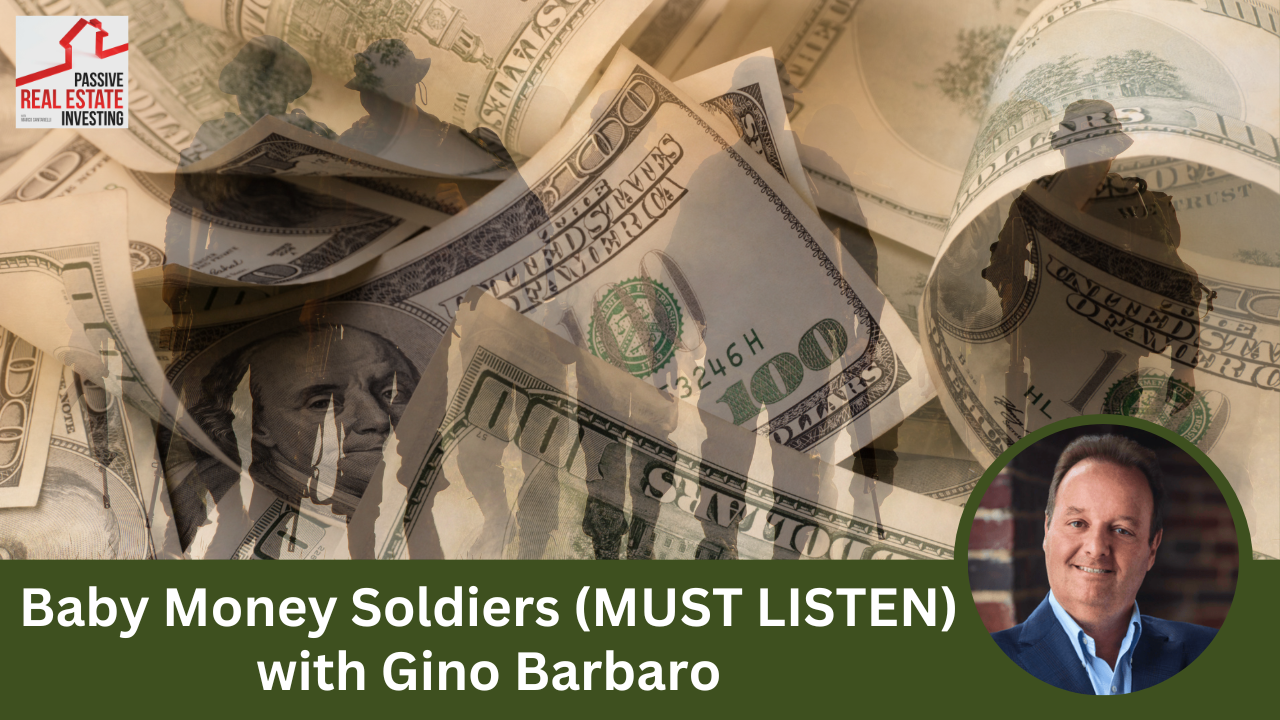
Hello my friends, and welcome to another episode of Passive Real Estate Investing. I’m your host, Marco Santarelli. I have an interesting guest today, an exciting show, someone who is a friend of mine, but I haven’t interviewed him for a while, and so I’m excited to have him on. We’ve had like a couple of hours of conversation already today before recording this interview. But my guest is Gino, and I always pronounce his name in so many different ways, Barobaro, but Barbero, if you want, <laugh>. We’re both Italians, and actually we both come from the same region of Italy. So Gino is an investor. He’s a business owner, he’s an author. He is also an entrepreneur. And as an entrepreneur, amazing guy, he’s grown his real estate portfolio to over 2100 multifamily units representing close to $300 million in assets under management, which is phenomenal.
And I’ll tell you why I am so impressed with him here in a few minutes. But he’s also the bestselling author of three books, Wheelbarrow Profits, which is his hardcore real estate book. He also has a book called The Honey Bee, and then one that’s a little bit more about food, but Family, Food and Friars, or, and the Friars, interestingly enough, he lives in St. Augustine, Florida, which is an area that I love, and I’m looking to potentially get a second home in that area. And he lives with his beautiful wife, Julia. And yes, six children.
FREE copy of The Ultimate Guide to Passive Real Estate Investing.
If you missed our last episode, be sure to listen to Ask Marco – More Great Investor Questions!
Gino, welcome to the show.
Marco. When you said an interesting, I wasn’t sure what you meant by that, but it’s been an interesting life for me. How you doing, brother?
I’m doing good. How are you?
I’m doing good. When you said family food in the friars, your listeners must be like, what the heck is he talking about? I was the pizza guy. Jake was the drug rep, and I was in the restaurant business for years and years and years. And that was my passion. And I know you’re gonna get into this, but real estate really took a hold of me back in 2008 and oh nine, and that’s how I sort of transitioned out of the restaurant industry.
<Laugh>. And you’re Italian and you love food, so family, food and friars completely makes sense. <Laugh>
To you. It does. Right?
Yeah. No, we, we live, we live for food. We live to live. I mean, we don’t live to work. I mean, that’s, yes, that’s the European culture, and that’s certainly the Italian culture. You know, we, a lot of Americans, interestingly enough, you know, live to work, whereas the way we look at is we work to live. You know, we don’t want to just be working all the time. We wanna live life. Mm-Hmm.
<Affirmative>, I agree a hundred percent. Yeah.
Cool. Well, it’s good having you back on the show. The funny thing I mentioned and, and for, you know, just kind of a, a little fun fact, when we originally had our first podcast interview you and I both ways, you and your partner Jake, were literally on a sofa in a room that had a foosball table. <Laugh>, that was your start. Yes. You’ve come a long way, my friend. Yes.
Well, Marco, you said something insightful on my show. You know, we recorded go to the Jake and Gino channel. I, I interviewed Marco, and what you said was ready, fire, and aim. And I think that’s what Jake and I were doing on that couch. We weren’t ready to get everything right. The lighting, the microphone, the, the, the, the look. We just said, let’s start. And what’s the worst thing that can happen? We have a terrible interview at Marco, but we’ll learn something from it. And it’s the same thing with anything in life. Awkwardness. When you feel awkward in the beginning, that’s the sign that you’re doing something right. That you’re stepping outta your comfort zone. And I’m glad that you reminded me about that. ’cause It makes me feel good. That’s, it’s, we live in the gap in the gain, as Dr. Ben Hardy says, we’re always thinking about, oh, what’s ahead, what’s ahead, what’s ahead?
And you remind me of the gain, how far I’ve come, and how clumsy and how terrible I might have sounded five years ago. And I’ve gotten a lot better now. I have a long way to go. As we like to, like you. We live in the gap. Say, well, what am I gonna be in the next five years? But let’s at least stop and appreciate what we’ve done. You, especially for 20 years, you’ve been doing this, you’re looking at your next venture. But let’s stop and appreciate where we’ve come from mm-hmm. <Affirmative> and all the things that we’ve accomplished, and sit with that for a few minutes and enjoy the day, and then let’s conquer the rest of our tasks.
Yeah, no, that’s a great point. You should look back and recognize the accomplishments you’ve made and then congratulate yourself, appreciate what you’ve done, recognize what you’ve learned and accomplished, and then just continue moving forward to your next goal and your next goal. I mean, that’s just, I think, what a lot of entrepreneurs do. So mm-hmm. <Affirmative>, but all that. Gino is a good segue for me to ask you to tell our audience, our listeners, more about yourself. Like, give us a bit of a history and who you are and what you do.
The 32nd version, very similar to your story, two immigrant parents came from Italy looking for a better life. My dad got into the restaurant business and I was a seven year old going to work with my father. I remember him handing me the Windex bottles, cleaning the baseboards, going in the kitchen, fileting chicken cutlets at seven years of age, having a knife working in the fryer. I, I loved working in the kitchen, and it was just part of who I was, that hard work ethic. I went to college, hated working corporate, didn’t want the cubicle life, didn’t want to, you know, commute to New York City every day from Westchester County. So I said, dad, let’s buy a restaurant. And at the age of 24 years old, May 19th, 1994, that was my day, that’s when I bought the restaurant. And I owned, operated the restaurant with my father and mom and my brother till 2016.
But 2007, Marco, for me, was the turning point. That’s when my dad passed away. And I remember when he passed away, I remember saying to myself, am I living his dream or am I living my dream? It was so, the restaurant and me and him were so intertwined. I loved working there, but it really wasn’t my vision. And I wanted to scale. I wanted to create some type of financial freedom, and I couldn’t do that through the restaurant. I didn’t know how to do that. I read the book, t Har Backer’s Secrets to The Millionaire Mind. And that changed everything for me. I’m like, I am that guy who’s been blaming everybody. Your fruits are in your roots. I don’t have the skills I need to learn. I, I, you know, went out. I found a bunch of mentors in real estate. I’d made a bunch of bad mistakes prior.
And I got into this multifamily thing. I met Jake in 2009. He was the pharmaceutical rep coming into the restaurant, getting those orders, bringing ’em to the doctor’s offices. And he’s like, I wanna do real estate too. He moves down to Knoxville in 2011. We start the partnership. It takes us 18 months to find that first deal. And, and we do in 2013. And I guess the rest is history. There’d been a lot of bumps in the road. One thing that you had mentioned, most of these assets, Jake, myself and a partner Mike, own ourselves. We, we didn’t have the luxury of syndicating early on. There was no money back in 2000 14, 15, 16, and 17. The jobs act hadn’t come. And we didn’t know what syndication was. We were equity hounds. We wanted to buy these deals, refinance these deals, and continue to grow like the small giants, the Bo Burlingham. We didn’t wanna be the next Facebook or the next PE company. We just wanted to have a nice portfolio that we could continue to grow and continue to build and continue to live off of. And that’s what we’ve been able to do date.
I’m curious, why did it take you 18 months to find that first deal? I, I’m, I’m asking one outta curiosity and two, for the listeners listening to this. You know, they’re probably wondering, well, why did it take you so long? I mean, back then there were a lot of deals, there was a lot more inventory than there is today.
That’s a great question. We didn’t have buy right manage, right. And finance. Right. You know, Jake is a salesperson, sales guy. When you’re talking to a broker, the brokers are the gatekeepers. You’re not trying to sell the broker. So Jake would go into these brokers and have these conversations and they just, he would just them off. He was like a bull in a, in a, in a China shop. And at one point it’s like, Jake, you gotta calm down. These are the gatekeepers. These are the guys that are gonna send you deals. We didn’t know how to underwrite deals that well. It took us months to find, you know, deals that made sense to us. It took us a few months to actually get broker relationships. ’cause We didn’t know how to really deal with brokers. And then in the, in the meanwhile, Jake’s fiance moves down, they buy a house, all of a sudden there goes his capital.
So he have to restart. So there’s a lot of things that were going on. And also the fear factor. Deals weren’t, were good, but they weren’t. And Marco, if you remember back then, there were a lot of deals, but the consumer sentiment, G D P was 1%. Rents were in the toilet. There was a lot of risk back then. So for us, there was a lot of fear, the fear of the unknown. But once you get that first deal, all of a sudden there’s momentum, there’s motivation, you’ve done it. Once you’re credible, you can go out and you can start talking to people and you’re a closer. Everything changes after the first deal. Think big, start small. That’s what we did. We only started with a 25 unit property. And for us it worked out really well.

So if you had to summarize all that into the biggest lesson you took from all that, what was the biggest lesson you guys learned?
Wow. The biggest lesson. There’s so many. For me, really understanding the market and understanding that real estate is a business. You’re not just buying an asset and it’s relationship. The, the lessons are on and on. ’cause That first broker that we had, he brought our second deal, our third deal, our fourth deal, our fifth deal. And we learned so much from him. We learned seller financing, we had seller financing on that very first deal. So re you know, relationships really is, is key to, to business building and to becoming an entrepreneur.
Yeah, that’s true. I know I’ve said that on and off over the years, but, you know, a lot of people think that real estate is a business about assets. It’s about the property, you know, the sticks and bricks, copper and concrete. But really it’s a people business. You know, your tenants are a customer. They’re people, they’re humans. You know, that’s a person. They’re people. Mm-Hmm. <affirmative>. Mm-Hmm <affirmative>, your broker is a person. You have a relationship with them. Your mortgage lender, your mortgage broker, they’re a person. You have a relationship with them, you have relationships with everybody. Like every part of this business is about somebody. Mm-Hmm. <affirmative>. So, you know, it’s just the, the product is the real estate, but everything around that and through it is a relationship with a person.
Mm-Hmm. <affirmative>, that’s an excellent point.
Yeah. It’s, and it’s very, very true. I know the bulk of what I want to talk to you about today has to do with this concept you and Jake have called Baby Money Soldiers and mm-hmm. <Affirmative>, I’m probably gonna title this episode as Baby Money Soldiers <laugh>. So I’m, I’m gonna focus on that for the rest of the show. But I want to ask a couple of real estate based questions. ’cause You know, my audience is in real estate, they love real estate. And you know, it’s kind of one of the themes of the show when it comes to markets. How are you choosing your markets today? I know we talked about this actually an hour ago on your show. Mm-Hmm. <Affirmative>, but, you know, what are you looking for today? How are you choosing your markets? Or are you just hyper-focused on one market only.
For us, we’re within three hours of Knoxville, Tennessee. ’cause We’re vertically integrated. We manage our own assets and we have enough deal flow. But for anybody wanting to get into multifamily, that’s a great question. When you’re first starting out and you’re learning the business, I would say choose one. Or at the most two markets. ’cause You wanna become an expert. You wanna really understand the market itself. You wanna know the median incomes of the areas. You wanna know the ages, the builds. You wanna know what the incomes of the areas are, the expenses. And then to take that one step further, well, where do you invest? If you could invest in your backyard, it’d be great. ’cause If you wanted to go do property tours, if you wanna meet brokers, you can. But if you don’t have that luxury, then choose a market. As you said in our interview with jobs, jobs, jobs, jobs, job growth.
And hopefully there’s not just one or two employers like Rochester, New York where you have a Kodak that decides to leave. Right? Or you have some markets. So you wanna have jobs, but you wanna have a variety of different jobs. And I would totally agree with the population growth. We’re all about renting apartments. And if you don’t have renters there and your population is leaving, then guess what? You’re gonna be in trouble. Now there’s a caveat to that. If you’re an investor and you’re living in a market like Cleveland, Ohio, that doesn’t fit the buy box of a Marco and a geno. But if that’s your backyard and you need to start, I would start in your backyard, learn it. There’s still value there. You can still cash flow those assets. But once you understand that market, you can always take that knowledge and move to another market.
Specifically, we love the southeast, Jay calls it the s e c, the Southeast Conference. That’s where people are moving. It’s more affordable down there. The quality of living is better, the cost of living is cheaper. And that’s where the employers are moving to. So we love the southeast and obviously in the Midwest, Kansas City, we love those kinds of markets. We love the Phoenix area. Tucson, Arizona’s a great market. Be careful with Texas because you have, you have property taxes and you have insurance. That’s a big killer right now. But if you can underwrite deals to actuals in those markets, you want people where they’re moving to. That’s what your focus is in real estate.
Yeah. Yeah. Well said. I like your comment about focusing on a particular market, or maybe two, which kind of plays into one of my 10 rules for successful real estate investing. I know we touched upon it before, this is more of a rule of thumb than anything else. I just think that real estate investors will succeed and do well if they focus on getting three to five properties. Usually it’s single family homes, could be duplexes or four plexes. And I’m talking, you know, in the non-commercial space here, you, you focus on commercial mm-hmm. <Affirmative>. But you know, for most real estate investors that wanna build their own portfolio, if they acquire three to five properties in three to as many as five markets, three to five in three to five, mm-hmm. <Affirmative>, they’ll do very, very well. Because then they’ll understand the market.
They’ll have you know, they’ll have that vertical integration that you call it. They’ll have that success factor, you know, that one property manager managing that small portfolio or footprint in that one market and then duplicate it into a second market, duplicate that again into a third market, geographically different. But you’ve got that concentration of focus and effort in that one to three markets. And then you just scale your portfolio size within those markets. Mm-Hmm. <affirmative>, that’s been a formula that’s worked very, very well for a lot of people. And I, I think there’s a lot of value in that. People don’t have to have one property in 15 different markets to have 15 properties.
No. And that’s what we did. We started out in Knoxville, then we ended up going into Louisville. We bought a capital properties in Louisville, Kentucky, then we bought a property in Lexington, Kentucky, all within that radius. But geographically, you’re also diversifying yourself as well. And when you’re starting out, you know, that’s why I say select one, you wanna become the master. And then once you’ve mastered that, go to the next market, understand that market, buy assets in that market. ’cause Then you’ll get some momentum in that market. But if you have the shiny object syndrome where genome goes to a market stays there two weeks, I don’t like this market goes to the next market. You need to give yourself a little bit of time to become an expert in that market and to learn the brokers and to learn what’s going on in that individual market.

Yeah. And you build your relationships, you know, again, it’s a people business. You, you build your relationship, a deeper relationship with your property manager and your property acquisition people, whether it’s, you know, NORAD or real estate investments, or a local real estate agent or broker or whoever it may be. Mm-Hmm. <Affirmative>, you know, you’re building better, deeper, richer relationships by focusing on a metro. Maybe one more real estate related question, and then we’ll kind of segue into, you
Can’t help yourself, can you, you like the real estate? I can’t help myself either. I love the real estate too.
I love it. But it all ties together. Your baby money soldiers, you know, are connected deeply with, you know, investing and real estate investing more specifically. But I, I’ve heard you in the past talk about the psyche of a real estate investor. And I, I don’t quite fully understand, you know, what you’re talking about. So for my own education and my audience, you know, what is it you talk about when you talk about the psyche of a real estate investor?
So when I talk about Psyche, I mean, I could be referring to a lot of things, but I think one of the most important things with a real estate investor or any kind of investor is long-termism. We would talk about speculation, speculators go in and out and in and out. I think the psyche of a real estate investor, you have to understand the three pillars of real estate, which is market cycle debt and exit strategy. And I see when, when people get into real estate, all of the successful multi-family investors that I’ve spoken to have that long-termism and the psyche is the responsibility. When you make a mistake, you pick up a call and you say, Mr. Investor, I made a mistake. You have to be transparent. So that’s the psyche that you need to have. And it’s also the psyche of, of the entrepreneurs.
We create multifamily entrepreneurs at Jake and Gino. And you need to have that kind of psyche continue to go on growth mindset. If you have a fixed mindset, everybody’s fault. I don’t wanna learn. I’m in a box. I know all I need to know. The psyche of a really important person in real estate to be able to learn is that growth mindset. Because things evolve, things change, strategies change. When I first started, there was no syndication, not syndication’s the rage, but guess what? It’s schooling down now and seller financing’s coming in right now. So there’s so many different things that you need to learn and to understand. And if you’re just pigeonholing yourself and saying, I know it all, I don’t need to learn anything that’s not gonna serve yourself as an investor.
Yeah. Psychology’s a huge factor in getting started, ramping up, taking action. We’ve talked about this before mm-hmm. <Affirmative>, maintaining that momentum and following through to succeed, you know? Mm-Hmm. <Affirmative>, psyche, you know, it’s, it’s like that old saying, the best investment you can make is an investment between your ears. It’s in yourself. Mm-Hmm. <Affirmative> and in your mind. ’cause If you don’t have the right mindset, if you don’t have the education and the follow through and everything wraps around your, you know, the psychology of it mm-hmm. <Affirmative>, but if you don’t have the right mentality, mindset, and psyche, you’re, you’re not gonna go very far. You might not even start.
Yes, I agree.
Let alone finish. Mm-Hmm. <affirmative>. So, well, let’s talk about these so-called Baby Money Soldiers a pretty funny visual. What are they? What what, what are you talking about? <Laugh>.
It, it, it’s one of those things, Marco, that like I’ve got six kids and I’m trying to teach them on a basic level all about creating wealth, all about finance, all about money. These are things that we’re not taught in school and you try to wanna make them funny, interesting. And you wanna leave an impression on, on somebody when you’re talking about it. So if you look at a dollar, we call a dollar a baby money soldier. Every dollar that comes into your life, you decide how to utilize it. And it doesn’t matter how many dollars come into your life, you can have $50 million a year coming into your life. If you don’t know how to utilize your baby money soldiers, you’re not going to create wealth. What ways can you utilize those baby money soldiers? You have operating expenses, your living expenses, right? Those baby money soldiers, they’re dead.
You’re never gonna be able to redeploy them on the battlefield luxuries. You got cars, you got jewelry, you got, you got vacations. Those baby money soldiers, they’re dead baby money soldiers. You need ’em in reserve. You can’t send all your baby money soldiers out to battle because what happens when you have a capital call? Or what happens when your properties goes into disrepair? Or you need, you know, have a cashflow problem. So have some of your money, baby money soldiers in reserve. Then there’s the baby money soldiers that you send out to battle. They buy a property, you deploy your capital, your baby money soldiers, you buy that property, you fix that property up. You can either sell that property and get more baby money soldiers or what you like. What we like to say is, we like baby money soldiers to procreate and have more baby money soldiers.
That’s the refinance. All of a sudden you’ve got more baby money soldiers. But the problem is, if you killed them with the luxury and the, and the living expenses, you can’t deploy them. So the people who are able to save their money and deploy them into assets and to let their baby money soldiers recreate and procreate, you’re gonna continue. It’s like the game of risk when you buy one property, then you buy another property. And that’s, it’s, it sounds like a very simple concept, but this is what we’ve been doing for the last 10 to 15 years, Jake and myself. We’ve been able to refinance over $20 million of baby money soldiers into our properties and we’ve been able to put them into the next deal and into the next deal. Mm-Hmm. <Affirmative> and let them procreate and let them continue to grow. And then obviously as you get older, you need estate planning.
You need baby money, soldiers, possibly for whole life insurance. Because as you become a real estate investor, you’re pretty illiquid. So if something happens to you, you need those baby money soldiers to protect you in the event of something happening. So for you to have that mindset of, oh, I just need to make more money, I’m gonna create more wealth, that is rarely the case. That is not the problem. The problem is not being financially intelligent enough and not having an understanding of the relationship that each one of us has with money. I would highly recommend everyone listening to the show to read The Psychology of Money by Morgan Howell. A phenomenal book if you don’t understand your relationship. I was an, you know, my parents were telling immigrants like yours, my psychology drilled into me was to save, save, save. I’m a great saver.
But at some point it was very hard for me to enjoy those savings or to deploy those savings. And once I understood the psychology, Hey, I’m buying an asset. I’m saving my money to buy an asset to pay for an event, I’m not saving my money to pay for that event. So the very first property that I bought with Jake in 2013, we still own it. It’s a 25 unit property. It’s producing between eight and $10,000 a month in cashflow. On average, I’m getting between two and three grand a month ’cause I own a third of that. That one property has put my two kids, oldest kids through college now my third one’s going to college. That baby money soldiers are continuing to produce cashflow. So don’t save your money for an event like a retirement or like for college. Save it to buy the asset, the single family home, the multifamily, which will produce massive benefits, capital appreciation, more baby money, soldiers, every single month.
Tax benefits. And when you really think about it, you’re going to a bank and you’re borrowing money, think about that money, that cost of the money. I call that cost of capital mercenaries. So you’re borrowing money and you’re paying money from the bank and you’re leveraging up and you’re utilizing other people’s money. So when you take that into consideration, that’s why people who create wealth utilize real estate and utilize baby money soldiers to their advantage. ’cause It’s not what you make at the end of the day. It, it’s what you keep. And you, by refinancing these properties and by using a bank’s money, it really will add tremendously to your net worth. Does that make sense? Do you have a picture of what baby money soldiers are out there? What they’re supposed to do?
Yeah, no, that was that was very clear, very descriptive, colorful. I enjoyed it. It’s a great analogy. I mean, it’s a great way to look at the dollar bill. Mm-Hmm. <Affirmative> rather than a piece of paper. You know, it’s, you, you think of it as a soldier and how’s that soldier gonna go out and go to battle and Yes. And hopefully win the battle. Come back with more mm-hmm. <Affirmative>, it’s basically how to put your money to work.

Yes. And most people don’t have that paradigm that we’ve been taught over the last six or seven years that we need to have every dollar at risk. And all we need to do is to chase yield. And, and that is not a good working strategy because you have all your money out. And then what happens when something, when when something goes wrong? I’m a big, big proponent of whole life. I love whole life insurance. I’ve got on all of my children. ’cause It’s a savings vehicle. The money’s there. If there’s an opportunity I can borrow from the cash value I’ve used it as far as collateralized it. That’s how I got into my first couple of deals through that. But that money is sitting there, that money is in reserve. If I need it, I can tap into it. If not, it’s for my estate planning.
So people need to understand when investing, ’cause you had mentioned speculators. People are trying to buy these properties and flip these properties. It’s great. But the capital gains you’re making on those properties, you’re killing some of those baby money soldiers. Why not try to buy this property, hold it long term, and access those benefits and continue to let those baby money soldiers grow. I think people kill their baby money soldiers too early or they spend too much on luxuries and living expenses and don’t give their a chance for those baby money soldiers to grow and to get momentum. ’cause You need a couple years, you know, that very first deal that Jake and I bought after 18 months, we were able to refinance it. So, you know, 18 months of sitting there and then being able to redeploy them into the next deal. That’s what ultimately creates true wealth. ’cause Marco, 164,000 bucks, you know how many pizzas that is. That’s a lot of pizzas to make. ’cause I was a pizza guy. I gotta make a lot of pies to make $164,000. That’s net. I can’t even imagine the gross how many I needed to do, but I didn’t kill those baby money soldiers. They went right into the next deal. So that’s, that’s how you are able to expand and to grow your wealth.
Yeah. Everything you just said has a lot that we could potentially unpack and there’s just not enough time and today, or even in one episode to unpack all that. Mm-Hmm. <Affirmative>, the one comment I do wanna make, which is just one of many things that I I was listening to you, you say is the whole paradigm change. You know, there was a time bet before 1971 where it actually made sense to save you saved because the dollar, you know, maintained its value. It wasn’t depreciating, you didn’t lose, you know, X percent through inflation each and every year. But that paradigm, you know, changed in 1971. So now it doesn’t make sense to save because if you’re saving for your retirement or saving for, you know, the long term, you’re actually losing money in the sense of losing purchasing power as time goes on. So the solution is only to invest wisely and prudently to take, as you call ’em, baby money soldiers and have them go out and procreate or multiply mm-hmm. <Affirmative>. Because if you don’t do that, if you don’t save to invest rather than save to save, you’re gonna find that you’re gonna become poorer and poorer each and every year. So by the time you get to retirement, you’re actually gonna be in a very, very poor position. Like literally and figuratively speaking, you’re gonna be in a poorer position. Mm-Hmm. <Affirmative>, because you can’t save just for the sake of saving anymore. You have to save to invest and, and invest in assets that generate income.
Can I make one comment to that? ’cause I think it’s important that people need to understand this. When we retire, we don’t have a net worth problem. We have a cashflow problem. So you’re, you’re building up your net worth. And I read Garrick Gunderson’s book Killing Sacred Cows years ago. It left such an impression upon me. ’cause I was doing the 4 0 1 k, I was doing the 5 29. I was getting into business with the government on these government plans. I’m like, what am I doing? But for me having $2 million in a 4 0 1 k when I retire, all of a sudden I have the scarcity mindset. I don’t even wanna touch that money. I’m afraid. I’ve been saving and saving and I’m trained to save for the rainy day. Well now the rainy day is here. I’m retired. I’m too afraid to even enjoy that money.
So you have to think of it from that perspective as well. But if you’ve got seven or eight single family homes, you know, in Charlotte, North Carolina and every month you’re getting an $800 check from those, you can spend that money, that money’s coming in. You’re looking for cashflow as you retire. That’s the important thing. And the net worth is there. Net worth makes you rich in real estate. You’re gonna crystallize that net worth. Yeah. But that’s a great retirement strategy to have that cashflow coming in every month and not worrying about saving, saving, saving. ’cause Like you said, at 4% you’re losing money at 4%. It’s a fiat currency plus the debt after you, you know, look at it five or 10 years from now, you’re paying back in cheaper dollars. So you’re winning in so many different things. And they changed the ballgame back in 1971. I totally agree with you. That wasn’t, that wasn’t fair. But for those of those are the people who understand the game, these are the rules. Let’s play by these rules. Marco is telling you on his show every week what the rules are. Let’s follow the rules and you’ll get wealthy.
Yeah. Money clearly is a game. I’ve said that for many years. In fact, I’m, I’m actually working on a, a book called Money is a Game. <Laugh> <laugh>
<Laugh>. I love that.
So, but you know to your comment, your last comment you know the problem, the way I look at it, it’s a problem of depletion when you get to retirement. If you’re saving to save, you’re gonna have a lot of money when you retire. But then you’re gonna be drawing from those savings and you’re depleting your capital. The flip side of that is if you save to invest in assets that generate income, you will never lose those savings because they’re held in the form of equity in those assets that generate income. Now you live off the income and you always have the assets forever. Yes. And you can pass them down. It’s the generational wealth that you pass on. So you have the assets from the savings that you use to acquire the assets. Mm-Hmm <affirmative>. But they’re kicking off passive income in perpetuity. Yes. And that’s a huge difference. Like when you make that mental shift, everything changes, you know? Mm-Hmm. <affirmative> in my opinion. Mm-Hmm <affirmative>. So you’re talking about these baby money soldiers and I know you’ve touched upon several rules. I believe you have six rules that apply to baby money soldiers. You don’t have to talk about all of them, you’ve touched on some of them, but maybe pick a few and let’s talk about, you know, the rules that apply to baby money soldiers.

I think a couple of the most important rules are you need to get away with the instant gratification. And when you’re first starting out, especially you don’t wanna kill your baby money soldiers early. You need to redeploy, you need to save. For me it’s from the richest man in Babylon. You need to save at least 10% of your income, if not more. And as you earn more, you’ll be able to save more. But you need to save at least 10% to be able to redeploy your baby money soldiers. That’s so important. I think the second component is when you’re starting out, David Green has a big book coming out in BiggerPockets. He’s got the three pillars and I agree with his first pillar. It’s defense. If you have no savings, if you have no nothing in reserve, you need to set up a reserve for yourself.
‘Cause If something goes wrong like the pandemic and you lose your job for three months, you at least have something to back yourself up with. So even before you start thinking about investing and chasing yield, have some type of baseline because that will give you so much comfort. If you wanna leave your job, you hate your job, you hate your boss and you have no money in reserve, that is a terrible life. But if you can have that option to leave, that’s the biggest R O i on your return on your money is having that optionality. And if you have some of that baby money soldiers in reserve and you can, you’re able to do that, do that. I think for higher, you know, level net worth individuals, start planning your estate. I mean if you don’t have a last will and testament, if you don’t have a healthcare proxy, if you don’t have power of attorney, if you don’t have your trusts, revocable trust, irrevocable trust, whatever that looks like, start that today.
‘Cause You never know what may happen. You wanna leave the legacy, we’re building all this wealth, we’re making all this money and then you don’t have any control over it. Start that. And for me, I, the whole life policy for me and for my children to have that peace of mind if something happens, I have the liquidity at that event. I don’t have to have the fire or sale. I don’t have to go out out and sell my assets so my kids can pay any the taxes. Thinking long term with your baby money soldiers is important. So I think saving them, you know, utilizing them properly to go into those deals. And don’t go out there and go into 15 or 20 different ventures. Pick a niche, pick single family with Marco. Pick multifamily, pick self storage. Become a really good steward of investing in that asset and deploy your baby money soldiers stare and through thick and thin. You may have a couple of years where there’s no deals or less deals. That’s okay. It market cycle will change. Keep those baby money soldiers in reserve. ’cause Everyone was telling me the last couple of years, cash is trash. Cash is trash. That’s what the gurus are telling you. Well, if you had cash, now you’re gonna be in a great position. ’cause The deals are coming now. Having those baby money soldiers on the side, you’re gonna be able to redeploy them into assets right now.
Yeah. All great points. I always like to say that you wanna save as much as you can, as fast as you can. Yes. And build up a chunk of cash so you can deploy that chunk of cash into an income producing asset. And then you rinse and repeat and you do it over and over and over again.
Marco, Let me ask you a question. What was the feeling you got when you were 18 years old and you got that first rent check, wasn’t it like, I don’t say intoxicating, but wasn’t it like, wow, what have I come across here
That was so long ago that I don’t actually remember. But if I had to think back and think, what did I think? I was probably thinking, wow, this works.
<Laugh> <laugh>. I’m just, I want the listeners to hear that because it’s important. If you’d ever done it before, Jake was a W two employee. He never, you know, never experienced entrepreneurism on that first 25 unit deal. The first month we close, he goes and collects cash from all the tenants. Not thing you’re supposed to do, but they were weekly renters. He goes home, puts all the cash on his table and he says to me, he the cash smells of cigarettes. And it’s just, you know, but he says to me at that point, I was hooked. I knew it could work. I have people paying me and that’s when the light bulb goes on. Don’t wait. We’re telling you right now that it works. And once people start paying you, it’s like game over you, your, your mind, your paradigm will completely shift.
Yeah. And that’s exactly the second thing I was thinking about is that once you’ve done a deal, and I tell investors this when I’m on a phone call or you know, at an event when they haven’t bought a deal, when they haven’t done their first real estate deal, but they’re thinking about it or they’re planning to do it or they’re working with my team and they’re, you know, on their way to acquiring that first turnkey investment property and whatever state it is. I tell ’em, I said, look, when you close escrow on that first property and that first rent check gets deposited into your account, you know, it’s usually an a c H direct deposit. It’s not even a check anymore today. But when you get that first rental payment and then the second one it becomes addictive, it be, you get hooked. Especially when you’ve done the second deal. Now it’s like you’ve got the bug. Mm-Hmm <affirmative>, you’re gonna keep going. You won’t stop.
Yes.
And look, if you had an extra million dollars of investible cash in the bank at that point, I guarantee you you would be investing at least half of that right away into more deals. Like you would be buying as much as you can as quickly as you can because you see it happening. You see it works, it’s real, it’s tangible. It’s no longer theory or a proforma that you’re just reading the numbers and saying, yeah, this is, this is what could happen. No, it’s actually happening. Mm-Hmm. <affirmative>. Mm-Hmm <affirmative>. And then you’re gonna look back a year and two years and three and four and five years and you’re gonna look at what you’ve accomplished and you’re gonna say, yeah, I made X number of dollars in income. Yeah. I took this much in depreciation as tax benefits. Mm-Hmm. <Affirmative> to lower or eliminate the taxes on that income.
So now I’m getting that income almost tax free. Mm-Hmm. <Affirmative> or practically tax free. Mm-Hmm <affirmative>. And then the third you’re gonna say, geez, those properties appreciated on average about four or 5% per year. Well let’s do some quick math. You have a hundred thousand dollars property, which is today, you know, on the light side, if that sucker’s appreciating 5% per year over five years, that’s more than 5,000 a year. ’cause It, you know, compounds. But that’s like $30,000 in equity on that one property in a five year period. Mm-Hmm. <Affirmative>, if you have five properties, multiply it times five, you’re $150,000 richer. Mm-Hmm <affirmative>. And it’s actually better than what I’m saying. It’s more than that. But, but you know, when you stop to think about what can happen in five years, it becomes an addictive form of investing.

Marco, let me ask you also, oh for the listeners I’ve heard with the Jacob Gino community over the last five, six years. Oh the market’s too high. The market’s too high. 2018 2019 2020 2021. It’s too high. 2022. Well, right now there’s a pullback in the market right now. Now is the opportunity. So if you’re saying yourself is now the right time to invest in real estate? Interest rates are high, prices are at all time high. Well, Marco gave me an epiphany on my, my, my podcast with him. He said there’s an, what did you say? 1.1 million homes that we’re doing right now, but we need over 2 million homes. So there is a problem with supply. So all that’s gonna happen is prices are gonna continue to rise. ’cause There’s not enough supply of real estate. So if you’re sitting on the sidelines and saying to yourself, I don’t really think now’s the time, you know, there’s a recession coming on the, the experts are telling me their interest rates are killing the market. Don’t listen to any of that noise. You’re investing for the long term. So it might be bumping for the next few months, which is what we want. ’cause Prices are gonna come down. But over the long term, like Mark would just laid out to you over the next five years owning these assets, you’re not only gonna get wealthier, you’re gonna have some tax benefits and it’s gonna change your mindset completely.
Yeah. Gino, you just reminded me of something too. You actually asked me a question that I don’t think I finished answering on your show and maybe we just skirted around it. But you asked me the question of, you know, is now the right time to buy something like that? And I do talk about this on my show and to answer that question, people will ask my team and myself, you know, is now the right time to buy? Should I be buying right now? Should I be investing right now? And you know, we’ve had a little bit of a pullback, but now we’re seeing things swinging back the other way. Like, you know, real estate is becoming hot again. Although it never really wasn’t hot for a long time. Mm-Hmm. <Affirmative>, it’s just becoming the right thing to do. But here’s my answer to the question of is now the right time to buy?
My answer to that is this, it is always a good time to buy and invest in real estate. It’s not a question of when it’s a question of where mm-hmm. <Affirmative>, it’s always the right time. There’s always deals and opportunities out there. It’s just a question of where, what market, sub-market area or neighborhood should you be buying in where there’s opportunity? Mm-Hmm. <Affirmative>, because we all need a roof over our head. We all need residential real estate. ’cause We need a place to live whether we rent or buy and our population’s growing. Demand is strong. There’s not enough resale inventory out there. Builders are not keeping up with organic demand. And so we have this great imbalance that’s to me tailwind, not headwind. Mm-Hmm <affirmative>. So it just plays more into the whole thing that I say that it’s always a good time to buy. It’s just a question of where, not when, but where.
And I’ll put a caveat to that. It is always the right time to buy. It’s not always the right time to sell, but it’s always the right time to buy if you learn the strategies that Marco’s preaching and teaching to his community members and he’s buying in great growth areas for the long term.
Yeah. So why don’t we do this? You have nine ways to deploy baby money soldiers. Why don’t you just hit on a couple of them as we wrap it up here.
So deploying baby money soldiers, listen, if you wanna deploy them 10 31, you can. 10 31 your baby money soldiers. That’s a tax way I would deploy baby money Soldiers into buying assets into buying real estate. One way to do it, you wanna deploy baby bunny soldiers into crypto. That’s your thing. Deploy them but deploy them into an asset that you understand. I mean crypto for the long-term, for if you have a long-term horizon, you’re not caught in the ups and downs. It may work, but you need to learn it. That’s the thing. I love self-storage as well. I’m a big multifamily guy. But I think any asset class pick anyone mobile home parks, great self storage. You have to be in the right area. Great single family. Great. I, like I said one other thing, I wanna put my baby money soldiers in whole life insurance.
Not my whole nest egg, but I’m gonna have money there set aside to deploy when I have the opportunity. I don’t wanna deploy them for luxuries. What I would do is I would take the procreated baby money soldiers and use that for luxury and continue to have the baby money soldiers I have there to produce. That’s what I would do and that’s what I’ve been doing. If you can’t buy a luxury early on and that doesn’t feel painful to you, then don’t buy it. You need that money. You need those baby money soldiers to go into your, into your next investment.
I like what Robert Kiyosaki says about that. He says you know, it’s, there’s nothing wrong with buying what he calls doodads. <Laugh>. Yes. <Laugh>. You know, but it’s better to have assets like real estate that spits off passive income and have your real estate pay for the doodads that you want. Yes. The vacations, the cars, you know, he went out and bought a Ferrari many years ago, but he didn’t go out and pay for it all cash. He basically said, okay, how many properties do I need to buy? Yes. In order to forward, you know, either an all onetime purchase or the monthly payments on that Ferrari. So he went and bought, I don’t know, three or five houses that generated enough passive income to pay for the monthly mortgage or lease payment on that car. That mean just makes sense now you’ve got the asset and you’ve got the income to afford the due dad, the Ferrari mm-hmm. <Affirmative>, you know, it just makes sense. So yes, you’re deferring your gratification on those vacations and due dads temporarily. You can still have them, but why not, you know, have your assets pay for it instead of you paying for it in cash and then not having the cash to invest.

<Affirmative>. Yep. Great point.
I don’t know what else you want to talk about. We can go on for hours and hours and hours, but do you want to have some final comments and takeaways before we wrap up.
Real, real quick, Marco. I I think for everybody out there, when you’re getting into investing and you wanna get into a vehicle, I can tell you wholeheartedly, I think multifamily is one of the best vehicles. It works well for us, but it may not work well for you. Figure out what your goals are, figure out what you’re trying to do. I, I think we jump into the stock market or into crypto ’cause it’s the next quick fad and we’re chasing yield. Understand. You have to try to understand and learn what the investor mindset is all about. Understand, like I said, the psychology of money, what your relationship with money is all about. If you’re a risk taker and you like that, well whole life insurance may not be the thing for you, even though I know it is. ’cause It’s really slow, it’s really boring If you like to take risk and you’re maybe crypto’s right for you, there is no right or wrong answer.
But I know, and I’ll leave you at this. In the book, he talks about making money and money all it does for you once you become financially free is it gives you the autonomy to do whatever you wanna do. And that’s truly powerful. That will lead to happiness more than anything else. So that’s what the goal is. The goal is to buy enough single family homes or multi-family to create that financial freedom, which will give you the autonomy to start doing Broadway shows or to start doing masterminds or to start doing whatever you love to do. That’s what the goal is with your investments, is not just to go out there and sit and save money and wait until you get old. No. It’s to make those investments, to create the capital and to create the cash flow to allow you to do what you wanna do today and not put it off for tomorrow.
Yep. Gino, very well said. Very well said. So do me a favor, tell our listeners how they can follow you or get more information. Where can they find you?
Just go to the hub, jakeandgino.com. You’ll see the podcast, you’ll see the books. We got blog write articles we’re writing every week. Just go to jakeandgino.com and you’ll, you’ll learn more about investing in multifamily.
Jake and Gino. Sounds like two Italian pythons. <Laugh>.
Yeah, they are <laugh>.
Awesome. Well, Gino, I, I appreciate you taking the time to come on the show today. This has been great. I know we can talk for hours and hours. Maybe what we’ll do is we’ll just schedule a follow-up interview down the road here and maybe I’ll see you next week when I’m down in Florida.
Sounds good, Marco. Thank you very much brother.
Yep. Thanks for coming on.
And for everybody else, remember to get your free strategy session with my team. If you wanna learn more about what we talk about on the show or real estate investing in general or if you’re actively looking for investment property, you know, just get your free consultation with my team. Remember to subscribe to the show. It takes you literally three seconds to click that subscribe button that then you never miss an episode. Help us spread the word. If you have friends who are like-minded and they haven’t listened to this show, tell them about it. Leave us a rating and review. I read every single one of them and I do greatly appreciate. And that is it for today. Thank you for listening. We will see you all on our next episode.
—————————————-
Download your FREE copy of: The Ultimate Guide to Passive Real Estate Investing.
Get your FREE coffee mug by leaving us a Rating and Review on iTunes. Here’s how.
See our available Turnkey Cash-Flow Rental Properties.
Please give us a RATING & REVIEW (Thank you!)