
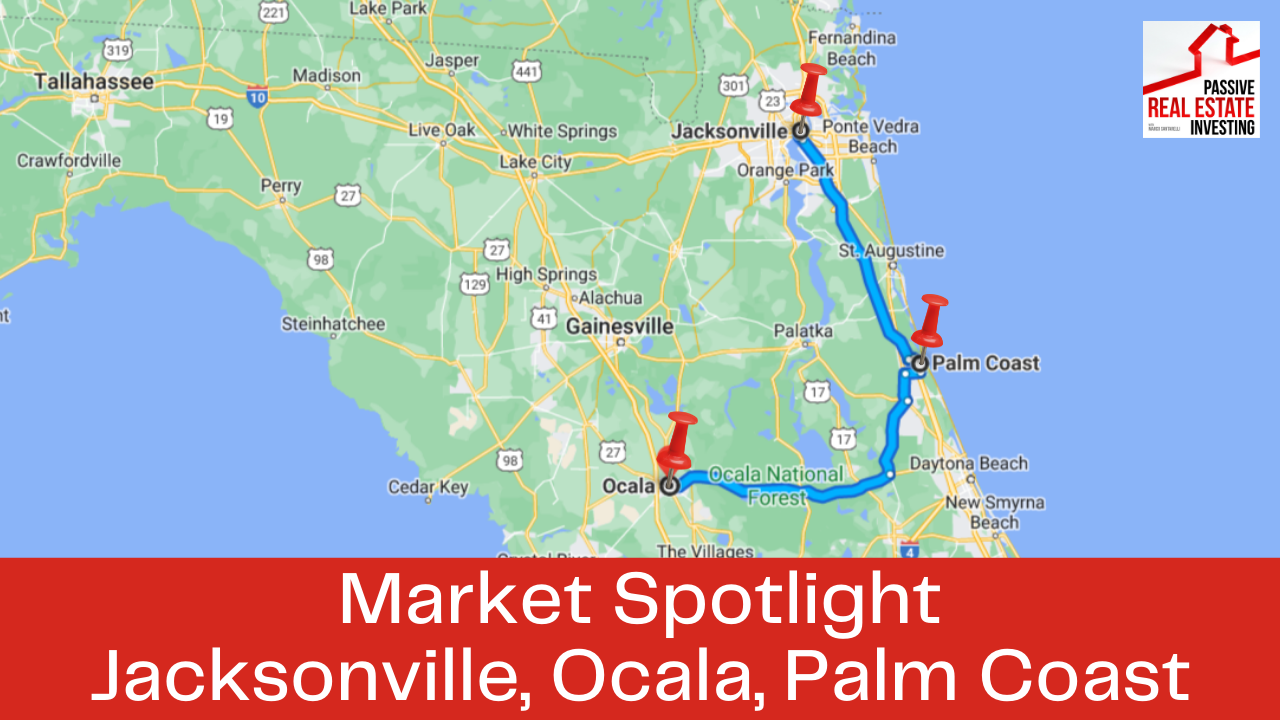
Welcome to another episode of Passive Real Estate Investing. I’m your host, Marco Santarelli. Well it’s time for another market spotlight. I think it’s been a little while since we did one. And the reason I like doing these market spotlights is to help educate you. So you have a better understanding of the different markets and the opportunities around the country and to share those opportunities around the us with you. But first, remember to subscribe to the show. It takes you all of three seconds. Just click the subscribe button and help us share the show with other like-minded individuals. Visit us on iTunes and leave us a rating and review if you can. We greatly appreciate it. And it helps us share the show with more people.
FREE copy of The Ultimate Guide to Passive Real Estate Investing.
If you missed our last episode, be sure to listen to Building Wealth One House at a Time with John Schaub
SUBSCRIBE on iTunes | Stitcher | Podcast Feed
With me today again is one of our great builders, Jim. He is one of our multi-city builders in the state of Florida. Great guy. We’ve done a lot of work with him over the years. And Jim, welcome back on the show.
Yeah, good to be back. Thanks, Marco.
Great having you back, you know, it’s very interesting to see what has been going on in Florida. You know, some of the data that I have has shown that nationally appreciation rates have been 20% year over year, and this is coming through new builder surveys. So, you know, mm-hmm, <affirmative>, we we’re hitting these record numbers. Four of those regions have posted even higher year over year appreciation rates. And this is led by Florida somewhere in the neighborhood of 25% year over year, which is mind boggling. And what’s also impressive is, is if you look at Florida as a state over the last five years, home values in the state of Florida have, have increased by nearly 69%. Those are phenomenal rates of return on the appreciation side of the equation. So you’re definitely in a great state in terms of wealth creation and opportunity and migration and all that good stuff. And I think those are some of the things that I’d love to talk to you about today and touch on. So sure. Tell us the markets that we’re gonna talk about today. I think there’s three of them.
Yeah. We’ll focus more up in the Northeast Jacksonville Palm coast and then a little west of us as Ocala. We’ve done a lot in those markets together over the last, you know, seven, eight years. And it’s been great to watch the steadiness of need. These are three markets where the housing demands cannot be kept up on right now. It’s very interesting, you know, going into oh seven Marco. I remember, you know, we all remember that writing on the wall in the Jacksonville greater Jacksonville area, there was almost three years of inventory, almost three years on the market that tells you, wow, that’s a lot of inventory. It’s gonna take a long time. That’s gonna press down on pricing right now in Jacksonville. We’re sitting at about four months, four months of inventory, which is quite a difference. And that’s great for the position we’re in for the need of housing.
And we’ve seen the prices gone up a lot, but it’s been interesting to watch. Like I was talking to you in our conversation before Jacksonville’s median value is still below 300,000 and it’s had great growth, but a lot of our investors that have come out of California for example, and they wanna, you know, get into a, a more landlord friendly area or better tax area. Well, they’ve gone to salt lake city or they’ve gone to Boise, Idaho. Just give two examples. Well, on the market check, we did last month on that those median values were at 585. So they’re almost $300,000 more in cities like that. The median income in those areas is just around 60,000, Jacksonville’s 59,000. So we’re feeling really good about the fundamentals of where the price point still is, even though it’s grown and what the affordability index is because there’s still a really high affordability index with that higher wage. The pandemic pushed a lot of business and jobs here, and I can tell you for our own building company, the upward pressure of salaries has really gone up here, which was tough for us to be able to pay, but also great for higher rents.
So these three markets, what I mean, I don’t know how deep you want to get into this, but what’s driving demand in Jacksonville, Ocala and Palm Coast?
Jacksonville and Ocala I’m sorry, Jacksonville and Palm coast. It is definitely a lifestyle and opportunity of jobs. Huge, huge opportunity of job growth here. And that is, that’s what a lot of people want. Ocala is definitely affordability. It’s an affordable market. It’s a slower market. When people were looking for lower density, they love the Ocala area, you know there’s, there’s really good healthcare for retirees out there. So, and it does have, it’s quite its own job market out there as well. You know, Gainesville is only 20 miles to the north and then the villages, which is the largest, second largest retirement community in growing is only 12 miles to the south. So, but it is a more affordable market with a little more rural field to it.
So for just as a visual for people who are not familiar with Palm coast, it is in between Jacksonville and Daytona beach almost halfway down. So it’s, it’s what, not even an hour drive. If I’m not mistaken.
As you know, I live in St. Augustine, which is greater, Jacksonville is area I can be in Palm coast. And about 20 minutes, I love Palm coast. That’s where I got engaged in my wife. So it obviously has a sentimental value for me there, but it, it’s definitely one of our most pristine markets because of the proximity where we are to, you know, water living. It’s it, it has been a hidden gem for quite a while. And it’s now just starting to get discovered, but people love living there. A lot of telecom commuters that have come out of the Northeast have moved to Palm coast for the lifestyle. And the affordability is still incredible compared to the Northeast or west coast where a lot of these people are coming from.
What are you seeing on the supply and demand side of the equation? I always like to see markets that are always trailing behind in supply for that demand, because that just keeps the housing market inching along and healthy and you know, keeps prices in check or, you know, puts pressure upward pressure for, for pricing. So that way prices go up through supply and demand dynamics, not just because of inflation. What are you seeing in these markets in terms of supply and demand?
The supply. I mean, we are definitely having the wind at our back right now. The average day on market for a finished unit is 17 days. And sometimes they’re being pre-leased before that demand you, you, you know, it, it takes a while to build a new construction home. Now, even us who have built up a good volume and the nationals are, are quoting about a year. We’re getting some stuff done. Some of our inventory that’s available is at about six months, right now, two things happened. Marco, the, the permitting departments in these counties were working from home and the old joke was, well, they weren’t getting it done the best while they were all in the office let alone being home. And they, they just came back at last summer. So they’re still working through that, that slow things down.
And then obviously the supply chains, which we’re seeing, I’m not gonna say better, but a little loosening on that, but that’s also kept things where it’s, it’s kind of the the, the wanted thing that you can’t have. So it’s slowed down the building to a point and the amount of population influx is, is just keeping us again, like I said, Jacksonville is about four months in oh seven. It was over three years of inventory on the market. So it just shows that we’re not able to keep up at this point. And a lot of that migration has to do with it along with the supply chain.
What do you see for a trend here? Like, are you seeing population continuing to grow in these markets and the supply not keeping pace with it or is there something else going on?
It is going to be tough to keep up with the supply for at least the next three years, from what everyone’s predicting. Remember when you, when you go into something and come out of something, timeframes can actually start to match. I mean, we’re just maybe starting to normalize and we have this flame of inflation on our back now. So from what everyone I’m speaking to is saying, the next three to four years is gonna be catch because we just didn’t expect Florida already had growth coming to it. I mean, you and I have talked about that before, but the pandemic opened up a, a new wave of, of early arrivals that we weren’t expecting. And you’re seeing it even in the DMV offices where, you know, I used to brag, oh, you can be in the DMV 20 minutes in and out now it’s, ah, I’ve been in here two hours and right. So it’s, it’s very interesting to watch. Very interesting, but from what I’ve seen, Marco, and again, I’m not gonna be exact on this, but it’s, I believe it’s gonna take three to four years just to start to catch up on that.
Yeah. I think one of the things that came out of COVID was it forced people to work from home or remote locations. And then they realized, well, I can work from other locations and I don’t need to be in the office. And that gave them the freedom or flexibility to actually move to places that they were either thinking of moving to, or wanting to move to, or just more affordable areas because they got out of the more expensive downtown cores of many cities and they went to the suburbs or maybe they even went across state lines. I E Florida to places that are sunny, warm, better lifestyle, zero state income tax, all those good things. And it’s just been driving a lot of people. I wish I remember the stat, but if I’m not mistaken and don’t quote me on this, I believe Florida saw 300,000 people move into the state last year from other states. And that’s a lot.

That is a lot. I thought I actually thought it was a little higher.
But It could be.
But it’s from what I’m seeing too, is people are coming and some people are delayed because they’re having trouble finding housing. So as that continues to come out, you know, that pressure of it coming out, there’s still people jumping on it, but I think it would be even more if there had been more inventory, if that makes sense.
What about supply chain issues? We hear about that a lot everywhere, and it’s not just housing it’s in, you know, new cars and everything else. So is that having a negative impact on you or is that actually a benefit for real estate investors that are buying new construction?
You know, material, price increases have not been fun for any of us, but it’s something that we’re all normalizing on now of, of what, what it costs to get things done. The, the thing that I think is, is really good for us in particular is, you know, you’ve worked with us for 10 years now. You know, we started doing the new construction about eight years ago. We’ve gotten to a capacity in 15 different markets, but we’re not one of the big national home builders, but we’re feeding quite a bit what we’ve saw happen. And I don’t agree with it and I don’t think it’s fair, but the suppliers had to cut off really small builders, building operations. You had to have a certain level, or they just weren’t taking your orders. So for the really small people who are just building one or two houses, man, I feel for them, cuz they’re getting cut left, right. And center from supplies. We were at a, a volume that allows us to get the materials and sure we’re still having shortages or delays, but they seem to be coming together. But I’m, I feel really lucky Marco that we got to a capacity because they are kind of saying, well, we’re only gonna work with a certain amount of people and it’s gonna be our biggest order takers mm-hmm <affirmative> and you know, we got in under that umbrella, luckily,
Right. Let’s get a little granular here and just take a minute and touch on the areas or the neighborhoods that you’re building in because whether you know or not, I always put a lot of emphasis on neighborhoods and neighborhood quality for you as a new home builder, it might be the path of progress, but how would you describe the types of areas or neighborhoods that you’re building in right now? Because I think that plays in to people’s decisions on where they’re investing. It’s not just the market, but it’s the areas within those markets.
Right now, Marco, we, you know, getting back to the old grading system of his, a neighborhood B neighborhood C neighborhood in Jacksonville, like what we’re doing with Panther Creek. And I’ll talk a little bit about that. You’re looking at an, a property in an a neighborhood. It was a very interesting project Panther Creek. It was a defunct golf course. It took a long time to take over buying the notes, working out the whole negotiation won’t get into the holy galleries, but we finally got it. And it was being, it was able to be converted into 850 lots, 850 lots, 650 of the lots we sold off to national home builders. There’s about five national home builders that like to buy finished lots from us. So we kept 150 of them in for bill to rent. And so that keeps a good ratio of renters and homeowners.
And also this neighborhood is gonna be amenitized. So we’re able to keep the cart paths from, from the old golf course, there’s gonna be a clubhouse with two pools. There’s all sorts of, you know, kids jungle, gym sets. And we’ve actually now figured that to get dirt. We actually built a lake in there and is the second largest lake in Jacksonville now. So that’s an example of what we’re doing it. And then there’s great ratios. So that’s in a neighborhood, a property, you know, we’re looking at 1500 square feet to 1995 square feet. So these are full houses, three bedroom, four bedroom homes, a neighborhoods Palm coast, same thing, I’d say a property in a B plus neighborhood. You know, this would be an area that I would’ve no problem living close enough to the different water amenities, whether it be intercoastal or beach.
We do do some mixtures of duplexes and single families in this area. But these are the areas that if you and I said, oh shoot, we forgot to collect rent from a property we’re self-managing, I’d walk down there at nine 30 on a Saturday night. No problem. So it’s again where we build. I could be where I proposed my wife in 10 minutes. So I, I know the area. Well, it’s a beautiful area. The nice thing about new construction Marco, and I’ve done a lot of refurbished properties. I was a rehabber for 15 years before I went into the new construction is we seem to be able to better pinpoint a higher end area with the new construction than I could with the older rehab properties.
And you mentioned, well, lemme think you mentioned Jacksonville Palm coast, but Ocala.
Ocala, same thing. So Ocala, these are a houses and B neighborhoods. And I say B neighborhoods because they’re, they’re very simple living called people will call it country living, definitely safe, safe areas, but not amenitized like we would in Panther Creek in Jacksonville, more of a simple living. So I’d call it an, a house in a B neighborhood. I mean, everything we’re building now is an a house cuz it’s new construction, two 10 warranty, you know, we’re, we’re doing the upgrades of vinyl playing flooring, the granite countertops, stainless steel appliances, tile showers in the master bath, all the things that we’ve tried to work through over the last eight years of what really gives a house value and pop, meaning the protect perspective tenants walk in and go, oh, we want it. And we wanna stay. So all those upgrades, when you normally would work with another builder, those are already included the upgrades that most people would want to entice renters or have more value we already give, which has been a nice thing for everyone involved.
Jim, just take a, a minute and just quickly break down the price range of the product that you’re building in each of those three markets. And if you can, the rent range for the same properties in those three different markets. And then this is just to give me and the listeners some perspective as to what they are.
Yeah. So Palm coast, you’re looking at about the mid threes and that’s for, you know, 1,617 square feet, four bedroom, two bath, two car garages rents will be around 2100 2200, and those are 10 31 exchangeable. So they’ll be done within six months. And then if you go into more of the lemme pull up real quick, the pricing on, on Panther Creek Panther Creek is the same thing. That’s gonna be the mid three hundreds, probably about 355 to 379. Those are models that are looking at same thing, 1761 square feet, four bedroom, two bath, two car garage in an amenitized area, Ocala you’re gonna be going down and pricing Ocala. You’re you’re looking more at about, and I’m sorry, those rents would be over 2000 as well. Ocala, you’re looking at a 1357 model three bedroom, two bath, two car garage rents are about 1550 prices are about a hundred thousand less. So you’re looking about the two seventies in Ocala.
Okay. Sounds good. Management. You wanna touch on that? Who’s doing the management or
Yeah, so I’m a partner in the building company and, and the, the owners in the building company with me, they’ve owned the management company for 10 years. Again, I started with my own portfolio there before we ever started building together. So management actually came before building for us and then we built out the building company. We don’t go into a market unless we have a hundred houses to manage so that there’s capacity to get the right people’s staff there. So management is in place at 8%. You know, Jacksonville, a lot of times you come here, you start at 10 to 12%. At most shops, we start at 8% and that’s where my personal portfolio is. And all of our people are. So the nice thing about working with us, if you buy a house and again, you’ve had lots of people do this. They’ve all won in Jacksonville, Palm coast and Ocala. Well, you have the same management team. It’s it’s the under underlying same management team that you would work with, which so you’re not having to set up another management agreement or another portal. Everything can run together very nicely being in multiple markets, which a lot of people like, cause they don’t wanna have three different managers. They like it all under one and we’re able to do that.
Cool. So someone listening to this, who’s not overly familiar with Florida does not live in Florida, but is thinking about investing out of state. And obviously, you know, that’s, what we’ve been doing for over 18 years is helping people do that. Being unbiased. If you can, you know, you’re a builder there, what would you tell somebody who is considering investing outta state and looking or considering, or thinking about Florida versus other options out there. And I won’t mention any other states, but what would you tell that person?
I think it’s important to look at. We’ve come into a world now, and this is not political. This is just fact where landlord laws are varying state by state very greatly. And you need to look wherever you go. If you’re going to invest into a property and become a landlord, I think you obviously want to go where there’s fair landlord laws. That’s a very important thing. Also, you hear about the growth, oh my gosh. Things have gone up so much, but there’s different weather patterns between here and North Dakota. And you have to look, there’s not a national weather average doesn’t really make sense because that’s just mixing a lot of numbers. So you have to look at the fundamentals of each market. I’d look to see where you’re going. What is the average family household income and what is the medium value compared to that, that gives you a lot of understanding.
Is can people afford rent, could rent still go up and are we still getting in at a good price point? And you’ll see some markets, you know, that, that I like, but they seem to be a little bit out of whack. So I’d encourage people to look, you know, where is it landlord friendly? Where are the fundamentals still there by the numbers? And also I’ve become a little biased as you know, I old own old houses Marco, but my job is to simplify, look at the difference of performance of new construction compared to older houses, older house can be great. I’ve made a lot of money with them. Yes, they can appreciate and rent and value. But for simplicity, I’ve seen a lot easier quieter approach by doing our new construction for our people.
Sure. And one thing I think is apparent to a lot of people, but not everybody when you’re comparing new construction home as an investment versus a refurbished home, like what you used to do for many, many years in the past, I have found, and this is not necessarily true in all cases, but you can maybe give me some feedback on this. I’ve generally found that your cap rates and your immediate cash on cash returns are lower with new construction, but the appreciation that you typically find, and of course there are no guarantees, but the appreciation and I would argue the appreciation potential is much higher on new construction homes than it would be on a refurbished property. So your gains are actually higher overall when you factor in your realized and unrealized gains. So are you still finding that to be true?
Absolutely. There’s, there’s a very interesting three year curve that I’ve been monitoring because of, I play on both sides. I’ve been invested on both sides, but I’ve really gone heavily into new construction. And it was for very clear reason. So new construction will normally start at a lower cash flow. But what I’ve seen is the I’ve watched the rents increase more rapidly and steadily with the new construction than the refurbished. So in three years where that cash flow is lacking, it can catch up another interesting thing that happens though, too, with the refurbished homes I called the three year curse I can do for myself, for people, a new roof, new heating, cooling, new plumbing, update kitchens baths. But if the home was built in the forties and fifties by year three, my maintenance normally starts to go up. Some, it just does. At least that’s been my experience and I’m not seeing that three year jump with the new construction. So when you go off this three year curve, you’re seeing a steeper increase in, in rents more quickly, which catches up your cash flow. And you know, we’re talking 36 months and the maintenance and repair stays low compared to how it raises some with the refurbished. So that’s just been something that I, I really watch. And that’s why more and more, I really only do new construction now, as you know.
Yeah. Well, that’s what you’ve been doing for years now. Are there any opportunities that you are looking at for refurbished homes in Florida?
You know, for me right now, I’ve become kind of a hyper focus. Yeah. We’re really dedicated to the new construction Marco, you know, we did lots of refurbished together. I own refurbished. But there seems to be, there’s a little thicker barrier to entry for what we do. And for the refurbished homes, anyone can try to refurbish a home. So we were seeing with some of ’em, they were getting bit up and they were getting bit up or, or listed at a level where if I was to do it right and make any sort of profit margin for my people and myself, I’d have to cut corners on a rehab. And I don’t like to do that. So I kind of got pushed to the sideline and I’m okay with that. But at this time I’m not really looking at the refurbished. I think the best work we can do is the new construction people stay the course again, and three years comes quick and we all know that now the position I believe they’ll be in in three years will be the best that I can provide for them with the new construction.
Well, that’s a great closing comment. All right. Well, Jacksonville, Ocala, Palm coast, you have inventory available in all those markets. And of course there are future builds that you’re working on as well. So we’ll keep talking about that. Any final comments you wanna make, Jim?
o, just great working with you. Anything we can do, you know, we work with the coaches really well and we do a lot of people do ask, do you have anything new construction? That’s can be 10 31 exchange. And yes, we do have some properties within the building range. Now that you could go into a 1031 exchange on and would be done.
Beautiful. All right. Well, Jim, thanks for taking the time to come on the show today. It’s always good catching up with you and we’ll certainly get this information out in front of our investor clients as they request it. So if you’re listening to this and you would like to find out more about what we have going on there in Florida and what Jim is providing in Jacksonville, Ocala, Palm coast, just reach out to your investment counselors here. If you don’t have an investment counselor, just fill out the form on our website. And you’ll be contacted within 12 to 24 hours and we’ll get you on a free strategy session, so you can learn more about the opportunities that are going on out there. That is it for today. It was a short episode. Thanks for listening. And we will see you all on our next episode.
Download your FREE copy of: The Ultimate Guide to Passive Real Estate Investing.
Get your FREE coffee mug by leaving us a Rating and Review on iTunes. Here’s how.
See our available Turnkey Cash-Flow Rental Properties.
Please give us a RATING & REVIEW (Thank you!)