
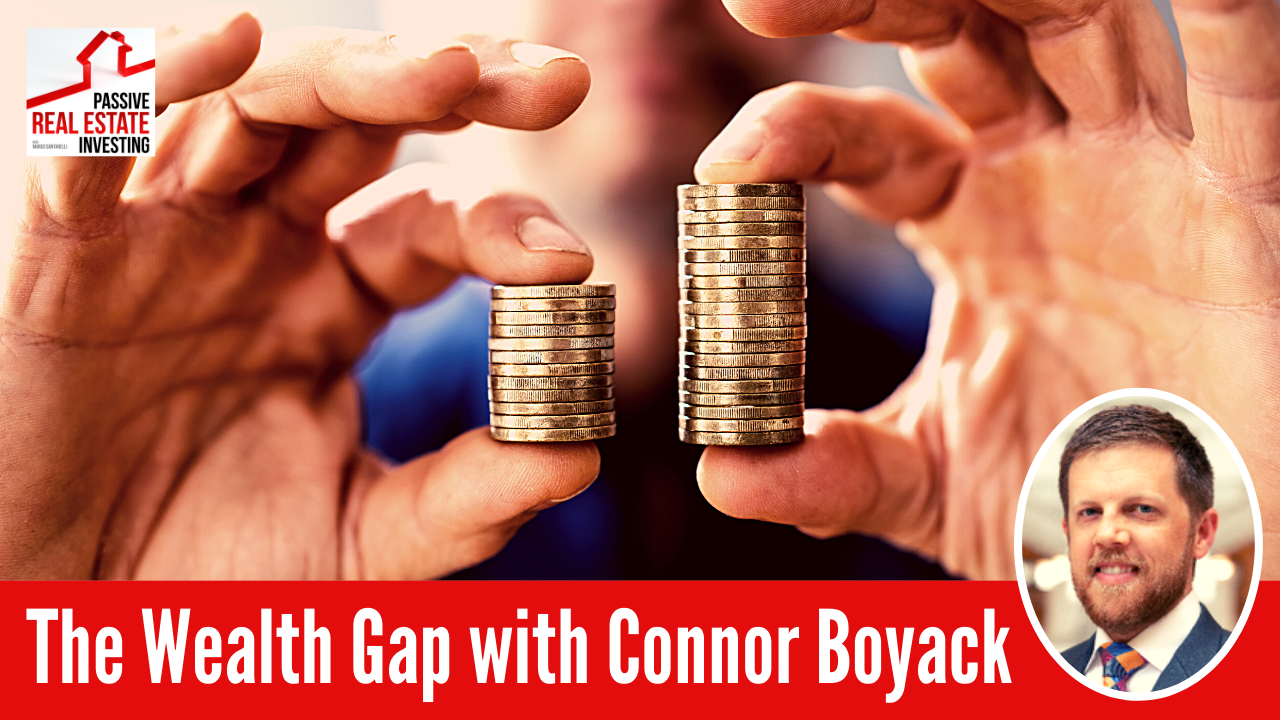
Well, I have a very exciting guest today. And this guy is someone who I’ve known about for many years only because of his amazing series of books, which I’ve bought not once but twice. So, um, but, uh, for those of you who are familiar with the Tuttle Twins book series, you’ll know who I’m talking about here. There’s a lot of things that we could talk about. I figured we keep it tight today and talk about the wealth gap, financial education, and a little bit about his books, because you know, we live in a capitalist society, at least for the most part, we believe we’re in a predominantly free enterprise market system. The reality is that’s not entirely true. And we’re going to talk a little bit about that today, but we still have great opportunities. You know, sometimes people refer to the United States as the cleanest shirt and the dirty laundry, and there’s some truth to that, but you know, I’m happy about where I’m at in the country that we have, but you know, sometimes you have to question the policies and politics that go on and how that affects you as an entrepreneur or an investor or just the layman.
Download your FREE copy of The Ultimate Guide to Passive Real Estate Investing.
If you missed our last episode, be sure to listen to Getting Unlimited Mortgage Loans Beyond Conventional Financing
Get your FREE coffee mug by leaving us a Rating and Review on iTunes. Here’s how.
See our available Turnkey Cash-Flow Rental Properties.
Please give us a RATING & REVIEW (Thank you!)
SUBSCRIBE on iTunes | Stitcher | Podcast Feed
So we’re going to talk about things surrounding the topic of the wealth gap today. And my guest, who I’m very proud to have on the show here today is Connor. [inaudible]. Connor is a founder and president of the Libertas society. And I hope I got that right. It’s a free-market think tank in Utah, he was named one of Utah’s most politically influential people by the salt Lake Tribune. Connor’s leadership has led to dozens of legislative victory spending a wide range of areas from privacy, government, transparency, property rights, drug, policy, education, personal freedom, and so much more. He’s a public speaker and the author of at last count 21 books and Connor is best known for the Tuttle twins books series, which is a children’s series, introducing young readers to things such as economics, politics, civic principles, just a great series. But interestingly enough, it’s great for adults last but not least Connor lives in Salt Lake City, Utah, with his wife and two homeschooled children. So Connor, welcome to the show.
Thanks for having me Marco. I appreciate it.
Well, I’m excited to have you on because uh, your books have been great. In fact, I was really turned on and inspired by them long before I ever was introduced to you. So, um, we’re gonna talk about that a little bit later. Can you maybe fill in any gaps that I missed in introducing you because I know that you are doing a lot of very interesting and cool things.
Uh, no, I appreciate the intro. Uh, we’re up to 28 books now. Uh, so the, that bio was a little outdated, but it’s hard to always keep that updated because we’re cranking these things out like crazy. Yeah. So Libertas Institute is the free market think tank that I run, we primarily work on what’s called policy reform, but my real passion is education and entrepreneurship and finding ways, help people understand how these policies like impact their lives, right? Like we’re all turned off by toxic partisanship and what’s happening in Congress and it’s all kind of theatrical. And, uh, but, but in a very real sense, you know, policy, what the laws are impact us as business owners, they impact us as families. We all have a vested interest in making sure that we have the right balance. Um, and that we have a system in place that, you know, provides us protection and security and fairness and the economy and so forth, but that doesn’t get in our way.
It doesn’t impede people and that that’s our bread and butter. That’s what we’re focused on is really just making the system kind of go away enough to the point where folks like you and your listeners can just go about their business. Focus on their family, have a, a system that allows them to thrive and succeed and help other people. Our perspective is that capitalism and entrepreneurship are service oriented. It’s a way to serve other people and improve the world around us, make other people’s lives. You know, some people look at a Jeff Bezos, Oh, he’s so rich and that’s unfair. And I think that guy has made my life so much better. You know, I ordered a book the other day and it arrived six hours later. Like that’s, I don’t have to leave my house. Like that’s service to me. I can be lazy. You know, I don’t have to get in the car and drive to the store. So, so these are the ideas that motivate us and they find expression both in our policy work, but also in these educational projects, like the telephones that we do
Well, that’s a good segue because you know, capitalism promotes and inspires innovation and it’s the innovation that provides value in service and growth and value to other people. And you’re rewarded for that. So the more people you help and serve, the more money you make. So it’s not that it’s an unfair unbalanced system. In my opinion, you know, the more you serve and the more value you provide society, the wealthier you become because you’re doing something good for the greater good. But you know, it’s unfortunate that the wealth gap, this whole concept of the wealth gap is so unfortunately politicized and even weaponized. And, you know, you hear it in the media and I’ve been very happy turning off the mainstream media long, long time ago. I don’t even listen to mainstream media news anymore, but let me set the stage real quick here, in terms of some stats, you know, you can think about what you want.
This is actually coming from the St. Louis Federal Reserve. So this is from 2019, but you know, back then they measured total wealth to be a little over $96 trillion. And when you break it down, the top 10% of people in society made up about 13 million of those families. And to be in that top 10%, you needed 1.2, $2 million, which doesn’t sound like a whole heck of a lot today. You know, it’s certainly very achievable, especially if you’re an intelligent investor or you’ve been investing in real estate for a while, but the next 40% you might call it, the middle 40% is someone that has $122,000 and above. But here’s the interesting thing. And this is, I think what ultimately gets politicized and weaponized by politicians and the mainstream media is the so-called bottom 50%. And that’s basically any family that has less than $122,000 in wealth. That makes up a very significant percentage of the population. You know, you can debate whether that’s right or wrong, fair or unfair, but that’s just the nature of the beast. So first of all, why do you think that this wealth gap is such an issue in the US.

I think it’s an issue because I think it’s easily weaponized. It’s an emotional topic that allows people who maybe have some jealousies, some envy, some I’d even say self-hatred. In some cases, situations that I’m familiar with, it allows them to play the victim card and suggest that it’s an externality. It’s someone else’s fault that I’m not making more money. It’s someone else’s taking. Therefore, you know, I’m having to give, I’m losing out. It’s a mentality that is derived from this zero sum game approach where they believe it’s a fixed pie. And if you know, Elon Musk has taken more resources, that means there’s fewer for me. So we need the government to go in and, and redistribute that the problem with that is when you look at some of the charts that you’re mentioning, I don’t think the fed puts this one out, but there’s several economists who have, uh, overall wealth is increasing.
So yes, there’s a gap. There always has been a gap. I mean, let’s not dilute ourselves. There always will be a gap, but the countries and not just the country, that the world’s poorest live better in many respects than teens, you know, 50 years ago. I mean, just look at something simple like refrigeration and how basically everyone has refrigeration, uh, cell phones, Netflix subscriptions, even low income people have modern day conveniences that are phenomenally superior to anything just a few decades ago that the most wealthy, you know, oil barons, everyone else in the world didn’t have access to. So yes, there’s a gap, but by focusing on the gap, we deprive ourselves of recognizing how the market has created such abundance, such efficiency, such wealth, that even the people on the lower end today are doing excellent compared to the way things used to be. And that should be celebrated. It should be something that we have informed people about, but instead people prefer to focus on the negative and the disparity, which I think is a distraction to the real issue at hand, which is, you know, overall wealth has been increasing and substantially so.
So with all this focus on the bottom 50%, if you will, you know, it only leads to solutions that are actually not good solutions, which is ultimately a, a road or a path to socialism because you’re trying to redistribute wealth from the so-called upper 10% or upper 50% down to the lower 50% to even things out. But that really is not a solution. Or is it, I mean, I guess this is an ongoing debate with people, but I don’t see the wealth gap being a problem, correct me if I’m wrong. It’s just a natural function of capitalism. It’s the wealth do get wealthier, but in providing value, it brings up the quality of life for the bottom 50%. Is that a true statement?
I think that’s very fair to say that the juvenile mentality with which a lot of people approach the wealth gap is not unlike believing that the world’s rich are like Donald duck sitting in his vault full of gold swimming in coins. Like the cartoons we watched in the eighties and nineties and just, you know, doing snowflakes, but in gold, that’s not how well it works, right? The, the world’s richest people. Yes, they’ve amassed personal wealth, but largely their wealth is tied up in the productive enterprises that they are in charge of. Right? It’s not like Jeff Bezos has, you know, all the money that is his wealth in cash, ready to spend. He’s not liquid. He’s got them in shares in Amazon. The company is being productive as the company succeeds, he succeeds, well, how does the company succeed by helping other people, by saving them money, by empowering them to obtain things that help them go build businesses and do all these things.
And so, you know, yes, it’s convenient to think of the wealth disparity in a way that makes you think that these people just have all this obscene amount of money. But of course, they’re spending that money. They’re creating jobs, they’re investing it back into the economy and growing other businesses, which is helping other people. And it’s this really jaded mentality that perceives these people as inherently evil or that capitalism is inherently immoral because of this disparity. When in reality, when you really understand how the world works, it’s a moral good, you know, you look at Elon Musk, this just happened recently, right? Where he’s trying to accumulate all these resources to, you know, make the human species interplanetary, right. And you had Bernie Sanders criticized him publicly. I think it was on Twitter saying, Oh, Elon Musk should be investing in people here on earth and helping more people and his ideas.
He should just give out all this money, you know, and help poor people. But Elon Musk is like, look, I’m trying to accumulate resources with this important mission and his view along the way, he’s creating a ton of jobs, which is like increasing overall wealth. But he’s harnessed. I think of it like letting off steam, you can go spend your money. You can go hand it out to poor people, or, you know, you can be charitable, just give out the money, but then it’s gone. It’s like letting off steam. It just dissipates. But if you harness steam, if you channel it and apply it to a productive use, you can move a locomotive. You can do some really amazing things. And that’s what I see a lot of the wealthier people are doing today. But of course, if you’re building a locomotive and you’re moving freight and you’re doing all this stuff, you’re enlisting so many other people in that cause that you’re helping and serving and making the world a better place.
So it really just comes in my mind. It boils down to the mentality with which one looks the world. Is this a Ciro’s zero sum game? Is it me versus you? Or is it this kind of collaborative effort where through the economy, it’s a win-win opportunity where we can work together and yes, you’re rich, but Hey, you can give me a job and I can, you know, get a leg up in my life and go start my own business. It’s a very different mentality that people have. And I think it’s reflective of a broader kind of socio-cultural pattern that we see outside of just economics per se.
Well, that begs the question. And then I want to transition to financial education, but our subsidies or any form of subsidy, a solution to this quote unquote problem, or is it just another problem that we’re creating with providing, you know, government handouts and subsidies?

Yeah. Yeah. There’s a good quote from an economist, Frédéric Bastiat, where he talks about that, which is seen, and that which is unseen. And his point was look a bad economist or someone who has opinions about the economy. A bad economist will focus on that, which is seen. So to your question, look a stimulus, Oh, look, it helped. I could pay for my mortgage. I could pay my rent and to those people, with their tunnel vision of their immediate problems and their short-term situations, that’s a good thing, but it’s a bad economist who saying, look, we can see the help that the stimulus is giving. It’s helping people spend and bootstrap themselves back up out of recession or whatever. But Boston’s point is a good economist takes into account, not just that, which is seen, which is easily evident. It’s also that, which is unseen.
That which is not immediately apparent what are the secondary and tertiary effects? What are the consequences down the road from these short term decisions that we’re making? And the problem is when the economy is subject to the control of politicians, politicians have a very short time, they got tunnel vision of the next election, the 24 seven news cycle. And so they’re making these decisions with a short-term benefit, but the long-term disaster, they’re kind of kicking the can down the road. And so if we’re going to be good economists that we’re going to have, right. And correct opinions about these decisions and proposals, we have to take into account the long-term as well. Um, and so to your question, I think it’s critical that we have eyes wide open about that. And when we do, we begin to realize, yeah, this can help some people in the short-term, but you know, it’s like the medicine is, the cure is worse than the disease, right? Like let’s not swallow this medicine. That seems good at first, but it’s actually gonna produce poor health outcomes in the future. And that’s where we are today.
We’re referring to these unseen situations as unintended consequences, or is that something different?
So I have long used that term unintended consequences because generally speaking, yes, I think they’re synonymous. But in recent years I feel like some of this is intended. I feel like there are people look at the great reset, right? When COVID happened, all these lockdowns, you had all these globalists central planners, the world economic forum, and all these people start coming out and preaching this mantra of here’s an opportunity for the great reset. And we can restructure the global economic order around socialism and blah, blah, blah. And so given that there are people out there looking for these crises, it’s remember Rahm Emanuel, Barack Obama’s friend. He said he never let a crisis go to waste. That was a quote that he from when she became famous. So you look at these people taking advantage of COVID and other crises, and suddenly there’s no more coins. We can’t find coins anywhere. Why is that? And I fear that, and I suspect a lot of this is intentional. So I fear that when we use the term unintended consequences, we’re giving a pass like, Oh, shucks, you know, these things they weren’t intended. And it’s a scribing virtue. And, uh, and in a sense to people who I think are often quite nefarious. And so I don’t believe that those terms are as synonymous as you might suspect, because some of this is intentional.
Yeah. I agree with you a hundred percent. Well, how much of this is now tied to financial education? Or I should say a lack of financial education because clearly, and I think you agree with me, our school system is somewhat antiquated. Uh, you know, it’s based on a very old system that came out of the industrial revolution. You know, how much of this is really because of a lack of financial education?
So it’s important to bifurcate two related the distinct issues. Oftentimes an education and pedagogy. You refer to financial education. Financial literacy is another way that people describe it. And financial literacy, there’s a decent amount of financial literacy in the schools. You’ve got groups like junior achievement and others partnering with a number of school districts across the country, state councils of, uh, education and curriculum developers to work on financial literacy. Well, what does that mean? Well, what is a bank and what is money? What’s a dollar. How do you save it? It’s extremely rudimentary and superficial information about money. And that is what passes off for financial literacy when it comes to like K through 12, especially, okay, there’s plenty of financial literacy. There could be more, but there’s a very robust amount of financial literacy education efforts across the country. Well, the problem with that is it’s superficial.
It’s not substantive. So what is substantive? That’s where I bifurcate financial literacy from economic theory and economic theory is more of an understanding about the underlying principles of an economy. Why people make the choices they do, right? What money really is. But some of those secondary and tertiary effects, for example, inflation, understanding the federal Reserve’s role in all of this and the central bank. Why is our money worth less than it used to be? Grandpa used to go to the movie for a nickel today. It’s, you know, $8 and 50 cents. And so these are the more substantive principles and theories that when children understand them, they’re really simply coming to learn how the world works, why people make decisions. They do. Economics is not charts and graphs. I did horribly in my economics class in college because it was all charts and graphs. They’re just talking about supply and demand curves and the intersectionality of blah, blah, blah, but economics fundamentally.
And in ways that kids can understand is really just about why humans make the choices they do, right? What are the incentives? What is the scarcity? What is the urgency? Why do people exchange? What’s the time preference that they have? It’s really just how people are motivated to do what they’re doing and that’s economics, and you can break it down from this global aggregate, whatever into just me, my family, why we make the choices that we do, why do I go to work instead of, you know, playing all day and what are the priorities that I have and the needs versus wants. And these are fundamental things. So your question Marco is totally absent from the school 100%. They’re just, there’s no curriculum, no schools that approach this from an economic theory point of view. And for that reason, these kids, when they become voters, when they become professionals and taxpayers, everything else, they lack any depth of understanding about how the economy works, what politicians are doing into it and how they can make informed choices for themselves in terms of saving and investing and all of these things. It’s just totally absent from schools. And it’s something I’m deeply worried about and subsequently passionate about trying to resolve.

Hence the reason why you wrote the books, the Tuttle twins, and some of the other, you know, uh, course material that you’ve created. And it’s not just financial education and financial literacy, we’re in a capitalistic society, supposedly an economic free enterprise system, which, you know, arguably is not entirely free enterprise, but we’re not even talking about our teaching entrepreneurship, which to me goes hand in hand with financial literacy. So I would think that if we had courses on entrepreneurship, how to start a business, or, you know, in your case with, you know, one of your books and, you know, the lemonade stand concept would, you know, get people thinking about, Hey, yeah, I could be an entrepreneur. I could start my own business. Do you want to talk about that for a minute? Because I think you talk a lot about that.
Absolutely. Thank you. So precisely because of the problems that we’ve pointed out and, uh, economic and financial understanding, lack of entrepreneurship and all these things, that’s why we started writing the Tuttle Twins books. So these are children’s books that help families have conversations about real-world ideas breaks down these complex ideas and issues into lessons and stories that kids can understand. They’re fun. They’re beautifully illustrated stories. So kids enjoy reading these books, they read them again. And again, what’s really interesting is that the parents get educated a ton as well. We get so many comments from parents who are like, I didn’t learn that in school at all. Or like that made way more sense than anyone ever explained to me. And so what we’re finding is that you create this family dynamic, where mom and dad and kids, they’re learning the same issues together. They’re talking about them around the dinner table.
We provide them discussion questions after they read the book to kick off some of those conversations. And it creates these opportunities for kids to understand like big kid ideas, right. Adult ideas, which they always like to do, but in a way that makes sense and is relevant to their lives. And parents love it, of course, because they’re increasingly recognizing, especially last year with COVID and that the school lockdowns and all that stuff, uh, you, you’ve probably heard stories of how teachers have gotten upset that, that the parents can see what the kids are learning on zoom. And the teachers don’t like that parents are watching, right? So parents are cluing in like, wait a minute, I should be able to know this stuff. You shouldn’t, you know, resist me knowing what my kid is learning. So parents are cluing into the fact, the schools are really derelict in their duty and teaching this information.
And thus, I mean, we had just a crazy year last year selling these Tuttle Twins books because so many people were recognizing this problem and the need. And so turning to our resources to help I’ll mention one other brief one too. So we do a lot of these books. We’ve got books for kids and toddlers and teenagers, kind of all different age ranges, but we still noticed that there was a great opportunity for a lot of our readers where they want a more depth than a short story book could provide. And so we actually started creating a curriculum of free market economics to teach families bit by bit, starting at the very basic building blocks and then getting increasingly complex, you might say, but basically teach them economics from a free enterprise perspective in simple ways with lessons and activities and discussion questions and all this stuff.
So the whole family week after week after week can learn these ideas can talk about them and begin to really have a deep understanding about, uh, the free enterprise system, make better decisions about it. Go start businesses with that knowledge, et cetera. And so it’s become super important for us. We sold over 2 million copies of these books. We translate them into a dozen languages. I mean, it’s just exploding right now. And it’s kind of one of those things like when preparation meets opportunity, you know, like for us, when we started, it was like, Oh, this will be fine. And we’ll do some little books. And it was really just a fun little project, but as the world has kind of melted down and people lost their minds for us, it’s been like, Oh my gosh, this is so critical right now. And so we’re trying to just run as fast as we can to produce even more materials.
Well, the book series, I mean, I have to point this out, you know, not to pitch it or anything, but they’re really great for everybody. And they talk about subject matter. That is so fundamental. So core, like principle related from individual rights. And I’m just looking at your website right now, the book, you know, the law, which is actually based on the actual book, a little book by Bastiat called the law, right? So you know about individual rights, you got a book on free markets, protectionism. How does money work? In fact, I interviewed, uh, G Edward Griffin from, uh, you know, the creature from Jekyll Island, which is what your book is based on. Fantastic, you know, collective control, the whole concept of the golden rule, you know, can a child be an entrepreneur? I mean, these are great. You know, why is socialism so harmful? I mean, that’s just the, you know, the principle or concept of another book, this is great. And you just released a new one called Messed Up Market. Why we act the way we do. I haven’t read that. I need to, but, uh, yeah, so that’s great. I mean, that’s, I think adults should read these and I noticed that you also have the audiobook version on audible too. And I didn’t know that until just recently. So I’m going to download those.
So we’ve got audiobooks, we’ve got parent guides for all the books that parents want a little more handholding and information. We’re working on a cartoon series right now, so that kids can watch cartoons and learn these ideas as well. So we’re trying to expand the age range. As I said, we have like toddler and teen books as well, but we’re also trying to expand the type of offering. So we have a podcast, we’ve got a card that teaches these ideas. We are working on the cartoon. And so we’re trying to just create more materials because our audience, we’ve got about 300,000 families so far reading the books across the country and consistently their messages. We want more, we want more. And so we’re just trying to produce as much as we can because there’s nothing else like this at all. And first too long parents like you and I have had to like, just do our best or just figure it out.
I’ll talk to them about this kind of stuff when they’re older, you know, when they’re, you know, gonna ready to vote. But my worry and my theory, which I think we’ve validated as we’ve been working on this project is that too often, if we wait till they’re adults, it’s too late, because they’ve been getting counter messages in school, they’ve been getting crap in the media, they’re a sponge, right? They’re soaking all this stuff in. They’re hearing from their friends and what’s trending on social media or whatever. And they’re getting all these flawed ideas crammed in their head. And I’m not one to say that we should like, what’s the word, like shelter, our children, and just not expose them to these different ideas, but you know, good heavens why? Like, why would you not at least have a conversation about your values and what you think are moral and true and ethically, correct?
That is where the children and we want to good parents want to do that. They just struggle to articulate these complex and funky ideas that quite often, they themselves fear that they don’t understand. And so enter the Tuttle twins books, which, which make it super easy to teach the kids, the stuff the parents have a very easy baseline way of articulating these ideas. Once they’ve read the books and it just facilitates those conversations that otherwise wouldn’t be happening, thus giving these children kind of this foundation of a freedom-free enterprise perspective so that as they in the world encounter these contrary ideas, they can evaluate them and discuss them. And at least have a reference point rather than just, Oh, socialism sounds great. Okay, here we go. Right. They’ll know a little bit better and they can at least challenge ideas rather than just swallow them wholesale. Yeah.
Connor, I honestly think there’s real hunger, especially with adults, not just parents, but adults in general for this type of education. And there’s that concept of you don’t know what you don’t know, but when you start to expose people to these concepts and principles related to economics and free enterprise and capitalism, and then you start to really understand how the world works. You know, it’s like the movie, the matrix, you start to peel away the layers. Now you get hungry for it. And you go down this rabbit hole where you start to learn some things and you think, wow, that’s really cool. I’m seeing the world and the economy in a whole different way. And now I want to learn more and you just keep going down this path where it’s just amazing. It’s, eye-opening, it’s enlightening and it’s fun. And then I think that’s been perpetuated over the last year or so because there’s been this great disruption with COVID and whatnot, and people are being forced to help their children or to look into what their children are learning.
And, you know, with YouTube being so accessible and so much information being available out there about money in the economy, the markets and all that stuff, people are naturally becoming more and more curious about this and your product. I wish more people knew about it, but it plays right into that hunger, that thirst for that knowledge. So, you know, the timing is great, but I, you know, I think it would have been great if it came out 10, 20 years earlier, you know, honestly, let me circle back just for a quick minute, because I forgot to ask you something when we were talking about, you know, the concept of the wealth gap and how it was being politicized and weaponized. And I think a lot of the people listening to this might want to know the answer to this question, but recently in political circles, you’ve been hearing more and more about democratic socialism. And it’s just a term that sounds kind of benign on the surface. You know, it’s like, Oh, you know, it has to be good. It’s democratic socialism, but is that really just a play on words or a Trojan horse for something, you know, more nefarious?
Um, the short answer is yes. Uh, you know, socialism, it’s like when there’s a little bit of like dog poop in your batch of brownies, like, okay, maybe the whole thing is a dog group, but you’re not going to risk taking a bite out of any piece of that. If you know that it’s contaminated. So the fact that socialism is democratic, whatever that means is, you know, a misnomer and it’s also important to define socialism in a way that’s inclusive of what we mean. And what I mean by that is the technical literal definition historically of socialism is when the government owns and controls the means of production. Right. Which is basically like a quasi communist government. That’s like, like Atlas shrugged, right? They’re just saying, this is where the engines, the trains will go. And when, and we don’t have that, like that, we don’t have it to anything to that degree.
So then people might think, Oh, so we don’t have socialism. We’re okay. The inclusive definition of socialism is when the costs of various programs and policies and benefits are socialized. What I mean by that is when Connors healthcare is socialized among the taxpayers, when the cost of education of the rising generation is socialized among society, right? That is socialism. We want a hundred percent. Have we have it all over the place when you’re handing out these benefits, when you’re a politician saying, Oh, free healthcare and free college and free all this kind of stuff, what you’re really advocating for a socialism, because you want society to pay for it. You want to spread the cost across the many to benefit the few. And so in that sense, whether it’s democratic or not, it doesn’t change the end result, which is where, you know, getting money taken from us for stuff that we don’t really benefit from or want. And so, no, it’s not inherently superior because it’s democratic or voted in as policy by elected representatives rather than a dictator kind of taking control when the outcome is the same, that’s what we need to be watching. It’s the moral principles involved. And so there’s no inherent virtue just because a group of elected officials say we’re going to have socialism, you know, ends don’t justify the means kind of thing. And so really at the end of the day, just more social.
Right? Okay. Well said, what didn’t I ask you that I probably should have asked you based on, uh, our topic today of the wealth gap.
You know, the wealth gap is such an important issue. I would actually point your listeners if they’re curious about this topic, but related topics. There’s a great organization that I support called the foundation for economic education. Oh, that’s fantastic. Yeah. They put out a lot of material articles, videos that break these ideas down. Very simply because if you’re interested in this idea, there’s related ideas, of course, that you’re going to be interested in its fee.org, F E E. And they write kind of like a college level, maybe even high school, they try and simplify these things so that younger people can understand that. But then of course us adults who are busy and a lot of us didn’t learn this to begin with. And so full of materials, I would encourage all your listeners to head to feed.org. You can even just search on their website wealth gap. They have a number of good articles that break down the reality of things, not unlike what you and I have discussed. Great resource to consider, to learn more about these ideas as well, especially for the, yeah.
Yeah. I’ll put all those links in the show notes, as well as links to all your stuff. Let’s wrap this up with one last thing, which I think is a brilliant project. It’s your, one of your latest projects? It’s free market. Well, I love the title free market rules. Talk about that for a minute because I love the, uh, I don’t know if this is your tagline for it, a comprehensive curriculum for parents and children to learn together about the free market. I think that’s brilliant, but tell our audience a little bit about it and then the link to where they can find it. Thanks
So like I said, the telephones, we got all these books and game and podcasts and all these resources. This is our attempt to create a curriculum, not one for schools necessarily it’s really for families to do together every week. We send the families who participate materials here, stuff for your younger kids. Here’s stuff for your older kids. Hey parents, here’s a little bit for you just to understand what your kids are going to be learning about. We call them dinner conversation starters. They’re really just discussion questions. Like once you’ve kind of done the worksheet or, you know, watch that little video or whatever, go talk about as a family. And here’s some questions and it’s a way for us to facilitate that kind of group learning within the family. A lot of folks in my position, they think we got to get this into schools.
We got to go teach there. And it’s critical that we do. But if you go teach kids in school, they’re going to go home. And mom is going to say, what’d you learn today? And the kids are going to go. I don’t know. You know, and there’s no like retention in the family. There’s no application, there’s no deeper learning. So for our curriculum, we’re focusing on the family so that the, the siblings and the parents are all on the same page, learning about these nuts and bolts of free enterprise economics. It’s not super geeky. It’s not complex. It’s really, again, as I said, how economics really is? It’s how do we make decisions? Why do we make the decisions we do? Why do things happen the way they do in the world? That is what economics really is about and why kids like it as is. It helps them understand the world better. They’re growing up in this world and it’s confusing and so much happening. This is how they can make sense of what happens in the world, why things are happening when, so that’s it freemarket.tuttletwins.com where families can sign up and start learning together about free-market economics. I love it. Yeah. The website’s great.
By the way, I, uh, kudos to you on that. It’s a very well-done video
There. My kids doing a little pitch as well.
Yeah. It’s very cute.
An entrepreneurial endeavor of their own helping adapt.
Yeah. I can’t understate how great and brilliant your a Tuttle Twins books are. In fact, all your books. And I apologize for getting the number wrong. I had 21, I didn’t know it was 28.
29 next week, we’re coming out with our latest, but very what’s the title of that book? Nope, no problem at all. So this’ll be our 12th book in the children’s book series for Tuttle twins, our original series, it’s called the Tuttle twins and the Leviathan crisis. And as you mentioned, our first book, the laws based on the law by Boston, all of our children’s books are based on original important books or essays where we kind of distill the ideas down, wrap them in a fun story, full of illustrations. That’s kind of our shtick. Well, this book is based on a book written in the late eighties called the crisis. And Leviathan, Leviathan is a kind of a nickname for big government. And the book was a review. It’s a nonfiction book for adults and intellectuals and so forth, but it was an analysis of how in decades, past the government has grown every time there’s a crisis because people get scared and they say, save me.
And the government comes in and says, I’ll save you, just give me some more of your freedoms. And they say, okay, here you go. And, uh, and the author coined a term called the ratchet effect. If you know that the tool a ratchet, right, it goes one way and then you bring it back and then it goes up again and then it goes up again. And so he was using that to illustrate that with our free, I mean, think I was at the airport yesterday, flying back from Florida. We are now accustomed to having our belongings search through and Pat downs and metal detectors and bomb sniffing dogs. That’s just normal life. It’s the new normal, and it’s that ratchet effect. We have that new baseline that we kind of get used to. So our book is a children’s version of that. We actually wrap it in a fun story involving kind of as Dungeons and dragons fantasy game, but in the process, the Tuttle twins, and then our readers learn about all these historical instances in which we’ve surrendered, our freedoms and government Leviathan has grown. And of course, this is a message that has hyper relevance to what we’re going through right now is we wanted to focus on this topic. So the parents can talk to their kids about what’s happening in the world, but it’s a trend that is just, you know, perpetual. And so it will be something that will be unfortunately, quite evergreen, far into the future beyond COVID because this is a tendency that we all have to grow government to protect us from whatever, you know, hobgoblin or crisis is purported to be happening.
Yeah. It reminds me of that saying, you know, you get a knock on the door and you open it up and says, hi, I’m with the government. I’m here to help. It’s like you created the problem. Why are you here to help me with it now? Right. Yes, exactly. So anyway, Connor, I really appreciate you taking the time today. Uh, thank you. This is a very big, broad and deep topic. It could go on for hours, but I think we’ve given people a good of what it is, and we’ve probably teed it up for people to maybe do their own research and look into it a little further with, or without your, you know, your materials and content. So, uh, thank you for taking the time today. Connor. Appreciate it. I appreciate it very much. Thanks for letting me come on and talk to your listeners. Thank you. No, it’s been great. And for everybody listening, if you enjoyed the content, remember to subscribe, click that subscribe button. So you never miss an episode. We come up with at least one per week, help us spread the word, visit us on iTunes, YouTube, wherever it may be and leave us a rating and review. Thank you for listening. And we will see you all on our next episode.
Download your FREE copy of: The Ultimate Guide to Passive Real Estate Investing.
Get your FREE coffee mug by leaving us a Rating and Review on iTunes. Here’s how.
See our available Turnkey Cash-Flow Rental Properties.
Please give us a RATING & REVIEW (Thank you!)