

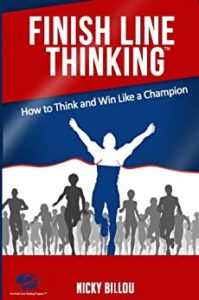
We all want to be a winner, but what does it truly take to be a champion? Joining Marco Santarelli on the show today is Nicky Billou, a thought leader and high-performance guru. Having taught clients for years to help them crush their business goals, Nicky believes how you think is the decisive factor in what makes you a champion. Nicky is the author of Finish Line Thinking: How to Think and Win Like a Champion, a book packed with his insight and his years of experience in working with Olympic champions, world record holders, business champions, and thought leaders. Don’t miss this episode and start thinking and winning like a champion.
Download your FREE copy of: The Ultimate Guide to Passive Real Estate Investing.
If you missed our last episode, be sure to listen to Lessons That Helped Build The Massive Sheraton Hotel Chain With Mitzi Perdue
Enjoy the show!
– – – – – – – – – – – – – –
Download your FREE copy of: The Ultimate Guide to Passive Real Estate Investing.
Get your FREE coffee mug by leaving us a Rating and Review on iTunes. Here’s how.
See our available Turnkey Cash-Flow Rental Properties.
Please give us a RATING & REVIEW (Thank you!)
SUBSCRIBE on iTunes | Stitcher | Podcast Feed
Before we go any further, if you haven’t subscribed to the show, remember to click that subscribe button and subscribe to the show so you never miss a great episode. Ask the question, “How do you think, and when like a champion?” Let’s, first of all, ask, what is a champion? According to the dictionary, there are two main definitions. One is it’s a person who wins a first prize or first place in a competition. The second definition of what a champion is a person who is clearly superior or has the attributes of a winner. I liked that second definition because we all want those attributes of being a winner. We all want to be a winner. You see how a champion thinks is the decisive factor in what makes them a champion. Their thoughts, attitudes, and beliefs are precise that they allow themselves to win. They ensure and virtually guarantee the path to becoming a winner and a champion. It’s what you will allow yourself to become as a champion in your own right, in your chosen area of endeavor. If you take the time to learn and apply the principles we’re going to talk about on this show, you can and will become a champion. My guest was on with Mark Victor Hansen, and although he didn’t do a lot of the talking, he had a lot of great things to say and it was impactful. I’ve come to know him much better here. He’s an interesting and dynamic person.
—
It’s my pleasure to welcome back on the show, Nicky Billou. He was on the show with me when I was with Mark Victor Hansen. I’m glad to have him back on. What you guys don’t know is that Nicky has spent many years figuring out the mindsets of champions, which speaks volumes, because we want to get into the minds of people who are champions and become champions ourselves. He’s worked with athletes and entrepreneurs at the highest levels from Olympic gold medalists to billionaires. I know Nicky can ignite your passion and he can push you guys further than you ever thought was possible. Nicky, welcome to the show.
Marco, it’s an honor to be back. I enjoyed being here the last time. I know this time is going to be as great.
It will be. I’m excited about your book that you sent me. A brilliant subtitle by the way. The book is called Finish Line Thinking and the subtitle is, How to Think and Win Like a Champion. That is extremely fitting because I know that our audience loves to become a better version of themselves to grow, expand, and be more to themselves, their family, and to the world. Before we get into some of the topics that you talk about and what you studied with athletes and billionaires, and even Mark Victor Hansen, I want you to talk about that. Tell us more about yourself. Let us know who you are.
I am an immigrant to Canada. I’m originally from Iran in the Middle East, my family and I are ethnic Christians, Syrians, Assuris. We left Iran a couple of years after the Iranian Revolution happened. It was an Islamic Revolution and being a nonMuslim in Iran, it was becoming increasingly difficult. They weren’t going after you and throwing you in prison or anything like that. It wasn’t ISIS territory, but it was just not working as well as it did prior to the Islamic Revolution. My family left and we were blessed by the grace of God to come here to Canada. I’ll tell you, I am ever grateful to my parents, A, for bringing us here would be to the people who created the concept that is Canada and is liberal democracy because we get to talk about whatever we want here. We get to criticize the government and nobody comes and holds us away in the middle of the night and throws us in jail, which would happen in Iran. It’s a beautiful and wonderful thing. Coming here, as I grew up, I started to appreciate all the wonderful things about our society. One of the seminal things that happened to me was a friend of mine, gave me a couple of books when I was seventeen years old. I read the first one and those books were by the same author. The first book was called The Fountainhead written by Ayn Rand and outside of the Bible. It’s one of the bestselling books of the last ’60, ’70 years it sells several 100,000 copies a year. It was published in the early 1940s, an incredible book. It blew me away.
When I was in university at the age of twenty, I started reading Atlas Shrugged, and I was in the middle of doing a paper and I couldn’t put the book down. I would read 50 or 100 pages in the book that I’d write my paper. For that week, I slept a total of two hours. I wrote the paper, I read the book and it set my philosophy in life. I started to see that God put us here on this earth, intending to self-actualize, intending to be the best version of ourselves and that we were intended to have the freedom to do what God intended for us to do. The government was created to allow us a context, and structure, to be able to coexist in harmony with our fellow man and woman and not for them to rule over us. The beauty of this is that I became a libertarian and Ayn Rand a powerful impact on me. That was the ’80s. There were another couple of individuals who had a powerful impact on me, Margaret Thatcher and Ronald Reagan. These were two leaders who were a conviction, politicians who spoke strongly in favor of the individual and who spoke against the tyranny of the collective that was represented by the Soviet Union.
I was hooked when Ronald Reagan delivered his speech in 1993 of the National Association of Evangelicals and what you call the Soviet Union, an evil empire. I stood up, jumped, and applauded because he was speaking for me and tens, if not hundreds of millions of people around the world. When, because of the moral clarity of President Reagan, Prime Minister Thatcher and Pope John Paul ll the Soviet Union collapsed and Eastern Europe, the captive nations became free. I thought that this was God’s work God’s handle is at play over here. Hundreds of millions of people that were formerly captive now, we’re living in breathing free air and creating their own life. For me, that’s always been what I’ve been all about. I do what I do to help spread freedom and enterprise. I created my company to help the entrepreneur and man or woman with a dream that wants to make their life better, who wants to make the world a better place because of their dream. I’ve created programs and I do my podcast and I deliver talks all in service of that man and woman in their dream.
That’s amazing. That’s an incredible story. Those are all great books too, by the way. Atlas Shrugged is a bit of a doorstopper of a book it’s so big. It has a great story.
I know and I read it in six days think about that because I didn’t sleep. That’s how taken I was by the message.
The movie doesn’t do the book justice though. Not at all.
No. It’s a three-part movie and I have all three parts and it’s an incredible movie, but the problem is, unfortunately, the left got in the way of this being done properly. The folks who wanted to create it never got proper Hollywood support. If they got Hollywood support, if you had some big-name actors in it, let me tell you that movie would be a blockbuster and it would do extremely well.
I would tend to agree with you. Let’s dive into one of your books. It’s not the first chapter, but it’s the one that is the place I’d like to start because it segues nicely off of what you’re talking about in your story and that is the expectation to win. That’s a differentiator because a lot of people who succeed even small successes have an expectation to win. In your studies with champions, you even said it yourself, “Champions literally expect to win.” There is no second choice. There’s no plan B. Let’s talk about that. How is that a differentiator and how can we change our thinking to be expecting a win?
I’ll tell you the story from the book because that’s an illustrative one. Michael Johnson was the great 200 and 400-meter Olympic champion. He was a four-time Olympic gold medalist and an eight-time World Champion by any definition, a champion, a winner in life. Back in the day, he used to wear these specially made gold shoes by Nike. Do you remember that?
Yeah.
They were $3,000 back then. Imagine what they would cost now. These shoes, they were paper thin and super light. They were designed for single use only. The cost, as I said, a lot of money, $3,000 at the time, and Michael would throw them into the crowd after every release. Nike loved that when he won, but when he lost it, it wasn’t great. One day a reporter, snarky, smart-alec reporters. We see much of these days went over to him and said, “Michael, how come you’re wearing these gold shoes? What if you lose? Why don’t you be embarrassed?” Like a true champion, Michael Johnson looked him in the eye with a look of utter disdain and disgust and said, “I run to win. I don’t think about losing, I think about winning.” He spat on the ground in front of his feet and walked away. To me that says it all, doesn’t it, Marco?
That’s huge.
The man who told me the story is one of my mentors, Olympic champion, Mark McKoy of Canada. When he told me this story, I said, “Mark, tell me more.” He said, “Whenever I expected to win, I almost always won and whenever I hope to win, I almost never won.” I’m like, “This is fascinating. Tell me more, man. What’s the difference between when you knew you were going to win and when you hoped you would win?” Those are two different states of being up here and put down here. His answer was startled. He said to me, “It was all a function of my level of preparation and focus. Whenever I’d done the work to be fully prepared and focused, I knew I was going to win. Whenever I hadn’t, I just hope that I win.” When I thought about that, I said, “That makes so much sense.” I looked back at myself when I had been prepared, I had done the work, I haven’t dogged it, cut corners or made excuses, Marco, and I feel like a champion, like a lion, ready to eat its dinner.
Whenever I hadn’t, I just hope maybe I’ll win, but that wasn’t a great strategy. The great General George S. Patton, America’s greatest fighting general of World War II, possibly the greatest general they’ve had since Robert E. Lee. He fought on the wrong side in the American Civil War. We’re going to give it to Patton. He said, “Hope’s not a strategy. You got to be prepared.” Think about for yourself. When have you been super prepared versus when of you cut corners? What’s the difference between the results when you’ve been super prepared versus when you’ve cut corners?
Preparation goes a long way. Even when I do these interviews, I always do some research on who I’m interviewing and what they’re all about and their philosophy. I structure my thinking in my questions around who they are? What they believe and what they want to talk about? That preparation ends up producing a better quality product in the end. You can do that and apply that to anything. I’m wondering what gets in people’s way. Is it self-doubt? Why don’t people expect to win? What what’s the enemy? Is it self-doubt or is it something else?
At some level it’s laziness. It’s not being willing to pay the price to do the work and to be that’s the truth. I’ve been a victim of that myself far, too many times. I don’t want to say, a victim. I’ve been someone who’s with assembled that remark. Let’s put it that way because I don’t believe in being a victim. Whenever I’ve been prep, I crush it. I’ll tell you a little story. I had a client I run a program for Thought Leaders. I had a client and I’ll tell you his story then I’ll tell you the main story of why I’m telling you this story. He was 62. When he started working with me, he’d never been his own boss and he wanted to start coaching. He’d always worked for someone else in his last twenty years. He’d worked for his brother. He retired and he said, “I want to do my own thing. I want to coach.” He was involved in men’s work so he wanted to coach men who were having trouble in their relationship. Keep in mind, this man had never made his own money. Not one penny. We took this guy to $2,000 a month from $0 and then to $4,000 and then to $8,000. He maxed out at $20,000 to $22,000 I forget which one. For a guy in his mid-60s, by the time he got there. He was retired and he’s doing this for you giggles, family-oriented show it all, but fantastic result.
Time goes on this guy goes to me, “After two years of being a client, I don’t want to be your client anymore. I’ve got what I needed. Thanks.” Calls me up and he says, “You need to become my client.” I was taken aback. I’m like, “What are you talking about?” In my own head, I’m going, “You’re my client. I’m not going to go to become your client. Why? You look up to me? I don’t look up to you.” It was one of those things. My ego was in full engagement mode. It was in charge there. This guy, God blesses him. He never gave up. He finally said, “I want to talk to you.” It was a year and a bit into his declaration that I should be a client. I said, “Okay. I got to give him the time. He’s been a client and he’s a friend.” He came to me and he said, “I know exactly why your business has plateaued at where it’s at. I know you’re doing well but I know you want to do better.” I’m like, “Yeah, you’re right. I want to do better.” He said, “It’s your ego. Your ego is too big and you don’t know that your ego is too big and it’s getting in your way. I’m the right guy to show you how to get it out of your way.” I’m like, “That was not an easy thing to hear. Especially from our former client but he was right. I sent him an email transfer. We started working together and I’m his client now.
By the way, Marco, if you know anybody, who’s married and they’re having trouble with their life or they’re a good guy. They got a bit of an ego and they don’t see it. You and I should talk privately and they should meet this guy because he is no joke. He is the real deal. He is the legit. We have our first coaching call. In that first coaching call, three things come up. Number one is my ego has been in charge everywhere. Number two is I haven’t been in a way to my ego that has been in charge. We started to look at the business, my dreams, and my relationship with my significant other. I looked at my relationship with my significant other and I would allow myself to get into arguments with her 2, 3 times a week. I thought everything was fine, but honestly, that isn’t good to do that. He helped me see that it was me. I don’t know it was me. If I shifted my behavior in a couple of ways, I’d be done so I did. I know my job with her as her man. My job is to sit down and listen. Let her done and not comment. Not trying to tell her what she’s doing wrong and tell her how it would be so much better if she did this. That was hard for me.
Marco, when I started to do that, all the drama went out of our relationship. Imagine a drama, free relationship. It’s a wonderful and beautiful thing. I can’t remember the last fight we had. She’s gotten annoyed with me a couple of times that used to be a daily occurrence. Twice in six weeks. It’s good and I didn’t lose my, “You know what?” With her. I kept cool and after 30 minutes, she comes to me and she goes, “I’m sorry, I got upset.” I said, “No big deal. I probably deserved it.” She laughed. I laughed, we’re good. That’s number one. Here’s the more important thing. It’s been my dream since I’ve been a kid to be a New York Times Bestselling author who sold a million copies of one of his books since I was a little kid and I gave up on that dream. I let other people talk me out of it saying, “You need to go get a good job. You need to go out there and this isn’t realistic.” I bought into that. I self-published some books when I never went after that. I’m like, “I’m no kidding going after that.” He said, “What’s the first thing you got to do?” I said, “I got to write.” I’ve been writing a book that’s more or less been on the shelf with a few 100 words, a book I’m writing with the owner of BNI Canada. It’s called The Power of Connecting. That’s coming out this year unless we get a publisher to buy it, in which case it will be 2021. It’s a big deal to write a book with the head of BNI Canada.
I went from having had less than 1,000 words written to 25,000, which is good. What I’m saying, Marco, and that’s expecting to win. My expectation now is I’m going to finish the book. I’m going to have it ready and bring it out there. I got out of my own way by getting out of the way of fighting with my beloved. I can tell you since that happened you met with Mark Victor Hansen became a reality. We’ve got other events that we got coming up that we’re doing with other speakers, I’ve been asked to participate in those. My ability to succeed in life has gone up because I’m doing the work to prepare. My perfect know I sock a lot, but if I was a 3 out of 10 and overall preparation in my life and now maybe at a 6.5, 7 out of 10, and I’m not going to stop until I get to 9 out of 10, 9.5 out of 10. That’s what people reading this blog need to think about is, “Where are you not preparing? What dreams have you given up on? What do you think is impossible?” This book Finish Line Thinking is about thinking like a champion and champions think about their dreams and they expect to get them. They don’t expect to lose. They expect to win.
You’re doing exactly what you talk about. In that line of thinking, we must expect to win. That’s an important thing. The reality is that for most people, if not everyone along that path or journey, people will ultimately fail. Failure is part of the process. What you talk about in the book is that you need to embrace failure and your title, the chapter Embrace Failure, and Fail Fast. Interestingly enough, I did an episode about this topic and I said that, “You should fail frequently, fail fast and fail forward.” You say that champions embrace failure and most people are afraid to fail but the thing is, is you have to embrace it. Talk about that, how do we position ourselves to accept failure and learn from it and move forward?
I’ll read the story from the chapter in the book again. Mark McKoy, my mentor, in Health and Fitness and also in having the Mindset of a Champion began his illustrious career at a high school in Toronto. He wanted to be a splinter. Here’s the problem, when he was a sprinter, his coach high school said, “I got enough splinters. I need a hurdler. You can either be the team waterboy, or you can be my hurdler, choose.” He goes, “Okay, I’ll be your hurdler.” The coach said, “Great, I got good news and I got bad news. The good news is you’re my hurdler. The bad news is we don’t have any hurdles. Why don’t you go out on another track and pretend there’s hurdles every three steps and pretend to jump over them.” Mark said, “Okay.” He did it. The problem was when there was an actual race the hurdles weren’t three steps apart. They were more ten steps apart working every hurdle at the first race. He came in dead last and he was ticked off and he went and he said, “I am a better coach. I made some real hurdles.” When he found a place with real photos and he got himself, a real coach. Within a few months, he was champion like offset champion, Ontario champion and he became Canadian Champion.
He ran against Ronaldo Nehemiah, who at the time was the number one, hurdle in the world. He played professional football too. Nehemiah came first in that race. It was in Toronto at the old Maple Leaf Gardens. Mark came last and he went to Mr. Nehemiah and he said, “Mr. Nehemiah, you’re my hero. Will you help me? Will you show me how I can be like you?” Fully expecting the guy to say, “No.” The guy said, “Okay, sure.” He spent 30 minutes with him. He outlined everything. Mark was doing wrong, showed him how to do it right. Mark took what he learned. The next time he won, he didn’t come last. He figured out that the training was getting for hurdlers in Canada wasn’t good so he moved to the States and he won fifteen straight Canadian Championships. Think about that, he’s the greatest hurdler in Canadian history. He’s been World Champion a couple of times. He won the first Olympic gold medal in track and field for Canada back in 1992 in 60 years, a huge result. He failed along the way. He finished out of the medals three previous times at the Olympics before he won. One of them, he didn’t finish out with the medals. It was the 1980 Olympics. He didn’t get the medal, but twice he finished out with medals. This is a guy who understood how important that was. He said something to me, this is powerful, Marco. He said, “You need to learn how to lose.” I’m like, “That’s deep. You need to learn how to lose.” If you don’t know how to lose, you’re not going to learn how to win.

You have to embrace failure, learn from it, and then use it as a springboard to leverage yourself to your next failure or success and keep moving forward. Moving forward, we have to have the mindset and expectation to win. We need to embrace failure, learn from it, and move forward. Something I talk about my second rule of my 10 Rules of Successful Real Estate Investing is to set goals. I wish it’s much different than a goal, but a lot of people wish to be rich. The fact is that most people don’t become rich because first of all, they don’t have the mindset. Second, they don’t set their goals. You talk about setting big goals. Let’s talk about that. As you and I both agree, most people think too small and then play too small. How do you set big goals and why is that important?
I learned that I could take this to a whole new level. I’ll talk about that. The biggest winners and champions of life, they don’t set little goals. They don’t want to win the high school meet. They don’t want to make, $60,000 a year. They will set big goals that take most people’s breath away. They want to be World Champion. They want to make $1 billion. They don’t want to be the number one person in their field. That mission and vision inspire them. It takes on a life bigger than simply wanting to survive and make some money or gets a bit of recognition because it then becomes about something bigger than itself. The most successful champions I know don’t just do it for themselves. They do it for a cause bigger than themselves. They do it for the country, as much as they do it for themselves. If they’re running in the Olympics or if they become a billionaire or they look at it as a way of providing a livelihood for 20,000 people who otherwise wouldn’t have it, that’s the thing we’re talking about here, Marco. If somebody sets wimpy goals, or once they’ve achieved certain goals, they start to Coast. They become like Al Bundy in that show, Married… with Children. Do you ever remember that show?
Yeah.
He talked about how caught four touchdowns in a single high school game that was the highlight of his life. He peaked in high school. That’s horrible.
He talks about it over and over again.
While the Champion’s talking about the next thing. They’re happy that they won, but they’re talking about how they want to get to the next one. Michael Jordan, a great basketball player. If you watch that Netflix show The Last Dance that was on. After he won his first championship, he wanted to win his 2nd, 3rd, 4th, 5th, and 6th, and that kept driving him. He didn’t look back but he looks forward? That’s a beautiful thing and all of us need to do that. I did this great thing with Mark Victor Hansen, and it was a wonderful experience, but I’m looking forward to the next one. I got to be on your show once now, I’m looking forward to this one. I’ve written a bunch of books. I’m looking forward to the next one that’s coming out. I’ve written so far nonfiction books. My childhood dream was to be a novelist. I’ve written a novel that I’ve never published. I’m going to dust that novel off and I’m going to see if that novel can be made published. If not, I’m going to start writing another one. I’ve got a couple of cool ideas for how to do it and they excite me. You’ve got to have big goals. You’ve got to have goals that motivate you goals that are about being a bigger person than you are now.
I believe that most people don’t set goals, but there are a lot of people who do write goals, however well-written and effective, they may be. For those people that do write goals, why are they writing goals that are too small? Why are they setting goals that are relatively easy to reach? Why not make big, hairy, audacious goals?
They’re scared. People are scared. They don’t believe it’s possible. They think that if they set a goal and they don’t achieve it, probably embarrassed and they’re not ready to do the work. One of the reasons I wrote this book is to show people anything’s possible if you adopt the mindset of a finish line thinker and if you do that, your mindset will drive your actions and that will drive your ability to achieve. A lot of people go, “I’m going to do it.” They run into an obstacle and they fail and they quit. Failure to me is like, “I figured out one more way not to do that.” Great, let’s go find a way to do it. That was Thomas Edison’s great thing. Once he started to create, one of the greatest inventions of all time, which was the light bulb and he failed 10,000 times. When people said, “You’re a failure. You failed 10,000 times.” He said, “I’m not a failure. I found 10,000 ways not to do it. I’m the smartest man in the world. I am the best-qualified person to find a way to do it because I know all the ways not to do it.” I sat back and went, “Wow.” He got something that few people get, but anyone who adopts that mindset and that Thomas Edison was a finish line thinker. That dude, I’m telling you, he would set you up for victory in the biggest possible way. I want you to take this book in 2021. I’m going to create a new edition and expanded edition of it and put some of these stories into it because they’re powerful.
It’s interesting how many times the word mindset has come up. Not only in this episode. The same concept came up multiple times. It’s all about how you think, mindset, you being your own worst enemy or you opening it up and setting a high target, going for it, and believing that you can achieve it. You’re right, failure is the fear. The fear of failure is the obstacle, but that doesn’t even exist because you’re creating your own mental block by believing that there is a potential failure and you’re letting it get in your way.
I was reading the work of Dr. Joe Vitale. He’s got a bunch of books out. He was talking about whatever your goal is if you go to a party and you share it with somebody and they don’t think you’re crazy, it’s not big enough. I’m like, “Based on that definition, my goal isn’t big enough.” I’ve been thinking to myself, “I want to create 1 million millionaires. That’s I’m thinking too small, Marco. Are you ready with me, Marco? I want to create 1 billion millionaires a world with 1 billion millionaires is a world that works for everybody. A world where nobody goes hungry, where everybody is living in abundance that is a goal that captures the imagination because 1 billion millionaires, I couldn’t do that on my own. I would need people like you to help make it happen. We need to put that out there as a siren message to go 1 billion millionaires. We want 1 billion millionaires. We can start with North America. Think about that. Let’s say if Canada had 10 million millionaires in the United States had 100 million millionaires that would be a spectacular start. If we could take that vision and bring it to the rest of the world and show people what it takes to do that, free enterprise would be so strong. The roots of the free enterprise system would be deep because you’d have 1 billion people with a huge stake in making sure that free enterprise wins. That’s what I wanted.
That is a big, hairy, audacious goal. You’re going to like this. This conversation happened with my wife. We were talking about goal setting and I’m not exactly sure why we were talking about it. It had to do with someone I had interviewed and the conversation or the topic came up. I asked my wife, and I knew the answer. I was setting her up. She started setting goals because she’s working with an amazing lady in one of my mastermind groups. She’s all about energy and she’s spiritual, but she’s very much a personal development person. She started writing some goals and she struggles with it. She doesn’t know how to write goals. She’s always had a problem with even putting pen to paper, to create herself a goal. I said, “You need to create goals, but you need to create some big goals for yourself.” When we were talking about that, I asked her, I said, “Anita, do you know how you know you have a big goal? How do you know when the goal is big enough?” She thought about it for a second, she didn’t have an answer. I said, “It makes you uncomfortable. That goal needs to make you sweat. It needs to make you uncomfortable. That’s how you know the goals big enough.” She thought about it for a while. She goes, “Yeah, you’re right.” That’s what more people need to do.
A billion millionaires. That’s awesome.
That shouldn’t make you sweat a bit.
It’s making me sweat. It’s not just these lights I have going on here that’s making me sweat. It’s that. It’s also energizing because this goal will capture the imagination of every single person on the planet who does what you and I do, which is they put themselves out there to serve people and help them be more successful in business. It’s going to capture Tony Robbins’s, Jack Canfield’s, Mark Victor Hansen’s, Victor Menasce’s imaginations. By the way, Victor Menasce, I coach him for four years and I began coaching him with the principles in this book. I got into Thought Leadership with him. Victor was already successful when we started working together but within four years through the methodologies and this book and the methodology of Thought Leadership, his annual income went up over 10 fold, maybe even 20 fold. The types of deals he did, they went up exponentially by almost 100 fold. The man went from doing 10 and 20-unit deals to do in 500 and 1,000 unit deals. Finish Line Thinking has worked for Victor Menasce.

He’s doing a lot of real estate deals for sure. Victor is a friend of mine. He’s a good guy. Let’s talk about one more of these. I want to kind of wrap it up with your three simple steps that you have at the end of the book because that was interesting. I’m not even sure what to pick here, but let’s talk about the team concept because I know Robert Kiyosaki talks about that. He talks about it surrounding yourself with the right team and he refers to it as a team sport. He calls real estate investing a team sport. You talk about actively surrounding yourself with the support system and the team that will make you a winner and you say it yourself champions know that success is a team sport. They recruit the people to surround themselves to win. Maybe comment on that. Talk about how we go about creating our own winning team and letting that allow us to get to that point of a winner or being a champion?
Marco, you and I talked about this privately, and one of the biggest weaknesses of most entrepreneurs is they have a disease called entrepreneur’s disease. That disease is, “I am so much better at getting things done than anyone else, but I’m the only one who’s going to do every task in my business even if I am a high-value person who ought not to be doing that task even if I’m the best person at it.” This is one of the things that have kept many entrepreneurs from reaching their full potential, it’d be a surgeon deciding that he should spend twenty hours a week typing because he’s a better typist than his a secretary or she’s a better typist than her secretary. It’s insane. You’ve got to understand that if you want to be a champion performer, you got to figure out what is your sport? What’s the track for you to run on? For a Marco Santarelli, you need to be in front of the camera and the mic doing what you do. You ought not to be, for example, the guy who sets up all the audio equipment and does all the editing, and you’ve got to have a team around you. That’s able to do that for you and able to do it for you at a level that allows you to do what you do and all champion performers do that.
My better half Theresa Dugwell who you ought to interview at some point because she’s a woman who decided to set her first world record. She was 46 or 47, Athletic World Record. That’s pretty cool and crazy stuff and she did three of them. She ran for twelve hours on a treadmill three times for giggles as we said before. When she did this, Theresa had a team. She had a nutritionist, running coach, stamina coach, mindset coach, and a group of people whose job it was to loosen her muscles out so she wouldn’t tighten up too much. The size of her team was vast that you looked around and you go, “That’s crazy.” She had twenty people on her team allowed her to do what she does, which is to get on that treadmill and run. If she had to take care of all those things herself, she wouldn’t have come close to break in the world record. You will never hear of her. The power of that team allowed her to do what she did.
Let’s say your objective, Marco was, you want to be 100 times more impactful than you are now. You want to reach 100 times more people. I’m not saying that’s what you want to do but for the purposes of this illustration, let’s say you wanted to do. The first thing I would do with you if I were your finished line thinker coach by decided to take you on is I’d make you identify the Marco genius and I’d make you delegate everything else. No matter how good you were at telling you, I wouldn’t let you do one of them. I’d say, “Keep your eye on the prize and do the thing.” The thing is, what makes you a champion. A gold medal sprinter does not carry water bottles. He sprints. That’s why the team’s there.
I’ll take that boot out from behind my back. I still have the boot from the last time we spoke about this stuck in my back. That’s crazy. There’s great content in your book. We could talk about it forever. It’s a great read. It’s going to be super helpful for everybody. Can we touch on the three simple steps? I can list them off for you here.
Go for it.
In the back of the book, you talk about these three simple steps and I thumb through it and I’ve stumbled across it and I read it. I thought, “That’s interesting because I agree with all of it and I never saw it put out this way.” Step one is to listen to music that stirs your soul. Step two is to move your body. Step three is to ask intelligent questions. Three interesting steps and three things that I believe in and I agree with. Touch on each one real quick, because it’s a great place to leave off here.
Research shows that music that you love has powerful effects on your body and in your state. It releases adrenaline and dopamine into your body and that makes you feel energized and happy at the same time. Whatever means music does that for you, you ought to listen to that, especially when you’re getting ready to perform and then moving your body. Positive emotions come from moving your body. Tony Robbins talks about this, a great deal. The more you move your body, whether it’s in a dancer, doing jumping jacks, or clapping your hands and yelling. “Yes.” Ten times that’s going to change the state and puts you in a powerful space. Tony Robbins also said, “You need to ask intelligent questions.” This was his greatest contribution to my opinion, to the world of personal development is most people ask that questions. Mark Victor Hansen wrote a new book on Ask! This is an expansion on what Tony talks about and he came up with these 30 odd years ago. I came up with five questions. The first question is, what am I happy about? I’m happy I got to hang out with my friend Marco and we got to have a great conversation. What am I excited about? I’m excited that I’m going to get my message to go out to several 1,000 people because of this interview. That’s exciting.
Who can I make a difference for now? I hope to have made a difference for all your readers for you. I hope to make a difference for the other people that I’ve done calls for. I’ve had a whole bunch of calls and I got a whole bunch more to do. How can I attract my ideal clients? One way is to be on a great show like this and talk about things that help people. That’s going to attract ideal clients to my message. How do I give my best? I give my best. For me coming on the show, I asked you, “Marco, are we doing audio or video? Because if we’re doing video, I wanted to make sure that I look presentable and I looked right. I got this powerful ring light behind my camera. You get to see me more clearly. I made sure that I’d eaten. I didn’t come to this particular interview without energy, having skipped a meal, which when I’ve got fifteen calls lined up in a row, sometimes that happens.” That’s what I did to give my very best. The final question, the bonus question that I ask is, “I wonder who’s the luckiest that gets to meet me now?” That’s a beautiful way to affirm to myself that, “I’m lucky to meet people, but people are lucky to meet me and I get to make a difference in their lives too.” It’s important for people to affirm that there is a good person who has value in the world. That’s why I added that bonus question.

I love that bonus question. It contributes to your self-worth. It makes you realize that you are a person you have self-worth and something to contribute. It’s not, you’re not a nobody. You are a somebody.
It’s a beautiful thing.
Nicky, share with us where readers can find out more about you and follow you and maybe pick up some of your books or whatever it may be.
The best way to get my books is to go to Amazon. I have a free copy of this new book on my website it’s ECircleAcademy.com/TLJ. I’ll send that to you as a text or an email, so you can put it up properly. I may have missed something up there, but they can go to Amazon. This is a great book to pick up. You should definitely pick this up. You can pick this up as well. If someone wants the book to be signed by me if the people who are into that, being a bibliophile who likes signed books, then the best way to do that is I’m going to set up a link for that at some point, but they can email me and I’ll organize to sell them a book and sign them and we’ll ship it out to them. I’ve got this thing where I offer this comprehensive coaching session to people if they decide to take that up as a single session to delve into their messaging and whatnot. The best way to get a hold of me is to go to this thing called my 360 site and Nicky360.com. Everything Nicky Billou is on there. My podcast is there and I highly recommend that they subscribe to my podcast. I get to interview a lot of great people, including yourself, Mark Victor Hansen, Jack Canfield, Dr. Ken Blanchard, and the list goes on and on. It’s a great podcast. It’s called The Thought Leader Revolution.
They can look at all the social media that I have and all that cool stuff. I want to say one last thing I’ve signed on to a new social media platform called Gab Gab.com. Gab is a free-speech alternative to Twitter. Twitter has been censoring, a lot of voices in this day and age. There have been a lot of the big tech social media platforms that are censoring free enterprise voices. There seem to be some socialists’ types that are running those. Gab is a free-speech platform. It is the equivalent of Twitter on the free speech side. I highly recommend that people check out Gab spot those who believe in free enterprise and free speech.
I’ll check it out. I didn’t even know about that, but I appreciate it. Nicky, thank you for your time. It’s been great having you on. All it will speak to you and thank you so much.
Thank you, Marco. Thanks for having me on. It’s been a blessing to be here.
Likewise. Thank you.
– – – – – – – – – – – – – –
Download your FREE copy of: The Ultimate Guide to Passive Real Estate Investing.
Get your FREE coffee mug by leaving us a Rating and Review on iTunes. Here’s how.
See our available Turnkey Cash-Flow Rental Properties.
Please give us a RATING & REVIEW (Thank you!)