
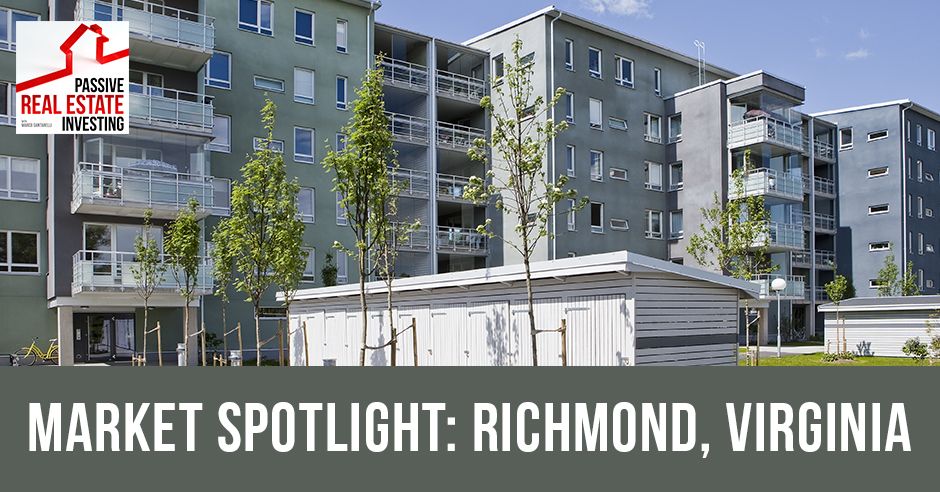
In terms of real estate investing in the various great Southern cities, people don’t think as often about investing in Richmond, and that’s a huge missed opportunity. Prices and properties in Richmond are great, and more investors out there should definitely take a look at what this city has to offer. Marco Santarelli shines a spotlight on why you should be investing in Richmond, Virginia. It’s a very diverse market and definitely deserves the spotlight after having been in the shadows of other Southern cities for so long. See what Richmond might be able to offer you!
—
In this episode, our focus is on the Richmond Virginia market. Richmond is the capital city in the State of Virginia. The Richmond Metropolitan Statistical Area, the MSA, is the 44th largest in the United States. It includes independent cities such as Richmond, Colonial Heights, Hopewell, Petersburg, as well as a number of surrounding counties. The population of the Richmond Metropolitan Statistical Area is very close to 1.3 million people and a growing international community adds to the areas of cultural diversity and cosmopolitan character. It’s a metropolitan area that is strong, vibrant and growing. Richmond’s economy is primarily driven by law, finance and government with federal state and local government agencies located there as well as multiple legal and banking firms in the Downtown area.
The city is home to both a US Court of Appeals, 1 of 13 such courts and a Federal Reserve bank, 1 of 12 such banks. Also, Dominion Energy and WestRock are there. Fortune 500 companies are there and many others in the metropolitan area adding to the economic diversity. As far as regional trends, population growth has been very positive. It’s grown by about 2% and job growth has been over 4% putting it in the top 80% nationally. Income trends have been strong. Incomes have increased by over 5.6%. The unemployment trend is also very strong, dropping about 1% and putting it in the top 80%. That market continues to add housing units which are needed and have very low vacancy trends so there is strong demand for rentals.
The market has seen about a 4.5% appreciation growth. It is a fairly strong market. I would call it a growth market when you’re at that 5% range. What’s interesting is it has seen over 14% appreciation putting it at the top of the country. This isn’t top 10% of appreciating markets or at least has been for the last ten years and very much so in the last five. I don’t expect that to continue in any market around the country, primarily because of the Coronavirus thing and the effect on the economy that it has had.
When we bounce back, we tend to bounce back strong. I am very excited and bullish about this market. Last but not least, in terms of national rankings, the median house cost in this market is 68%. That means compared to all markets across the United States, this is in the 68% mark. Cashflow potential for this market is very strong. It’s at 79% in terms of a national ranking so it’s in the top 20%. Rent growth has been very strong, certainly above the midway point at 57%. It is also a strong rental growth market.
Download your FREE copy of: The Ultimate Guide to Passive Real Estate Investing.
If you missed our last episode, be sure to listen to Ask Marco – Buying Turnkey Properties With a 15-Year Mortgage?.
Enjoy the show!
– – – – – – – – – – – – – –
Download your FREE copy of: The Ultimate Guide to Passive Real Estate Investing.
Get your FREE coffee mug by leaving us a Rating and Review on iTunes. Here’s how.
See our available Turnkey Cash-Flow Rental Properties.
Please give us a RATING & REVIEW (Thank you!)
SUBSCRIBE on iTunes | Stitcher | Podcast Feed
Market Spotlight: Richmond, Virginia
With me now is Frank. He is one of our fantastic new providers in the Richmond, Virginia Metropolitan Area. We are excited to have him on. I’ve known Frank for many years. He’s a real solid guy. He puts out a great product and we’ve been able to get product or inventory from them. We’re excited to be working with them. We’ve already got many clients working with us and with them and his team on the ground. Things are rolling along. Frank, welcome to the show.
Marco, thank you very much for having me. I appreciate it.
It’s great to have you on because we want to get the Richmond Virginia market exposed and my investment counselors here have been saying, “Let’s get Frank on. We’ve got to talk about Richmond because we’ve got to educate the investors out there.” Let’s talk about Richmond. Richmond is an interesting city because it’s so old. It has a lot of rich history as far as the United States is concerned. You live there and like it. Tell us a little bit about Richmond, Virginia and what’s it like.
I was born in New England and I grew up in Florida. The way that I ended up in Richmond is I lived in Northern Virginia, which is a commuter town. DC is cool but Northern Virginia isn’t. I lived in Charlottesville for about seven years and it’s a small college town in the middle of the mountains. I moved to Richmond for a couple of very specific reasons. I already had my business and Charlottesville was too small. There wasn’t enough volume in Charlottesville, but there was a ton of volume in Richmond. I was single at that time. I was in my late 30s and I was in a college town. I was in the wrong place. I moved to Richmond because it’s a vibrant place that attracts young people.
I’ve chosen to live here because it’s a great southern town. You don’t hear about it like Charleston or Austin. It’s not nearly as expensive. It has no traffic. It’s got great people and it’s got a lot of cool things. You mentioned history. It’s got a great history. It’s got great rivers. It’s known as River City in some ways because the river cuts through. You can go kayaking, walking and hiking. I’ve got an eighteen-month-old and my wife and I take her for a walk all the time along the river. It’s a cool city that attracts young professionals. It’s a great spot to be. There’s not a lot of traffic and it’s still close. We can be in DC in 90 minutes. We can be in the mountains. We can be to the beach but it’s a cool, small southern city that’s nestled on the Atlantic seaboard.
I’m an investor. I’m in California and I’m now looking at Richmond for the first time. From a very high level, why would I want to invest in Richmond, Virginia? Give me the cliff notes overview.
Here’s the best reason to invest here. We’re a diverse market. We can bring you the product at sub-$100,000 and we have products in our market that sell for $3 million to $4 million. We’re not California. You can’t buy a $5 million condo here, but it’s a diverse market and this is what makes it great. The lower-end stuff, $150,000 is in the path of progress. You don’t have to go somewhere with a pocket knife to get $150,000 house as you do in California. Its 3, 4, 7 blocks away from where it’s vibrant and it’s renovated. We can provide incredible returns and good property back with Section 8 rents. That’s hugely important because our people are all paying because the government is paying a lot of their rents.
It’s several blocks from the path of progress. If you’re an investor who wants returns, you can get that with us. If you’re an investor who wants appreciation to potentially sell, you have that as well. If you don’t mind the appreciation but you don’t want to sell but it’s always nice to have that in your back pocket, that’s the beauty. It’s not like we’re fractioned off like we’re on the other side of Crenshaw in LA. Our stuff is very close to a $400,000 house. That’s what makes it so attractive to me. We own hundreds of units ourselves and I had double, triple, quadruple in 4 to 7 years because the market’s been great. The neighborhoods that we invest in are great and that’s how this place is built.
I always consider the condition of the economy and what makes up the local economy because I don’t like markets that are solely focused on 1 or 2 industries like oil and gas, for example. What makes up the local economy there in broad strokes?
I wasn’t all that great as a student in 4th and 5th grade, but Richmond is the State Capitol. It’s a huge tourism draw because we were the home of Confederacy in the Civil War so there’s a lot of rich history. Into the 21st century with the State Capitol, we have a lot of medical and financial services like Bank of America and SunTrust. Capital One is the biggest employer in the marketplace. There’s a lot of banking and servicing. Amazon has got a huge presence here. This used to be the tobacco home of the world, so it used to be called Philip Morris but now it’s Altria. They’re big. We’ve got a diverse makeup of big employers. The healthcare system is big here. As I mentioned before, there are universities but then there are offshoots, so there are good medical colleges.
We have a lot of high paying jobs. If you look at the median income, it’s not California median, but our median income is at or above the national average, and we have a lot of educated people that will move here. There’s a service sector of this market that’s huge. These are a lot of state jobs so these people don’t get affected the way they have in a lot of the other markets. They’re not restaurant workers in a lot of instances. The people with decent jobs are retaining their jobs and we backstop as I said with Section 8. That’s what’s so beautiful about it. We’ve got good employers, but we also have working-class folks that do a lot of renting from us and it bounces off the market.
I know Richmond is primarily driven by law, finance and government, but you’ve got all kinds of other sectors and industries there. From what I’ve read, you even have supposedly a huge BioTechnology Research Park. I don’t know if that’s a new thing or if that’s been around for quite a while.

It’s on the cost but it’s new-ish. It’s located on Capital One’s campus where a lot of it takes place and there are other things that come to it. I mentioned I grew up in Florida and this is relevant for this reason. I moved to the DC Metro Market in 1998, so I’ve lived in the State of Virginia for 22 years. CNBC ranks the business-friendly states and Virginia is always on the top of that list, usually top ten and many times top five. You asked about the research triangle that’s about three hours south of us with Durham in that area. The DC Metro Market, which is 90 minutes north, has a lot of government contracting and the Dallas Corridor has got tons of IT. It’s 2 to 3 times more expensive to be up there from the cost of a house. The commute is awful. What we have seen is a lot of migration of these businesses come 90 minutes south. Their employees can live at a much lower rate and they can offer satellite offices here that will report up to the bigger offices. That’s where a lot of that tech comes from is it’s a Northern Virginia influence, but it’s so much less expensive for office space and for staff to be. That’s part of our growth.
Let’s talk about the areas and the neighborhoods that you focus on because neighborhoods are very important. Generally speaking, they can range from your low-income C-class neighborhoods to the higher income A-class neighborhoods. What neighborhoods are you guys focused on and why?
It all starts with our product. I mentioned it several times. Our bread and butter is a three-bed, one-bath that runs for right around $1,300 a month. We can rent those things in minutes. We got a waiting list for people who want to move into them. We’re going to talk about what we do with the product, but we go to places where that stuff makes sense. I tongue-in-cheek said you don’t need a pocket knife to go where we go. I moved from Florida to Virginia and it’s moving through a time machine backwards. Florida is a planned area like Arizona is in California. Those were planned.
In Virginia, it felt like there was a path with someone walked through first, took a machete to second, railroad a horse through third and they said. “Screw it. Let’s pave it.” That’s how it all is. There’s a ton of sprawl. There are $100,000 houses that are 7 or 8 blocks away for $1 million houses. We try and find the neighborhoods that are nestled properly, that are in the path of progress. It’s not very hard to tell. If you look at Phoenix, Arizona and Richmond, Virginia, geographically it looks very different, but this is why working with a partner like us makes so much sense. We know the markets and the places to not go and the places to go. We’ve been doing this on our own, as I mentioned. We pick the right places where the product and the neighborhood all jive. Running to people like Marco and me, we’re pains in the ass.
You do not want to rent to us. You want to rent to a professional renter who understands what it’s like to be a good tenant and who likes to be a tenant, who doesn’t have aspirations to be homeowners. What we do is we pick neighborhoods where people will want to go, want to stay and they want to stay in that property. We’ve been doing this particular model for years. We retain the 90%-plus of our residents. That’s a big number. If you’re going to buy a property from us, you want someone to be in the property year over year. The property’s got to be right and so does the neighborhood. We pick those things in conjunction with one another so we don’t turn over our tenants regularly.
Can you touch on the demographics a little bit? Who or what type of persons are in these neighborhoods that you’re talking about?
This is working-class stuff. Now and again, you’re going to see a Tesla or a Mercedes Benz parked there, but by and large, you’re going to see vans. Most of these people make somewhere between $35,000 and $50,000 a year. The people who rent from offsite, I’ve said this multiple times in Section 8, they qualify for a voucher. If it’s a single person with a couple of kids or it’s a stack of a family where there might be a grandparent, an aunt or an uncle living there as well, that’s who our bread and butter are. We do a good job for these people though. We have folks that look and sound like them who come to the houses. We have people who live in similar neighborhoods that work for us who provide maintenance. If you can qualify, we’re going to run it to you. We’re good at reading the tea leaves to make sure that you look good on paper but you’re going to perform. It’s not that you look at on paper and then you default. We don’t discriminate. We take a good qualified candidate who we think will pay the rent. Ninety-three percent renew year-over-year so we’re good at filtering that out.
You mentioned Section 8, I have a two-part question. First of all, how many of the tenants that you place are Section 8 as a percentage?
It’s between 85% and 90%. That’s through our whole portfolio.
People reading this blog never heard any of this for the first time. People have mixed feelings about Section 8. Most people either love it or hate it and there’s a very small amount of people who are in between and indifferent. Talk about Section 8. What is it so people know what we’re talking about when we’re talking about Section 8 tenants? Why do you use Section 8?
When I say we’re roughly 90%, we own a small apartment building and some other things. Globally, we have about 300 units. Of those 300, it’s right around 90% that are subsidized. That’s what Section 8 is in its grandness form. It’s some level of helping people with affordable housing or allowing folks that can’t get a property to get them into something. They can stand in their own two feet. I say Section 8 when I use the 90% number, but what we use is we use not-for-profits and other folks that are in our local market who have housing programs or housing vouchers. These are people who are grateful for a home and they’ve been qualified in some form or fashion. With Section 8, we’ve got their hoops that you’ve had to jump through. I have a local church who is run by fifteen houses from us and they had their criteria.
These are people who are thrilled to have a nice house. We’re going to talk product. We renovate our homes to a standard. Some of these homes are older. They are built right around World War II in the ‘40s, ‘50s and ‘60s. We make sure we’ve appointed them so when they move in, the electric bills aren’t too expensive and that they can afford to live there. These are the small things that a lot of people don’t do. There are slumlords in every market. We’re not that. We like to provide a sense of real pride of rentership so people move in and people will stay. Let me ask you this question because I can answer it my way, but I’m more curious from your perspective and I’ve of course heard it. When you said there are negative connotations around Section 8, what are the negative connotations that you’ve heard?
The two biggest reasons are, one is the bureaucracy and red tape involved with Section 8 when you have a tenant move out. You have to turn it over and have it inspected. Sometimes if you have a bad inspector, they come in and nitpick a bunch of things. You have to go back and address those things. Even if they’re low costs, ticky-tacky stuff, it wastes time that you could be marketing the property and placing a tenant. That’s been my personal experience on a few properties and I believe that’s why other investors don’t like Section 8. They love it when the tenants are placed because the income comes in clockwork. It’s sent by the government, not by the tenant. It’s a beautiful thing once you have the tenant placed but the turnover is sometimes slow.
I know this is market by market. That’s the biggest reason for the dislike for Section 8. The benefits are there. Sometimes Section 8 pays more than market rent. You get a little bit of a bumper premium and it comes in clockwork. This is anecdotal. The second and the only other reason why some people dislike Section 8 is that this relates to personal experience. For some people, because of the demographic of the Section 8 tenant, they’ve had a bad experience when the tenant has moved out and they’ve left a bunch of trash and some damage and stuff. They’re not the type of demographic that you’re going to find in a premium A-class neighborhood. It’s a little bit of a messier turnover.
I’m going to address both parts of this, the inspections first, and I’ll deal with the tenants second. On the inspection side, we renovate our homes to a standard where the inspections are not hard to pass. Do we fail some? Of course. We might miss grounding an outlet or there could be a problem but it’s usually minor stuff. Section 8 in our market inspects annually. We have a relationship with them where they inspect our stuff every other year because we have such a good record. If there’s a turnover and you become a private owner, they might inspect it but this is minor stuff. The inspection is $200 to fix. It’s a low barrier of entry and as I said, our stuff is renovated to withstand these types of inspections year over year.
It goes from a speed bump to almost flat road because we’ve tried this ground so many times in the past. We don’t see that as a major issue. This is something that I hear a lot and if you didn’t bring it up, I was going to volunteer it. People in the Section 8 Program are there for a reason. They’re not me. They’re not Marco. A lot of these people are professional runners. When I say professional runner, they’ve been in runners since Ronald Reagan was in office for a long time. That’s okay if you know how to deal with it. Our entire system knows how to deal with this. We do not do A-class stuff. We do C and B stuff, and we have a lot of these types of tenants. We can scratch into VA neighborhoods but we’re built for this.

Our property manager understands and speaks this language incredibly well. If you do not speak the language or work well with Section 8, this could be a massive hassle. Not for us as we offer property management to deal directly with these people. The woman who works for us that runs our heads up our rental division, she’s been in property management in and around Richmond for 25 years. She knows everybody over there. It’s a smooth process. They put us towards the top of the list because they know that when we bring in a property, we’re ready. We’re not going to waste their time and effort. As I said, we do fail now and again, but by and large, we’re ready to go. The tenant is able to move in and they like that. They’re collaborative with us.
The Section 8 office will say, “I’m looking for this type of product. I have someone.” We’ll try and find something for them or we’ll work together. They trust us and they know that there’s someone in their system who didn’t have the right landlord who they need to come to us and we can do that for. In a lot of instances, this has got our name on it because we are a company that does it for ourselves, but we also have twenty plus outside owners that we do this for as well. It’s the same process because they’re working with the same manager. I want to get a little bit deeper on the tenant too, if you don’t mind, Marco. There are scumbags in all walks of life. Bernie Madoff was living in a beautiful tower in New York and he turned out to be a thief.
There’s no way that you can be 100% accurate. You have to have feel. We’ve got a feel. Are we perfect? No. Are we 90%-plus perfect annually? Yes. That’s what this is. This is a people business and sometimes you get a gut that you should take a chance and you should get a gut that you shouldn’t and that’s what we’re going to do. The way that our system is built, and we have this in front of your folks and counselors, is there are some guarantees with our rents in year one to make sure the year that you do take ownership of this property, we guarantee that the rent is being paid. Those are things that we bring to the table because we take this seriously. I’m a former executive of a publicly-traded company that now has my own small business.
We run with a great deal of sophistication and we understand how important it is. If you’re believing in us, your staff and your clients are buying stuff from us, we want to perform. We don’t want you to have one property move on. We want you to do the opposite. We want you to do one feel good about it and say, “I want to go back to Frank and Cindy. I want to do more with them. I love the product. I love what’s happening.” All of this works in an ecosystem and that’s our goals. To satisfy you as the customer and to satisfy our residents as well. That’s it. It’s an integrity-based product that self-serves itself. You can’t please everybody. If everyone is getting good service, they tend to stay even if they’re a little irritated from time-to-time. The other side of it is if you show them respect, they do trash it from time-to-time when they move out.
It’s very rare. As we’ve gotten good at this system and getting the right people in the door, we’ll identify problematic people and we might say, “We’ll throw $500 at them if they’ll leave the broom and sweep on the way out.” That’s way cheaper than dealing with something. The other thing is if you deal with integrity in the entire time, you may have to help them on the way out. They’ve lost a job or something negative has happened. We work through it with them and we say, “We understand. Let’s leave the place broom swept. Help us on the way out. Let’s do those little things.” This is the stuff that our property manager brings to my attention, but we’ll bring it to your attention too. It becomes collaborative so you can take a situation and neutralize it by being proactive and helping the people. That’s what we have seen. Most of these folks are very good citizens.
One of the key points that you said that I totally agree with is that this is a people business. We’re dealing with humans, with people. If you can relate and understand, be firm but fair, you’ll go a long way. That’s what makes good property managers is they’re firm but fair and they know they’re dealing with people. They’re not dealing with robots.
I’ll give two examples. When I brought Cindy, she started getting thank you letters. I’ve been doing Section 8 for a decade, nobody got thank you letters. She did because she’s firm but she’s personable and she gives them what they need. This is an anomaly, but I’ll say it anyway. I was bringing my parents out showing them properties and I showed them one that a woman had moved into a Section 8. The woman hugged me in front of my mom and said, “This is the nicest house I’ve ever lived in.” If you’re buying an investment property, these are not houses that we’re going to live in. These are houses that are built for return and they’re built for residents. They’re built in a way that allows them to afford to be there but it’s us as investors, we get what’s most important, return. That’s what we’re going for. This is a return game and that’s how these things are built.
Let’s talk about those properties. Properties vary from market-to-market as you mentioned at the very beginning and very much so by neighborhood. Describe a typical property in the neighborhoods that you’re operating in right now.
Richmond is old historically for America. Most of it was burned to the ground in the late 1800s at the end of the war. Most of the stuff that we deal with here is built in the 1900s and later. There are two segments. There’s the stuff that was built 1900 and 1925 and then there’s a crummy period from 1925 to post World War II and picks up around World War II after, so 1945. Most of our stuff is built in those two pockets, 1900, 1925 or post World War II. What we do, we have 25 people on staff. I have a class-A license. We renovate and sell tons of homes. If you go and find out who we are in our marketplace, we do tons of renovation. We can renovate $1 million plus houses. What we do is we go in and then we look at whatever house we’re inheriting, no matter the age and we fix the things that are going to potentially be albatross going forward. Roofs and windows, we renovate to a standard.
That’s what we do. We also renovate to a standard that’s easy to repair. One silly thing like hardwood floors and a lot of our house we inherit because that’s how they used to build them in the old days. Instead of going back and refinishing the hardwood floor, we stain it with deck paint and then we put poly over it. It’s about 1/6 of the cost to do that versus to finish it with a house that I live in that’s been sanded and polished. Why is that relevant? It’s easier to maintain if it gets screwed up. It’s cheaper to fix and it’s built. The house is built and renovated to a standard that allows it to perform. As one of my friends says, “It’s built for battle.” It’s built to put people in it who can live there successfully, safely over time but they don’t call you every three days with a maintenance request. That’s how we build the house. I hope that answers what you were looking for.
That gives us an idea of the quality that you’re putting in. What does a typical scope might look like? We don’t need to get into the details of this because it’s standard across a lot of markets, but if you want to brag about it, that’d be great.
Every house you inherit is a little bit different because we’re buying inventory that was already here in most instances. We take what’s there and we make sure everything has at least five years of life left on it or we replace it. If we don’t think the roof has between 5 and 10 years left, we replace it. Not all of our units have HVAC and it doesn’t affect the rents. If it has HVAC, we make sure it’s got 5 to 10 years left on it or we replace. A lot of the CapEx has done before you’re going to take ownership of it because we want to make sure that the expense is done before you take ownership of the house.
Give us an idea of the price range, the low-end and the high-end of these turnkey rental properties. What is the monthly rent on that same range of property just so we have an idea of what the ratio is with prices and rent?
I don’t know where the market is going, but as where the market is now, $90,000 to $100,000 is the low-end and somewhere in the neighborhood of about $175,000 is high-end. If you said, “Frank, what’s your median or average?” I would say, “$150,000, something smack in the middle of that.” We are bringing almost everything to you guys with an 18.5% or better cash-on-cash return. If we are getting $1,300 a month for rent, that’s going to sell for between $140,000 and $150,000 in most instances. If I had to say an example, it rents for $1,300. I sell it to you for something in the neighborhood of $140,000. If you cash-on-cash and cap rate, those numbers are very favorable. Our taxes are low in our market compared to if you go further north in Northeast Pennsylvania or New York State, we’re a fraction of those. Our mill rate is $1.20 per $1,000. Our rents right where they are with the lower taxes gives it a nice return.
I want to highlight one interesting thing that relates to what you said. A lot of investors are trying to shoot for that 1% rent-to-price ratio. You won’t find that all the time in every market. Markets fluctuate and change. Those ratios change from neighborhood to neighborhood. If you go into better-quality neighborhoods, that ratio goes down. The point I’m trying to make is that you don’t have to have a 1% RV ratio. It can be higher or lower and you can still have a great property with solid cashflow and good returns. You highlighted some examples where you have strong cap rates and strong cash-on-cash returns, but you’re dealing with let’s say $140,000 to $150,000 property that rents for $1,300 or $1,400 a month.
That’s not a 1% rent-to-value ratio. That’s 0.8% or 0.9% and that’s okay. As long as it’s above 0.7%, you’re going to have favorable cash-on-cash returns. The other thing to consider too, to look at things holistically, is to consider the market in the neighborhood you’re in. You may have very strong appreciation potential over the next 1, 2, 3, 4 or 5 years, which will far make up for the cashflows that you get from that property with a better rent-to-value ratio. Don’t be penny-wise and pound-foolish as they say. I wanted to point that out because some people might be reading thinking, “It’s $150,000 property. It’s a fantastic rental but it “only” rents for $1,300 or $1,350 a month.” Don’t be shortsighted. You got to look at the whole picture.

You said two things are hugely important. One of them is the initial number. The initial number is, “Here’s your rate to get you in the door. What’s the turnover rate of the person that you’re working with? Are those tenants going to stay? If you have a five-year tenant, how much do you raise the rents annually?” What we usually do with a Section 8 tenant is we leave it flat for year one. They lived there for 24 months before we raise it. We raise it somewhere between 5% and 6% and then it’s 3% to 5% every year after that and it all works. If you look at what our projections look like long-term, that rate is a little bit lower on the front end. We’re not turning over the tenant and then year 3, 4, 5, 6, we’re getting fractions of money more per month. We average a 4.5% raise on rent per year. That’s our average across 300 houses. That makes a huge difference long-term and that’s what you’re going for, that year three and year six rent. You haven’t turned somebody over. That’s a sweet spot.
I want to talk about property management before we leave the whole content topic of properties. What would you say are the types of neighborhoods that these are in if you were to grade them? I know this varies from person-to-person when I asked this question. Generally speaking, are these like B or B-plus type neighborhoods? What would you call them?
They’re solid Cs. There might be some Bs. There are no Ds or Fs. They’re working-class neighborhoods that are seven blocks away from B or B-pluses. That’s where this stuff is.
Let’s finish up with property management because management is very important, especially for people who are investing out of state or long distances away. Describe the property management services. It’s common from market-to-market but touch upon it and then tell us what those terms are under your company’s management.
Here’s why we sell properties and why we offer property management. It gives us as a business another resource and it’s another tentacle to business. Why should you consider us for property management versus somebody else? Here’s a bunch of reasons. If we’re rented through Section 8 or some other program that’s on some a voucher or assistance, we already have the relationship with them and we’re already collecting rent. There is no ramp-up period for you. We transfer going from our bank account to your bank account if you take ownership, so it’s instantaneous. We do direct-to-seller marketing and advertising. We buy 300 to 400 houses a year. We’ve already bought the property. We have a relationship with the property. We understand what buttons to push and what not to every single property, so we made the decisions at the turnover.
It’s like if you take your car to an auto mechanic, they tell you the next guy or that last guy was an idiot. He just had a different perspective on it. Whenever someone calls the last guy an idiot, I know I’m getting billed way more. That’s the beauty of sticking with us. We understand what the decision metrics were that went into making these choices. Because of that, if we’re managing it for us or if we’re managing it for you, we’re going to make the best possible decision because we know the property. This makes a huge difference, Marco. Nobody in my business knows if I own the property or somebody else owns the property. When they go out and they do a service call, they think I own it even if I don’t. I’ve got twenty-plus employees as I said earlier. To them, it’s another one of our rentals. They treat them all the same. They treat it like it’s mine and that’s the benefit for you because my staff is not going to gouge or do other things if they think it belongs to me because I signed the paycheck.
It’s one of those things that work hand-in-hand. It’s a nice thing. As I mentioned, we have several dozen outside owners that we work with. It’s a good relationship. We stand behind what we do. I said it’s a people business on the other side. It’s a people business with you. If you decide to work with us and you want to feel comfortable, call us. Talk to us and ask questions. That’s allowed. It’s encouraged. Feel comfortable. This is your money and your investment and we stand behind our product. Is it perfect? Is it all marbles and travertine? No. Is it something that does a great return? Yes. It’s where all of my money is invested. What we do on the property management side, the property and tenant make a lot of sense. The property management is the one who exposes for bad or realizes the good. If you’ve got someone who already knows the tenant already brought them in, it’s going to make your process of collecting so much better.
I don’t want to ask you this question because it almost doesn’t matter when you have good properties, good neighborhoods and good management, but do you have any stats on occupancy rates or turnover times or anything like that? I know a lot of property managers keep track of that data.
We’re over 96% occupied. I’m talking about this while everybody on lockdown and nobody can go anywhere and we’re in the middle of COVID. We ran a 0% vacancy for about eight months in a row. If we have a vacant unit, we don’t bring it to you guys until it’s turned. Once we have a vacant unit, we have a tenant in place within twelve days. From advertising to move in, it is twelve days. What we will normally do is we’re already looking ahead at July move-outs. We’re looking 60 to 90 days in the future and then we start advertising 30 days ahead or 45 days ahead. In many instances, if we have a turn, there’s a tenant in there within a week. It’s usually days but within a week is almost guaranteed.
You mentioned one thing I want to hit in. We get 121% of market-rate on our rents and I had my CFO build that out. The reason that we’re able to do that for similar properties is that we utilize the vouchers. The downside of the vouchers is a negative connotation. The upside is they’re willing to pay and because of that, you get guaranteed rent and it’s way better than what the neighbors are paying around because it has that voucher with it. From our perspective, we love it. It’s guaranteed. Not only guarantee, it’s more than we would get if we found a market-rate tenant. It all works.
I’ll point out one quick thing to address and to piggyback on what you said. Some people might be thinking, “What if I lose the Section 8 tenant and one day down the road, be it a year or ten years, I want to rent to a plain vanilla traditional market tenant, not a Section 8 tenant? It’s my choice to do that.” The interesting thing about that is the property still makes sense. It still cashflows. It still generates a good rate of return, even if you’re leasing it to a normal traditional market tenant. It’s not that you have to have a Section 8 tenant. It’s you getting a bumper, a bonus.
The choice is yours.
Any other comment you want to make about the properties or the market?
I think we’ve done it. Thank you for your time.
You did a great job. Thank you for all the details. Thanks very much for everything you do, Frank.
It’s my pleasure. Thank you.

—
To learn more about the Richmond, Virginia market and more specifically about investment opportunities that are available there or coming down the pipeline, be sure to reach out to your investment counselor. If you don’t have an investment counselor, fill out the form on our website. We will immediately assign you to somebody. You can have that conversation and we will certainly educate you at no cost. We want to help you with the knowledge and the resources that you need to build your real estate portfolio and become successful at real estate investing.
If you are new or you haven’t read The Ultimate Guide to Passive Real Estate Investing, just go to either one of our websites and download that free report. There is no obligation. It is a fantastic primer and you will find it helpful. The other thing too is if you are new to real estate investing and you want to get a direction and maybe a bit of a roadmap on how to proceed and move forward, then talk to one of our investment counselors about a strategy session. The benefit to you is that you’re going to get more clarity in what you should and even shouldn’t be doing so you can be successful.
Whether you’re ready now, six months or a year from now, this will at least get you into the loop and start building that relationship with your investment counselor. It’s a good idea. Even general questions about real estate investing, if you have those, by all means reach out to us. That is what we love talking about is a real estate and investing and the combination of the two. Remember to subscribe to the show. If you haven’t done so already, just click the subscribe button, help us spread the word and leave us a rating and review on iTunes. We greatly appreciate that. Thanks for reading the blog. See you in our next episode.
– – – – – – – – – – – – – –
Download your FREE copy of: The Ultimate Guide to Passive Real Estate Investing.
Get your FREE coffee mug by leaving us a Rating and Review on iTunes. Here’s how.
See our available Turnkey Cash-Flow Rental Properties.
Please give us a RATING & REVIEW (Thank you!)