
The concept of wealth has evolved throughout the years. In today’s world, it is often understood as something to look forward to in the future, that is, retirement. We all get pressured into working for that financial freedom that is often misconstrued as a faraway goal to work away for. Daniel Ameduri, a self-made multimillionaire and Cofounder of Future Money Trends, believes that retirement is a failed experiment. A full-time skeptic of conventional thought, Daniel says it is possible to enjoy a great life now and also live the life of a retiree by focusing on what the wealthy invest in. He tells us, Don’t Save for Retirement, and through his book of the same name, he takes us deeper into the reasons why.
Download your FREE copy of: The Ultimate Guide to Passive Real Estate Investing.
Identify great tenants using SmartMove. Visit www.TenantScreening.com and Save 25% using podcast code NORADA25.
Try LandGlide FREE for a week by visiting www.LandGlide.com/PassiveInvesting
—
From the moment we have even a small understanding of money, most of us believe that being wealthy means financially successful. In practice, wealth means something different to each of us and we each must undergo a personal journey to reach that understanding. We are in a tough situation as a society. As the economy inflated, our expectations inflated as well. It’s difficult to overcome peer pressure when we are young and it’s just as hard when we are older. We never learned how to manage money in school and we were conditioned into a certain lifestyle by our parents based on how they were raised. Our idea of wealth may change throughout our life and our plan should reflect those changes. Like a diet, you have a plan to follow to achieve real wealth, but it’s about making behavioral changes and shifting your mindset. Start by asking yourself how you want to spend your time and whom you want to spend your time with. We all need an occasional reminder of the goals we’ve set and the reasons we’ve chosen our paths. You will enjoy my guest as he’s been down this road and he has figured it out.
If you missed our last episode, be sure to listen to Lessons Learned From Jim Rohn and Other Great Legends with Kyle Wilson.
Enjoy the show!
– – – – – – – – – – – – – –
Download your FREE copy of: The Ultimate Guide to Passive Real Estate Investing.
Get your FREE coffee mug by leaving us a Rating and Review on iTunes. Here’s how.
See our available Turnkey Cash-Flow Rental Properties.
Please give us a RATING & REVIEW (Thank you!)
SUBSCRIBE on iTunes | Stitcher | Podcast Feed
Don’t Save For Retirement – Daniel Ameduri
It’s my pleasure to welcome Daniel Ameduri to the show. Daniel is a self-made multimillionaire and a full-time skeptic of conventional thought. He’s also a proud father of three. He is the Cofounder of Future Money Trends, a newsletter with nearly 150,000 subscribers, which is unbelievable. It is one of the most widely-recognized online authority sites and channels in the investment area, as well as a site where you can get economic advice. Daniel has been featured in the Wall Street Journal, on ABC World News Tonight, on Russian Today TV. He has correctly predicted the collapse of Lehman Brothers, AIG and Washington Mutual on his Victory Channel back in the day. His YouTube channel was launched back in 2007, which now has more than thirteen million views. I can also proudly say that I’ve been a fan, friend and subscriber of his for several years. Daniel, welcome.
Thanks for having me.
I met you a long time ago. I think we first met in Palm Springs and I’ve always been fascinated by all the topics that you talk about on your show and the things that you do. You’re a guy who’s young, successful, you’ve got your head screwed on right. You’ve got a great family. You travel the world. Tell us a little bit more about yourself because you’re just a well-rounded person.
I’ve always been fascinated with money, even as a kid at five years old and never materialism. I was always interested in and always preferred reading personal finance books, self-help stuff and Tony Robbins over going to school. That was my whole life. I was fascinated by it. I got very lucky despite having lost a lot of money, even though I accurately predicted the collapse and even bought puts, I had a lot of foreclosures during that time. I got very lucky that I started YouTube as a hobby and it turned ultimately and evolved into a business. I’m very grateful for Steve Jobs and Bill Gates and everybody who made the personal computer and internet possible for us.
We’re going to talk a little bit about your book. I’ve actually looked at a manuscript copy of it and thumbed through it and started reading bits and pieces of it. There’s a lot of stuff in there that resonated with me. We can talk a little bit more about the book as we go. One of the things you talk about, first of all, for those who don’t know, the name of the book is Don’t Save for Retirement. I’ve never liked the idea of retirement because of two things. First of all, why stop doing something that you like to do, assuming that it’s something that you enjoy in the first place. Secondly, I think the word retirement almost implies that you’re looking forward to something better and you’re only putting up with something that you’re doing now and for however many years because ultimately you’re going to get to this place of bliss called retirement. How do you see retirement and does retirement even make sense in this day and age?
I see retirement as a failed experiment. A lot of people assume that it’s been around forever and it hasn’t. You can say there were some pension funds for Roman soldiers, but then you skip 800 years and then you’d go back to the Germans in the late 1800s. You’ll see that the only reason they even have the age of 65 is that these two German politicians were running against each other. One at 70, the other at 65, trying to win an election. The entire retirement cartel we have now essentially where they’re separating people from their money. They’re convincing them to defer their happiness, joy and enjoyment of their money for 30, 40 years and speculate with that money in the stock market. It’s an entire industry. They’re making a fortune from the fees, from the vehicles, from the 401(k)s, from this entire strategy. They have convinced the middle-class not to invest and save like the rich. It’s a real crime because the generation that had the most success with it, it’s like the top of any pyramid. You look at the first person who put in $28 in Social Security.
They ended up getting $30,000, $40,000 back over their lifetime. Of course it worked out for that first go. You get the Baby Boomers who had the best setup ever with the bond market, the stock market, the real estate market, and even the ones that were high-income earners, they had to live like peasants to have enough to save for retirement. For the most part, over half of them, according to Fidelity, it’s not even working for them anyway. For the Millennials, Gen X-ers and Baby Boomers still out there looking to become financially independent, there’s a much better way and I think it’s a much better life. The Millennials have that trend, but they’ve over-corrected. They’ve gone to minimalist or living in vans. You don’t need to do that. You can enjoy a great life and you can live the life of a retiree, whether you’re working or not working, by having a focus on what the wealthy invest in.
In your book, you talk about this overspending epidemic that we have in our country. This is a segue to what you were talking about because you mentioned Millennials. First of all, let me ask you this question. Is the book geared towards Millennials? Because that’s the subtitle of the book.
It’s because I’m a Millennial. The reason I added that part in is because so many people, Baby Boomers and Millennials, are writing this generation off like the deck is stacked against us. That’s ridiculous. I think the deck is stacked for us. What generation could start a business for $10 on GoDaddy? What generation could start being a professional driver for Uber or build an entire empire on social media and YouTube? Freelancing. The Millennials have it perhaps better than previous generations. I wanted this to say, “Wake up, Millennials.” The book is, of course, for everybody.
Especially now in the so-called information age, we have access to information at our fingertips, in our pocket through our smartphones. The ability for us to be able to set up a business in literally one day and be able to market to a market of eight billion people worldwide is unprecedented. It’s never happened in the history of humanity. There isn’t an excuse to not be an entrepreneur now. One of the chapters in your book, you talk about this overspending epidemic in our country. Even without the crazy $1.5 trillion student debt problem that we have, I don’t think you’re talking about $5 Starbucks coffees here as an overspending epidemic. What do you mean by the overspending epidemic? What is that?
There’s an acceptance and normalcy that it is normal because your neighbors are doing it and your friends are doing it. Your mom and dad are doing it, your sister and brother are doing it. That five to seven-year, eight-year auto loan is normal. That if you make $50,000 a year, it’s perfectly normal to buy a $40,000 to $50,000 car. That if you make $100,000 a year, it’s perfectly normal to go out and get a $600,000 to $800,000 home. There are a lot of things that people think are normal, but it’s not and it shouldn’t be. When people talk about the latte, saving money on lattes, that’s what frustrated me. That’s how I even learned how to do some real deep cutting when I needed to back in ‘09 and 2010. I would go on the internet and there was so much frustration that all the savings advice is, “Switch your checking account. Switch your credit card. Stop drinking coffee.” I’m like, “Okay, now what? I’ve saved $25, now what do I do? I’m $1,000 in the hole.” That’s when I got into deep cutting that I talk about in the book. Whether you’re an LA officer and you need to move twenty more minutes into the suburbs or if you are somebody who can actually move out of state and save money if you’re in California.
The moving is going to be your best savings. I did crazy things. We stopped eating meat. We got rid of our pets. We did stuff that was probably unacceptable to a lot of people, but we made that short-term sacrifice. It’s not a permanent lifestyle. This is minimalism. I’m advocating for these documentaries on Netflix. I am not advocating for that. I’m saying you might have a year, eighteen months, maybe even two years of sucking it up, but it compounds rather quickly. What happened with my wife and me, the combination of extremely cutting expenses and paying off debt with the combination of buying passive income, it ended up balancing itself out rather quickly. We were able to do it rather fast over our time because we were so aggressive about it. We did stupid things. We left the beautiful city of Glendora, California, where all of our friends were buying $500,000 homes, and we moved to the desert and bought a $95,000 house. We were living like poor people. It allowed us to hit reset on our entire financial life. Now we’re very happy and financially free.
You’re not necessarily advocating extreme budgeting and living incredibly frugal for the sake of saving your way to wealth. I don’t believe in that concept. I don’t think it’s financially or physically possible to save yourself into riches or wealth. You’re saying that you’re cutting back and taking extreme measures for a fixed period of time, so you can take those savings and deploy them into passive income streams.
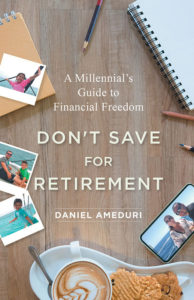
That’s exactly it. If I was to save and let’s say I wanted to put the money to 401(k) or the stock market, those are speculations that you’re hoping they’ll go up. That’s not what you want to do. You want to start putting in things that are actually bringing money into your life. You should check your mailbox every week and there should be something there for you. You should log on to your checking account and go, “Nice. The rental property company, ACH, the next profit check.” That’s the type of lifestyle you should seek. In my opinion, the Don’t Save for Retirement book, that’s what I put in there. The journey my wife and I went through, what we learned and exactly what we’re investing in. It’s simple stuff. If you think about it, the middle class is in a rush to get rich. They’re constantly speculating, hoping somebody will pay more for whatever they bought. The rich, they don’t have that fear in them because they’re rich. What do they do? They protect, preserve and buy cashflow, constantly capturing more income and that’s the name of the game. If you can condition your brain to do that, you will live a very fulfilled and free life. Ultimately, wealth to me is control of your time and what you’re going to do.
Is this problem spread out across all age groups? Is it confined from what you see to a particular demographic?
As Americans, I can only speak for Americans. It’s widespread. It doesn’t matter what age specifically because we’ve had such a debt-fueled and consumption-driven economy that it’s been conditioned into us that it’s very normal to finance things or to accept the credit cards. Look at our kids now. Over $1 trillion, I think it’s $1.5 trillion now actually. It went from $600 billion to $1.5 trillion in a few years because they’re so willing to borrow money. It’s what everybody else does. That’s the problem. In order to do this, you have to overcome societal peer pressure. I know my wife and me, when we were in our crazy saving phase, our friends said, “Let’s all pitch in $125 and do a limo ride and do a wine tasting.” We said no. Some of them said, “We’ll pay for you if you can’t afford it.” I’m like, “No, it’s not that I can’t afford it. At this moment in my life, I’ve chosen not to.” At the time, our priority was not to be poor. Think about the mindset in ‘09, 2010. Number two, my wife wanted to quit her job because we just had a newborn. We had our first child. It was very important to her and myself that we needed to liberate ourselves so that we could live the life we wanted.
It’s not that you were implying that everybody lives frugally and budget to an extreme. You’re saying that, but you’re not implying that has to be deep cutting and for a long period of time. Your solution is to cut back for however long it takes for you to get on your feet to start creating those passive streams of income because that’s when you can start to springboard this forward. Let’s take that forward. Let’s move that forward. I like how you talk about people’s investment strategy or investing strategy being stuck in the ‘80s. I had to read that twice because I didn’t know what you meant. After understanding it, that alone can be an entire episode in itself. First off, what do you mean by being stuck in the ‘80s?
Think about the last many years, anybody who’s reading. Think about what the world was like and then think about the next many years. Think about our school system. Our school system is deploying people into the world and the workforce with almost like the 1950s, 1960s education and skillset. When it comes to investment, all these guys show you all these mutual funds and the history of the Dow and all these things. They’re acting as if the Dow’s been around for 1,000 years and the 401(k) has been around since Adam and Eve, even though the 401(k) legislation was passed with the IRA in the late ‘70s and then enacted in the early ‘80s. For very specific reasons, as the pensions were being taken out of the system. If you look at what people are preparing for investment-wise, they’re preparing for a Baby Boomer who basically had the best stock market of any generation, had a demographics boom, had the internet revolution, had all these great things. That’s what they’re preparing for, but it’s simply not there.
Also the pension system isn’t there. Social Security isn’t even worth being there because it’s underpaying seniors by under-reporting inflation. We’re preparing for something that’s no longer there, the tools, the strategy. What I think people should go back to is the thousands and thousands of years strategy of the rich, which is owning things that make money. It’s very simple, even a stock. Buy stocks. I own stocks. My kids own stocks, but why do you own stocks that don’t share in the profits? The very purpose of having stock is to buy a fractional share of a business, but somehow we’ve forgotten about that a business’ ultimate goal is to share and bring in the profits to its shareholders and owners. It isn’t to just hope that several years from now, I’ll be able to sell Berkshire Hathaway for more than what I paid for it. How about sharing some of the profits?
We call those dividends, but there are very few stocks now that are actually paying dividends. Even then, it’s such a small return. I think the whole concept of a retirement plan or a pension plan is outdated. There used to be defined benefit plans and that went the way of the dodo bird and now it’s a defined contribution plan where it’s now on your shoulders as an employee, not the shoulders of the employer. You’re building up your own employee-based retirement plan. The whole concept of having a retirement plan or a benefit plan has gone out the window. You were talking about the stock market. Why are so many people in love with the idea of the stock market, when in reality it’s mostly the insiders that are making the large returns? We, the people, are just hoping. I emphasize the word hoping, that the price of those stocks goes up in time.
Wall Street has done a phenomenal job on conditioning Americans to think that’s where they should reallocate their capital. That they need to reallocate it immediately and hand it off to an expert who probably didn’t even study economics or finance as long as somebody who cuts hair and to give it to these salespeople. That this is diversification. It is buying more than one mutual. It is unfortunate that the middle class is participating in this with enthusiasm because if you look at what they could have been doing, the opportunity cost of not buying single-family homes over the past 30 years. Think about it. That’s insane. That’s incredible. Not just the tax deduction, but by then those Baby Boomers probably had those things paid off from somebody else. Those are pensions right there. I look at my single-family homes as pensions. You touched on something in the intro of this interview that it’s almost not even healthy. Think about trying to save money for many years and then getting rid of your active income and then all of a sudden withdrawing from that pile of money. That’s going to make you sick to your stomach. You’re going to have a scarcity mentality overtake your body. It’s horrible. It is conditioning your brain to get passive income and get paid 21 ways.
That’s the key. Robert Kiyosaki says, “Savers are losers.” Why are the savers losers? Because if you’re saving a pile of cash, it’s being eaten away by inflation. Why not turn your earned income into passive streams of income, either portfolio or passive income? Now you can live off that same principle and never have to touch it for decades, for forever. Pass it onto your kids. That is the ultimate financial freedom formula.
That’s one of the things I’m teaching the children is to invest. They go to the properties with us and they go to escrows and closing. I show them that. I don’t want to be like, “You have to start a business.” I’m like, “You guys do whatever you want.” It’s like, “Whether you have a job, if your dream is to be a police officer, a fireman, a school teacher or a business owner, you have to know how to invest. When you make that money, you want to save and earn that and take that wealth and put those dollars back to work. Those dollar bills should work for you.”
We’ve been talking about the stock market and the problems, if you will, of investing in stocks. What do you consider a better investing strategy?
The ultimate investment strategy is real estate because of the leverage. Your readers will be very familiar with this. You can control a $100,000 asset with $20,000. If I go in and buy Disney right now, most likely, unless I’m going to do something more sophisticated with options, but for all intents and purposes, most people will just buy $20,000 shares of Disney. I can use the $20,000 and control $100,000 assets that someone has to have. It’s a choice to do many of the businesses we engage with every day. Having a home, having somewhere to put your head at night, that is something Americans are not going to let go. I think real estate is the best opportunity. If you’re like, “I don’t want to be a landlord and I don’t care about the leverages,” there are great ways.
Family offices have invested in private REITs for hundreds of years. With crowdfunding, there are some smart people out there like Brett Crosby, the guy who started Google Analytics and started a company called PeerStreet. You can buy notes now, investing in real estate. You can invest in private equity funds that are crowdfunded, like Fundrise. There are lots of ways to invest, whether you want to be more hands-on, but I’ll be honest with you, I have found the most success in owning single-family homes just because of the cashflow. The appreciation is the icing on the cake, no one ever focuses on it anymore since being burned so bad in a way. The cashflow from single-family homes, if you focused on buying one a year, think about where that would put you in the next several years. You don’t know you own over $1 million of real estate.
That’s a very simple, powerful retirement plan that generates passive streams of income and grows over time. Most people can achieve that. If they, as in two people, husband and wife, whatever the case is, can be a little bit frugal like you’re talking about. Save and redeploy those savings as quickly as possible into their single-family home. The first one, the second one, the third one, and your example was brilliant because I use it all the time. The $100,000 single-family home with 20% down, $20,000 down. If you work hard enough, even if you have to work some extra hours or start a small business, it shouldn’t be that difficult to save up $20,000 to $25,000 per year as a couple and buy that single-family home one year and then another one the next year and so on. That’s your ten-year plan right there. It’s not that difficult to do. It’s very achievable. Let’s drill down a little bit further into that because in your new book, you talk about passive income is the key to anyone’s financial freedom, if you will. That applies now and in the future. I couldn’t agree with you more on that. It’s the main thing, yet so many investors still fall prey to the idea of “investing” for capital gains. Briefly describe the concept of conventional retirement and contrast that, if you will, to the idea of capturing passive income because people are still indoctrinated into this conventional retirement mentality.
First of all, they’ve been indoctrinated that they’re going to compound on the average returns, which is total BS. If the stock goes up 100% in 2019 and then in 2020 it goes down 50%, you’re exactly where you started. Yet your broker will say, “Look at this brochure. It averages 50% a year.” You’re not going to compound at the averages. They’ve done all sorts of studies. Investors lost money. When the S&P was up 13%, the average investor was down 4%. Long-term, they did a 30-year study from 1982 to 2012 and it showed that the average investor only had 2.48% on average returns. You’re never going to time this market, but that’s what they have the middle-class thinking that they’re going to do that. Keep buying these dips and keep contributing to the 401(k). Eventually, over the course of 30, 40 years, you’ll be able to withdraw that money. The biggest risk and the scariest thing in that entire plan is something nobody talks about and I talk about it in the book. You don’t even know what your withdraw rate is going to be for taxes. You would not borrow money from Chase, walk out and not know what you owed the banker in interest rates. Yet here we are, lowest taxes since 1931 and people have been convinced to, “Defer your taxes for many years.” For what? They’re lower than they’ve been since 1931.

We have a $22 trillion deficit, entitlement’s going through the roof, the national interest will probably be the entire budget within several years. Taxes are going way up and I do not want to pay taxes in many years. I’d rather pay them now. If you’re going to do one, do a Roth, but certainly these other ones, I think they’re dangerous because you simply don’t know what you’re paying. The alternative is stuff that’s offered on the show. The alternative that I put on Don’t Save for Retirement is a lifestyle where you can use the passive income to purchase more income, which is fun. You can use passive income to buy yourself a nice dinner, which is also fun. You can use the passive income to pay your utility bills. One thing I felt great about was once my passive income paid for my basic bills, not buying a nice car, but the passive income, paying for the electricity, the water, the groceries, and the basic housing and real estate property textbooks. That felt great. That’s that day I planted the flag and said, “I’m financially free,” because the fact of the matter is my active income, other things I’m doing, they’re now paying for luxuries. They’re paying for discretionary spending.
My lifestyle though is fully funded from the passive income. That’s what will feel great. You can retire conventionally and not work, but I don’t think you will. I think most people, this is just too much fun and they’ll keep going. Perhaps the engineer who’s making $100,000 will have passive income and quit his job and do whatever he wants. Maybe he wants to be a horse instructor and that’s his passion. Another thing I want to say is, and this you might disagree with me on this one. I’m a big believer in paying off your home mortgage, not because it makes sense on math because it doesn’t, but because I enjoy that wealth effect and that peace of mind. I personally do advocate for people to pay off their home. It’s almost like shadow income. If you have a paid-off house, you don’t have a $2,000 to $3,000 mortgage. You might even need to make less passive income if you get rid of a bad debt that isn’t serviced by somebody else.
I see it both ways on the principal residence, although I will argue that not every case, but in many cases are better off maintaining leverage on your rental properties for the sake of redeploying the equity into more rental properties and increasing your passive income. I understand the peace of mind on your principal residence, having it debt-free, paid off, free and clear. I won’t argue with you on that one. What you’re saying is the key is to invest into income streams. Why do people get this so wrong? It seems so fundamentally basic, but people constantly get it wrong and most people get it wrong.
Because they only focus on the small nut in front of them and they don’t think about what they can do over several years. Let’s be real. They want to buy a penny stock or the S&P 500 because they think they can double, triple or ten times their money on something. That’s how they’ll get rich. Everyone says, “I’m going to win the lottery, we’ll make a lot of money on the stock, and then I’m going to buy all of these things on your show.” No. I don’t care if your passive income is $5 a month for the first few months and then you up it to $20 a month and $50 a month. I promise you it will snowball. Keep making those good decisions. If you can, cut spending so you can put more money because it will still fall on the compound. Compound it at first. Roll it all back into to buying more income. Eventually, you’re going to be able to spend that. I think the defeating part is people say, “What can I do with $1,000? I’m only going to make $70 a year.” Make $70 a year and keep investing that and keep buying things to bring in more income.
Daniel, our school system sorely lacks in providing our kids any real financial education. Teaching our kids about wealth and financial management not only prepares them, as you say in your book, for the future. It reinforces the whole concepts that we need and needs to understand and utilize in going forward. We homeschool my daughter. If I’m not mistaken, you homeschool as well. Why is the school system so broken in a sense?
We’ve talked a little bit about it. The fact of the matter is they’re simply preparing kids for an economy that’s not there. They’re preparing them for jobs. We have entered into the freelance economy and they’re preparing kids for jobs. They’re preparing them for college, which most of them will get the degrees and it won’t even apply to whatever they’re going to involve themselves in their life. Colleges unfortunately are charging way too much, at least here in the states. The school system is broken in many ways. A lot of it is these teacher unions and we probably don’t want to go down that rabbit hole, specifically in California, but you’ve got teachers you can’t even fire and they’re bad teachers. It’s very difficult. My wife was a public school teacher. She taught third grade for a few years. We have a five-year-old, a seven-year-old and nine-year-old. She tells me, “When I had 30 kids, they all learn differently and it took six hours. In home school, I can achieve in 30 minutes, 45 minutes what used to take six hours because it’s customized.”
It’s a very exceptional way to teach a child and very natural. I know it’s a privilege though, so I don’t want to say like, “That’s the way to go,” because I know a lot of people that can’t do that or maybe they don’t feel comfortable doing that. I get it. I guarantee you that if you can homeschool your child, I think it’s an awakening experience. It’s very uncomfortable and scary at first because you’re not used to it. Maybe you weren’t raised like that, but it is the way to go. We teach our kids all about money. We play games, Monopoly Cashflow. They invest in their own businesses and stocks. We’ve adopted them. Like a farmer doesn’t wait until the kid is eighteen years old to teach them how to farm, I’m not waiting until my kids are teenagers to teach them about money and write a check. We do all that. They sign the checks and throw them into the ATM if we make deposits. They know how to do it on my phone. They deposit checks. I incorporated them into the family business and investing immediately.
That’s a smart way to do it. I agree with you. It’s a privilege. You have to be in the right situation financially and otherwise in order to be able to do that. I realize that most people or a lot of people can’t do that unfortunately, but it’s something maybe to aspire to. I would also argue that it’s not necessarily the school’s responsibility in the first place to teach our kids financial education. It would be great if they could. Even then we wouldn’t know if they were doing it properly and if they were teaching them the right things because who knows? Wall Street could hijack the school system then start pushing them down the directions of 401(k)s, IRAs, the stock market, REITs and ETFs and all that good stuff. It’s left to the parents to provide that education. Unfortunately, most parents don’t have the knowledge to begin with. It’s like the blind leading the blind. You can’t teach your kids proper financial education and knowledge if you don’t know it yourself. Does this become an unsolvable problem?
I agree with everything you brought up because it is the responsibility of the parent. Let’s be real, we complain about schools not teaching money, but the second they started teaching about money, we bitch even more because they would teach the retirement cartel’s teachings. They’d have these kids putting money in their IRAs from lemonade stands. They can do it to get into Wall Street, to transfer to them so they can put it in all their vehicles, their fees and commissions. It is unfortunate they don’t teach anything. I think I learned how to write a check in sixth grade. The parent is ultimately responsible. For parents reading, Cambridge University did a study. Financial habits are developed by age seven. That’s scary. Do not wait.
Start teaching your children great financial habits. Every time they want a toy, and especially the thing by the checkout, deny it to them. Train that brain to not buy on impulse. Make them shy. I’ve had my kids look for toys. They didn’t see the one they wanted. Even though it was a pain in the ass for me, I was like, “Let’s jump in the car and go to Walmart. Let’s go to Target. Let’s go check.” I taught them to shop for the best deal. I was like, “Now let’s go see what’s for sale on Amazon.” It was time that I would have rather not done. I would rather hit the Amazon button and be done with it, but I knew it was healthy for them to like, “Don’t just buy something. Look for the best deal. Find the best price.”
I’ve interviewed so many people that I’ve asked a question about the responsibility of financial education and virtually everybody agrees that it is the parents’ responsibility, not the schools. That includes G. Edward Griffin, the guy who wrote The Creature from Jekyll Island. Everybody believes that the school system is flawed and broken in that sense horribly. We have to take responsibility. Let’s talk about your book. You have a book coming out. It’s Don’t Save for Retirement. It’s such a great title. Tell us a little bit about your book. I think our readers need to know about it.
For your readers, if they want, they can go to FutureMoneyTrends.com/save and they can read the first chapter and the introductory of the book. The introduction starts where my wife and I are going to the bankruptcy attorney’s office. The book is basically broken into three parts. It’s the journey and the struggle my wife and I went through and the things that we did. The second half of the book is ideas that we’re actually involved in. Where am I investing my money? What have I learned? The third thing is helping people discover why they want even to do this. What almost snapped them out? What life are you living? Are you living the life you want? People invest in retirement automatically. People have also adopted a lifestyle that they may or may not even want as far as what do they do or why do you do that job? Is it because it pays you a lot of money? Why do you spend ten hours? Why do you drop your kids off at daycare? Why do you do anything? I want to wake people back up and say, “You only have this one life to live. You choose the life you want. Don’t worry about what other people’s perception or expectations are of you.”

That’s a perfect segue to my last question because I like the chapter you have. I think it was chapter one or chapter two. It’s the concept of wealth. It reminded me of an episode that I did on the difference between being rich and being wealthy. I have my own definition of that. How do you define wealth and what does real wealth mean to you?
To me, wealth can be summed up like this. It is the ability to control your time. Many people have surrendered to a boss or to needing a permission slip to take a week off and they become used to it. They’re using their time in traffic which leads me to the definition of wealth and I believe it’s ultimately how are you going to spend your time. Do you want to wake up in the morning and do yoga or do you want to sleep until [spp-timestamp time=”9:00″] and stay up until [spp-timestamp time=”2:00″] because that’s what you choose? Either way, if you’re wealthy, you can do whatever you want.
Daniel, anything else you’d like to share with our readers?
If anybody is interested in reaching out to me, they can always go to FutureMoneyTrends.com. I love helping anybody, much like yourself. When these letters come in from people who’ve made changes and I’ve done different things to improve their lives, that’s what it’s all about. That’s what keeps me very passionate about learning about as many passive income ideas as I can.
Daniel, thank you for taking the time to come. It’s been great and we’re going to have you back on here in the near future.
I appreciate it. Thanks so much.
– – – – – – – – – – – – – –
Download your FREE copy of: The Ultimate Guide to Passive Real Estate Investing.
Identify great tenants using SmartMove. Visit www.TenantScreening.com and Save 25% using podcast code NORADA25.
Try LandGlide FREE for a week by visiting www.LandGlide.com/PassiveInvesting
Get your FREE coffee mug by leaving us a Rating and Review on iTunes. Here’s how.
See our available Turnkey Cash-Flow Rental Properties.
Please give us a RATING & REVIEW (Thank you!)