

Little thinking is for selfish people, while big thinking is for an unselfish person because 10,000 units require tremendous responsibility. The New York Times bestselling author of Sell To Survive, The 10X Rule and Be Obsessed Or Be Average, Grant Cardone cracks the code to achieving massive success. A successful multi-family investor and sales trainer, he dives into the impact of setting the bar higher with bigger goals and deciding to go all in. A firm believer that being average is a formula for failure, Grant reveals the four levels of action and the top reason why you should be obsessed about your passions.
Download your FREE copy of: The Ultimate Guide to Passive Real Estate Investing.
—
I came back from Florida, where I did a video shoot in studio with Grant Cardone. For those of you who don’t know Grant, he’s a successful multi-family investor. He’s also a sales trainer and the author of several fairly well-known books, including The 10X Rule. He loves to talk about achieving massive success. He’s not a motivational speaker, but he’s so driven to the point where he drives some people a little back, in the sense that they need to take a break from him from time to time. He is about achieving massive success. He says, “Average is failing to plan. Average doesn’t work in any area of life. Anything that you give only average attention to will start to subside and will eventually cease to exist.”
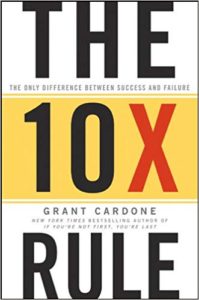
The 10X Rule is based on the idea that you should figure out what it is you want to do. What goal you have, what amount of money you want to make, finding your ideal loved one or achieving a certain body fat percentage and multiply that effort and time that you think it will take by a factor of ten. That way, you have a more accurate idea of how much time and effort it will take. If it doesn’t take ten times as long or take ten times the amount of effort that you originally anticipated, then it’s good. It’s better to be pleasantly surprised than to be greatly disappointed. At least that’s the idea. This is just one part of The 10X Rule. The other side of the coin is 10X Thinking, how you think. We talk about this a lot. I’ve even talked about Napoleon Hill’s book, Think and Grow Rich a few years back. We did an episode on that. We as humans tend to have a tendency to underestimate what we can accomplish. Therefore, we set lower goals. We don’t reach our full potential. Our conversation is about achieving success. You’ll get a lot of value from this episode.
If you missed our last episode, be sure to listen to The Creature From Jekyll Island – A MUST Listen.
Enjoy the show!
– – – – – – – – – – – – – –
Download your FREE copy of: The Ultimate Guide to Passive Real Estate Investing.
Get your FREE coffee mug by leaving us a Rating and Review on iTunes. Here’s how.
See our available Turnkey Cash-Flow Rental Properties.
Please give us a RATING & REVIEW (Thank you!)
SUBSCRIBE on iTunes | Stitcher | Podcast Feed
Achieving Massive Success: The 10X Rule with Grant Cardone
It’s my pleasure to welcome, Grant Cardone, to the show. Grant is an American author, sales trainer, real estate investor and motivational speaker. He is also a radio host and a multiple New York Times best-selling author of books such as Sell To Survive, The 10X Rule and Be Obsessed Or Be Average. Grant, welcome to the show.
Thank you for having me. I’m looking forward to it.
It’s great having you on. I admire the amount of information and great content that you put out there on a daily basis. You’re a very successful real estate investor. That’s where my heart is, real estate. You’re a great role model for so many people. It’s interesting because you wrote all these great books, but some people still don’t know who you are. What’s your background? How did you become the person you are now?
Everybody should know real estate. It’s such a good thing for a family and legacy. Different sectors know me for different things. I didn’t come from real estate. I started in the sales space. I didn’t have any money. I didn’t have any credit. I didn’t have any know-how. I got out of college when I was 23 years old and couldn’t get a job. My teenage years were extremely difficult for me. By the time I got out of college, things weren’t getting better. They were getting worse. I lost my dad when I was ten years old. I was raised by a single mother. I became a salesman. I had to learn how to sell when I was 25 years old to make money. I didn’t like sales. I didn’t want to be in sales. I was in the automobile industry, which had its own black eyes in reputation. I learned how to sell.
The way I learned how to sell was different than the way everybody else was selling. I went on to write a book about that has never been published. It was a self-published educational resource for car dealers around America. I was writing about how the car business would change and how car dealers would be forced to give customers information that they shouldn’t be forced to. They should just do it. They would give payments, down payments, offered trade figures up front, the shrinking margins and the length of time that it takes to buy a car. I was challenging all the things that car dealers did for 100 years to make money. One day, it caught on. It was for a few years I’d been out pitching it. It became a business. Unbeknownst to me, I became known not just with car dealers but any company that had a sales force.
I’ve worked with some of the largest sales companies in the country. It’s not sexy. You’re not going to become a household name because you helped Morgan Stanley increase their revenue by $1 billion. Nobody’s going to know you because of that. While I was building out this business, I was buying real estate quietly. Nobody knew it. I would earn money from a speaking engagement or consulting fee that a big Fortune 100 company hired me to come in and help their company reworked their sales process, their customer experience process and whatever their conversions online to make sales. I would take the money from that. I’d leave a little bit of it and the rest of it. 80% of the leftover money was going into real estate quietly. We’ll hit $1.1 billion in real estate assets.
In addition to that, when this social media thing started happening, I learned how to do it and started posting on Facebook when I had twelve followers. Now there are six million followers on my Facebook page, 1.4 million followers on my Instagram, one million on my YouTube channel and 389,000 on Twitter. I use it. That’s not my staff using it. That’s not my staff putting out data. I’m putting out content. It could be about real estate, sales, money, finance treasuries and rental properties. It could be marriage or whatever. Things that I’m learning, I’m sharing with an audience. That has become interesting to people.
I follow you as many people that I know do as well. You put out great stuff and it’s real. It’s coming from the heart. It’s not always about business. It’s about your life. It’s who you are. A friend of mine gave me this question. He’s saying, “Many of us feel that we have a purpose or a mission in life.” A lot of us do, especially the people that you and I associate with. Call it why. What is your big why?
We have more than one. The thing that drives me is I know I can do more. It’s not about having more. I have everything I need. I got a watch coming to me. It’s like, “I’ve got a watch. Big deal. I don’t need that watch. It’s a dumb thing.” I gave $1 million to charity. It didn’t just feel good. It feels better to them than it did to me.
It’s about giving back.
It’s about helping people. I told my wife, “Call that guy up. Tell him we’re going to do $1 million tomorrow or we’re going to do $1 million today.” The guy almost fell out of his chair. He’s like, “I can’t believe this is happening.” We funded $113,000 to a random Boy Scouts unit. It’s about potential. It’s not just about giving groups money either. It’s about what is my potential. Can an individual do the things that large companies do? When I bought this plane, the Gulfstream sent me a model of. I wrote a check for that plane. I had never been on a private jet prior to buying my own jet. It was a massive accomplishment. How does a guy that was the black sheep of his family, in debt at 25 and fired from his first six jobs write a check for a brand-new Gulfstream and convinced Gulfstream?
They didn’t have any jets for sale. I said, “I’ll call you back later. Maybe look around.” They don’t find anything. I wired a check to their accounting department. I called the guy back. I said, “Rick, I wired the entire sum that I think is necessary to pay for a Gulfstream G550. Find me a plane.” Sure enough, they called. That was a huge accomplishment. To do that, you need a place to go. Otherwise, you wasted money. I’m taking that plane to Malaysia, Singapore, Dubai, Madrid, London, Bucharest, Vietnam and the Philippines.
You have a business purpose for it. It’s a tax write-off.
What’s the big why? It’s reaching that potential. It’s not about money. It’s not about the plane. It’s not about another car. It’s not even about giving back. All those things matter. I want to set a good example for my kids. I’ve already done that. If I stop, my kids wouldn’t say, “What a deadbeat.” It’s me. What is my potential? That’s what drives me. What is the thing that, one, either impresses me or two, simply is the achievement of my potential? The latter is much more interesting. I would fulfill whatever native or innate talents I have. I would use them to their full capacity.
It’s you that have said multiple times, “It’s your duty and responsibility to fulfill your potential.”
I believe that success is my duty. Can I be successful if I don’t achieve my potential? I’ve got to live with myself every day. It’s not just about food, water and oxygen. It’s like, “What am I doing?” People forget that doing is also food. It’s doing something, “I can go play golf, but what am I doing to contribute? What am I doing to make a difference?”
Years ago, I read your book, The 10X Rule. I loved it. I highly recommend it. I recommend our audience to go out, buy it and read it. You refer to the 10X Rule as the single most important principle a person needs to achieve extraordinary results. Briefly, for those who haven’t read the book, what is the 10X Rule?
The 10X Rule is a multiplier. Many of us had been brought up to take baby steps. Do a business plan. Think it through. Take your time. Be patient. The 10X Rule says, “Forget all that and jump. Don’t jump off a ledge. Jump up ten steps.” Start taking on more, doing more. Understand that it will take more to get whatever you want to be done. To go from here to here takes as much energy as to go from here to here. It takes the same energy. It’s like, “How high are you going to go?” You’re going to fail on taking your first baby step. You’re going to fail on your first ten steps. The 10X Rule suggests that you need to multiply. Whatever your expectation of success is, multiply it.

Multiply also the amount of effort required and the number of people required. Everybody is underestimating what it takes to get what they want in life. The 10X Rule has been the thing that changed everything for me. It has gotten me excited about my life. I was doing the baby steps thing. I was doing the, “Be reasonable. Be patient.” That’s why the first piece of real estate I ever bought was the wrong piece of real estate. I was taking baby steps. I went out and bought a single house. I put down $3,500. I did what I had rather than what I should have done, which was figuring out how to raise money to buy the right piece of real estate. You can’t keep the wrong piece of real estate.
With the 10X Rule, are you saying that you need to work ten times as hard or much harder than what you are, taking more action?
It’s more than that. I need to go ten different ways on anything. I can only work so hard. Once you work hard like this and you’ve got that figured out, you need to figure out, “How do I go in ten different directions with that energy? How do I take one hour and turn it into ten?” A guy asked me, “How many hours do you work a week?” I said, “Last week, I did 5,240 hours.” He’s like, “That’s impossible.” I said, “I did 80 hours. I did twice as many as the normal person. I hired 120 other people to do another 40 hours for me.”
What you’re saying is, and I love Dan Sullivan, “I can work twice as hard. I’m already busy. I can’t work ten times as hard. For me to achieve 10X results, I have to put systems in place and leverage other people’s time.”
10X means 100. Most people don’t know this, even when they loved the book. They don’t look at what is 10X. They think it’s a ten and an X. If you multiply ten and X, it’s 100. It’s like, “How many different ways can I scale something? Do I want ten units or do I want 10,000 units?” If you buy ten units in the perfect location, you’re like, “Ten units in a perfect location, you’re going to get rich.” What if you have 10,000 units in the perfect location? Both can be done. Both have been done. The question is, “Which one should you do?” The little guy, the little thinker that Grant used to be was like, “It’s ten units in the right place. It’s good for me.” That’s the problem with little think. Little think is for selfish people. The big think requires an unselfish person because 10,000 units require tremendous responsibility. It’s a phenomenal obligation. You can’t walk away from 10,000 units. You can never walk away from ten units. It’s like, “Where do you want to play?” How many times have we all been told, “Bigger is not better?” Fifteen people have told me that in my lifetime. I said, “You went bankrupt, didn’t you?” Every single time that I’ve heard, “Bigger is not better,” I was like, “You busted out, didn’t you?” They think that when they got too big, they failed. The reality is they got big and they stopped getting big. That’s when they failed. The 10X Rule suggests, “You need more avenues than you believe necessary.”
For those people who are writing goals and failing to achieve them, it’s not because they’re not writing them down. Are you saying they’re setting subpar goals?
Yeah. Somebody sits down and says, “How much money do I need to make this year? I’ve got to make $68,000 this year so I can pay my bills.” You’re not going to stick with it because there’s no freedom in it. Even if you do hit it, you’re going to be so depressed. I know guys that have million-dollar goals. As soon as they hit the million dollars, they’re like, “I became depressed when I hit the million dollars.”
You set the bar too low.
They’re like, “Why is that?” I said, “It’s because as soon as you hit the million dollars, you realize you didn’t have what you wanted, which was freedom.” You want to be in charge. $1 million doesn’t get you in charge, unfortunately. I know guys that bought jets. They go out and buy the wrong jet. They buy the jet that they could afford rather than the jet that they wanted. They didn’t get the jet they wanted because they weren’t willing to work that hard to keep it or they hadn’t built the business that needed that distance. About my jet, this is what everybody said, “Tell me about jets. What’s your mission?” I said, “I don’t even know what that means.” They’re like, “What’s your budget? What’s your mission?” I said, “What’s the right jet to buy?” “It depends on your mission.” That’s saying everything. Why do people have houses? They think their mission is to be comfortable. “You need the dream.” The dream is you make it when you own your own home. The mission was a house. My mission is not a house. My mission is planet Earth. I don’t need a house.
You have much bigger goals than most people. You set your bar high. The second that you probably do, you set a bar. You achieve that goal. You have no one right behind it. If you achieve that first goal, you’re already looking at the next one and the next level.
Most of the time, what’s happening is I’m not achieving the first target before I realized, “That was the wrong target.”
Is it too small?
Yeah, it’s ridiculous. What was I thinking? We’re all affected by our calculations. I’m like, “I can only think with the money I have, the resources I have and the people I know,” rather than thinking, “What if I went way out here?” This is where big things happen. This is where Elon Musk lives way out here. He’s like, “I don’t know how to get to Mars, but I think we should do it.” He sells his PayPal Company. I think he sold it for $100 million. He put $80 million in Tesla. He took the $100 million. He can spend it all. He invested the $100 million in three different deals. They’re Solar, Tesla and the Boeing thing. He was out of money as soon as he cashed out. He’s renting. He’s worth hundreds of millions of dollars. The next day, he’s a renter. He can’t afford a house. He’s going all in on his dream. Most people are going all in on a 3,200 square foot house with a little welcome mat with their initials on it.
You probably believe that being average is a formula for failure.
Being average is guaranteed failure. It’s there if you study history.
It depends on how you define success. What you’re saying is being average is a formula for failure.
A successful person would not have fear. You’d have to ask, “What would success be?” rather than to find, “Is it a number? Is it a career? Is it happiness?” You can’t be happy if you’re scared. If what you think you had, if there’s a risk of it being taken away from you, that is not a definition of success. Is Tom Brady successful? Yeah. He’s won six of them. Going forward, he will have to continue to win for Tom to think that Tom is successful. Someone will say, “Tom Brady is the most successful quarterback.” It doesn’t matter what the world thinks about Tom or me. What matters is, “What does Grant think about Grant?”
The only person I’m trying to impress is me. I didn’t buy a jet to impress other people. I bought that thing to impress me. I was impressed when I bought that thing. I was like, “That was impressive.” Nobody can take that away from me. The fact that I can use it and carry my family with me, my little girls, I have such an unfair advantage over other dads. It’s not because I got a big plane but because I can spend those moments with my children. Everybody’s struggling with it as I have. Everybody’s trying to figure out, “What does it mean? What does it have to do with the money? What does it have to do with the family?” I’m still trying to figure it out.

I am too. We all are. I define my own levels of success, but I do that for myself. I don’t do it for other people. To achieve the levels of success that you need to achieve, you got to take action. In your book, you talk about these four different levels of action. We all use these at various points in our lives. You said that most people are stuck in the first three levels most of the time. What are these four levels? More importantly, how do you get to the fourth level?
Number one is no action. Number two is to retreat, go backward. Decide on something and then don’t do it. Three is average. Number three is where most people live. A few people are at one and two. Most of the world is on number three. Few people are in number four, a massive level of action. A lot of kids try to be at four, but their parents medicate them. In society, if a kid’s doing too much, the school counselor calls it some disease, which has never been quantified by any test anywhere in the world. There’s no brain scan, no blood test, nothing. Nothing has ever validated any of these made-up labels that they’re putting on children. Some parent out there is going to rag on me for that. Show me the test. If you show me the test, I’ll give your kid $10,000. Better yet, I’ll give your kid a ride on my plane. That’s more than the $10,000. You show me the test that said, “He had something that made him overactive.” I’ve been overactive my whole life. I would rather be overactive than underactive. There will be a day where you get to be underactive. I worry about it all the time.
That’s not what I want. That’s the thing I worry about getting old. I’m like, “You will live to 100, but what if I can’t use my body in the last nine years?” I’m happy when I’m overactive. I’m taking massive action, whether it was me as a six-year-old kid running, jumping and playing. I could swim in the pool for six and seven hours at a time at the local pool. I’d come home and want to do something else again. I had unbelievable energy. Nowadays, that’s a disease. I could have all this energy to run and play in the backyard or through the woods. When you brought me to school, I was like, “I hate this.” I couldn’t stay in one place. Massive action is frowned on in society. One day, it’s not frowned on and they’re like, “That guy’s a genius. Do you see that guy?” Who pulled up in the Gulfstream? “Wacko did.” That’s what they used to call me, crazy man. Crazy man doesn’t look so crazy. If you go back and you study all the super successful people that have visited planet Earth, they all did number four. Jesus wasn’t average.
Do you think everybody’s capable of taking massive action? I have my own opinion. I don’t want to tell you what it is yet. I want to hear from you. What’s the difference between a normal and a massive action person?
I don’t know anything about this. When the sperm and the egg hit, it went into massive action. There was a lot of activity happening right then and there. If you look in one single cell, you will not see anything average taking place.
Now you have a conscious mind. You’re an adult. What’s the difference between someone who takes massive action and someone who’s probably more typical, who’s running a normal?
We need to look at the 60 trillion cells that are activated in you. Disregard the guy being lethargic and say, “What’s going on with the rest of the show?” We’re looking at one thing. We’re looking at the guy just taking a nap. We’re looking at a Millennial that’s playing on his phone. We think something’s wrong with him. There’s nothing wrong with him. He’s got 60 trillion cells activated.
He’s not using them.
We watch kids nowadays. There’s this test where kids are sitting in a room. One kid is sitting in the room. He’s forced to watch TV and learn. Another kid is allowed to play with something. He can listen to a YouTube video over here and watch the TV. The kid had all three things going on retained more of the information off the TV screen than the kid watching one thing. We underestimate the potential and the ability of the being itself. We’re underestimating what Grant is capable of. We’re shocked all the time with young people. It’s because we underestimate all people. It’s like, “Can you believe he is only twelve and he can do that?” We don’t understand. There’s a lot of stuff that the AMA doesn’t understand. Why do people recover from stuff? Why that bomb was dropped on Hiroshima and some people in the same neighborhood are still alive? There are roaches that lived through a nuclear attack. Explain that. How do you explain a bumblebee able to lift hundreds of times his weight with those little wings?
There are so many things. We don’t hear that story enough. When we do, people piss on it. Look at what the ant does. People are a lot like ants, just moving along. When they work together, they get a lot of stuff done. My wife and I, we want to build an empire. We’re sick and tired of taking care of ourselves. We’re sick and tired of politics. We’re sick and tired of the local news. I’m sick and tired of having people tell me that I need to inoculate my children. I’m like, “I’m done with the world is flat.” We want to create an empire. We want to create our own little deal. If it’s wrong, at least it was Grant and Elena wrong.
You took responsibility.
You need a lot of resources. You’re going to get attacked a bunch. You start taking these positions. I’m going to have people attacking us because of this interview.
They do already.
You need resources. You need fortification. You need supplies. You need people. You need support mechanisms. You can’t go that route by yourself.
As we start to wind this down and land the plane here, there are a couple of things I want to touch on. Within the context of achieving massive success, you have all these different components and principles within The 10X Rule, the book, from taking control of your life all the way through expert criticism. You talk about going all in. That ties in well with everything you’ve been talking about. Can you elaborate on going all in? A lot of people need to hear this.
First, you’ve got to show up. You can’t get lucky if you don’t show up. One of the things I’ve done well on my life is I continue to show up. I make time where I don’t have time. I show up. I cross my fingers and hope something good comes out of it. 80% of the time, I have no idea what I’m showing up for. I’m in the right direction. I know I could be in the right space. I went to a party. I didn’t want to go to it. I showed up for it anyway. It turned out to be a good thing. I don’t know if anything will come out of it. Maybe there will. Number two is, once you show up, you’ve got to go all in on the deal. I’ve studied extremely wealthy and successful people for many years. One thing they all have in common, regardless of what they’re telling you, particularly around money or sports, these people go all in. These people are maniacs. They are completely obsessed with whatever it is they did. They didn’t diversify.
Warren Buffett became a billionaire making massive, all-in, shoving everything he has like, “Go ahead. Buy as much Coca-Cola as the law will let me.” He didn’t have a second stock until he got wealthy with the first play. He took his money out via refinance because the value of the stock went up. He took that money out, still on the paper and made another big See’s Candies. He did it with American Express. He doesn’t even own a lot of stocks. Mark Cuban made all of his money in one deal. Whether Mark Cuban can make more money, who knows? We don’t know if that could be the case. Most of my money has been made doing two things. Every penny that I own is targeted to be invested in apartment buildings. I believe in them. I understand. Bill Gates made all his money in Microsoft. He didn’t make 50 things.
You’re being obsessed about what you’re passionate about. It’s like your book, Be Obsessed Or Be Average.

You see what society says because we’ve lied to a lot. Wall Street tells Americans they should diversify because they’re talking to the middle-class. The all-in people tell the middle-class people and average people, no offense, it is what it is, “Diversify. You are not capable of going all in. You should not put all your eggs in one basket because you are an average person, incapable of going all in on one thing.” Can you imagine telling your kid, “You should play all sports, you should get decent at all sports. You should play football, be in the band and be the cheerleader.” You’re not going to be good at anything. I have a nanny for my kids, which some people will frown on. My nanny is also the homeschool. She homeschools the kids. She was nervous because she knows who I am. I’m like, “What are you nervous about?” My kids don’t need to know everything. I need my kids to walk in a room and be comfortable with any conversation that they’re having. They’re going to figure out what they’re going to go all in on.
You cannot go all in on everything. You’ve got to figure out what are you all in on, “I’m not a pilot. I sit in the back of the plane. I like it there. I have no interest in being a pilot.” Tell the pilot where to go. What are you going to go all in so that you can do what you want in your life and achieve your goals? I don’t want to be the nanny, the teacher, the banker or the lawyer. I’m not the lawyer. I’m the doer. I’m not mom. I’m the father and the husband. I would tell people, “Go all in on the handful of things that you do well. Be obsessed with it. Be obsessed with your path. Go all in on it. Be willing to be wrong on what you go all in on.”
That ties to the big why we started the show with. Let’s tie this all together here. There are lots of great information. Hopefully, it’s not overwhelming for most people reading this. If someone were to apply this 10X Rule, what suggestions would you give them in order to apply all this great information?
Number one, you’ll immediately have new problems. Number two is you will now be aware of what your limitations are skillset-wise. You’re going to go, “I don’t have enough people. I don’t have enough money. I don’t know enough people. People don’t even know me.” You’re going to start butting up against the problems that this little thinking has caused you. We started an advertising company. The old way of advertising used to be focused on your local market only. You want to focus on the world market. I want everybody to know me. The point of that is this. When you focus on the local market and that local market dries up, goes away or can’t fund, you spent money on a market that’s no good. People move around. Number one is when you set the 10X Rule in place and you say, “I’m going to go for $1 million to $10 million,” when you set new goals, the first thing doesn’t happen. When you activate this thing, you’ll have new problems. Number two is you’re going to hit your new set of limitations that you need new skills for.
I love the quote from your book, “Success is not something that happens to you. It’s something that happens because of you and because of the actions you take.” That summarizes all of it. I appreciate you coming on. Tell our readers how they can find you and get more information.
Wherever you are, put in Grant Cardone. You’ll find me so easy.
Keep up the great work. I loved having you on. Thanks. We’ll talk to you soon.
Thanks.
– – – – – – – – – – – – – –
Download your FREE copy of: The Ultimate Guide to Passive Real Estate Investing.
Get your FREE coffee mug by leaving us a Rating and Review on iTunes. Here’s how.
See our available Turnkey Cash-Flow Rental Properties.
Please give us a RATING & REVIEW (Thank you!)